Tuesday, June 10, 2014

Yellow-breasted Chat at Batiquitos Lagoon

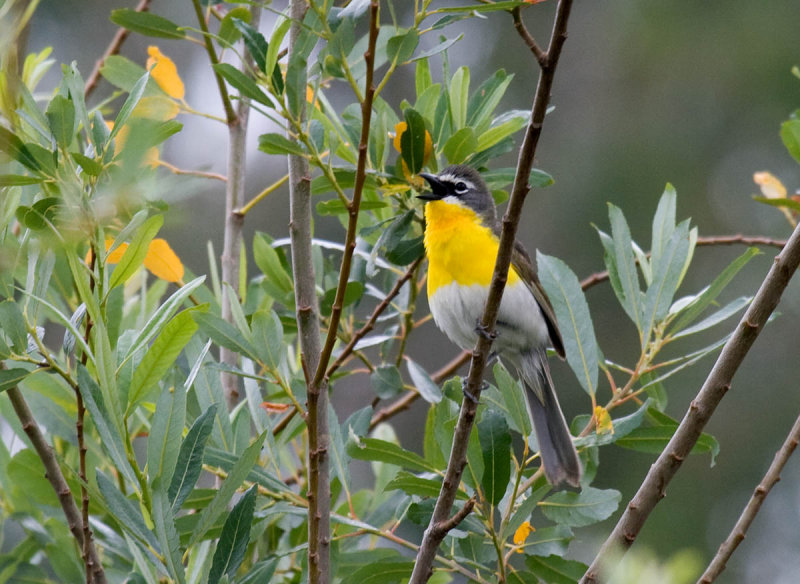
Yellow-breasted Chat
Yellow-breasted Chat. Batiquitos Lagoon, Carlsbad, California. June 1, 2014. Greg Gillson.
To view a Yellow-breasted Chat you must visit dense riparian bottom lands. Not just a willow-lined creek, but a wide, dense, impenetrable willow thicket. Such perfect habitat is rather rare, as most creeks are "tamed" and channelized.

These rather large song birds are currently lumped in with the North American Wood-Warbler family. That's not because chats are giant warblers but, rather, it is because they aren't anything else. Don't be surprised if in the future Yellow-breasted Chat is in your field guide next to the blackbirds and orioles!

They certainly don't have the sweet, lisping, monotonous songs of warblers. Their "song" consists of crow-like caws, grating cackles, clucks, hoots, and whistles. They frequently sing at night, again, unlike other warblers. They may give their song from deep within the brushy tangle or, frequently at dawn, flying low circles over the small trees and shrubs with exaggerated deep wing beats and glides with the wings mostly over the horizontal while dangling the legs down, making a terrible racket.
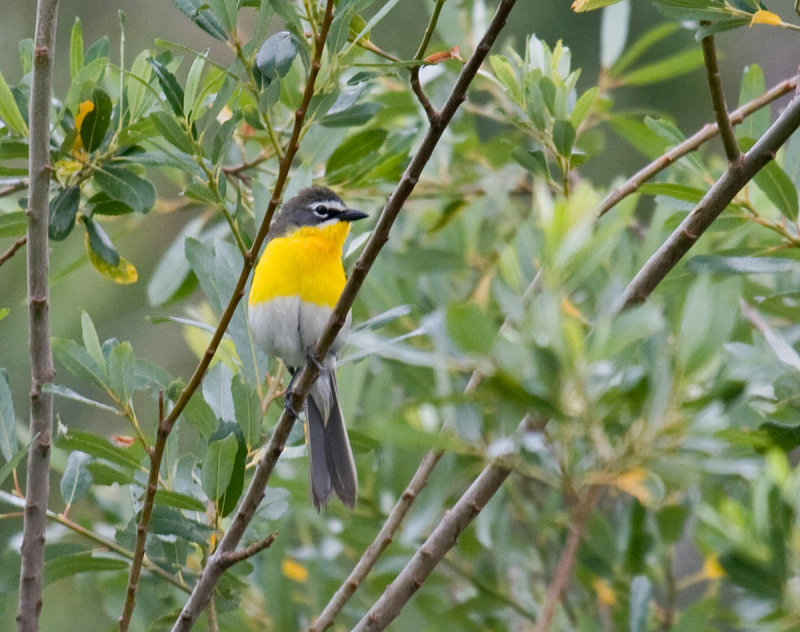
Yellow-breasted Chat
My most memorable Yellow-breasted Chat was one heard just before midnight on May 8, 1995. Tim Janzen and I were at the end of a big day of birding. It was a 24-hour birding marathon, referred to by birders, appropriately enough, as a "Big Day." You see, we had started the day--just after midnight, mind you--with owls. In fact, one of the first birds of the day was my first-ever Barred Owl at Whilhoit Springs, near Portland, Oregon.

From there we listened for other night birds of forest and marsh and drove 120 miles to the coast to listen to the dawn chorus in the Coast Range forest. As it started getting lighter in the east we ticked off scores of singing birds. Just after sunrise we hit the beach. By 10:00 am we were leaving the coast with over 120 species and heading inland to the Willamette Valley and birding our way eastward 100 miles into the Cascade Mountains. By noon we were over the top and leaving the Ponderosa pine forests and heading into the sage and rimrock for another 120 mile dash across the desert to Malheur NWR. We drove through the extensive marshes south of Burns for 50 miles and arrived at Malheur National Wildlife Refuge Headquarters just at dusk. From there we headed south through the refuge 35 miles, adding marsh birds and owls again, until we arrived at Page Springs Campground just before midnight. We stopped the car, jumped out, and there! A singing Yellow-breasted Chat was the 200th species detected in Oregon on one day!

[And you did notice the 425 miles we traveled that day, too, right? 690 round-trip miles. The current Oregon Big Day record is 219 species, set June 2, 2007 by none other than Tim Janzen, joined by Noah Strycker, Dave Irons, and John Sullivan.]

Sunday, June 8, 2014

Jacaranda


Jacarundi
Jacaranda trees line the street in Carlsbad, California. June 1, 2014. Greg Gillson.
Not to be confused with the Jaguarundi, a South American cat, these purple-flowered South American trees are popular ornamentals in the San Diego area. They bloom in both spring and fall.

Jacarundi

Friday, June 6, 2014

San Diego Year Bird #229: Hammond's Flycatcher

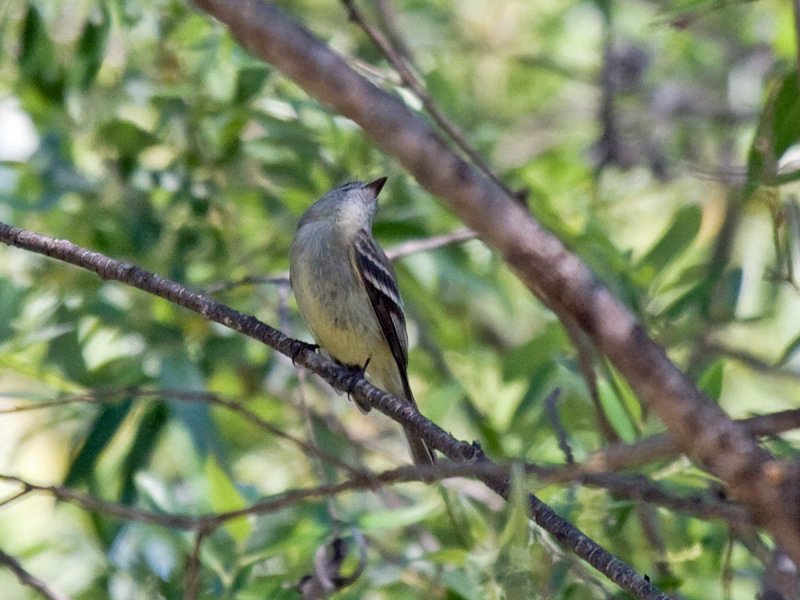
Hammond's Flycatcher
Hammond's Flycatcher. May 4, 2014. Fallbrook, California. Greg Gillson.
I'm not getting as much practice identifying Empidonax flycatchers in San Diego as I used to get in Oregon where there were 5 common breeding species. I don't have any sightings of Dusky, Gray, or Willow Flycatcher yet this year in San Diego County. These are migrants only here and don't usually breed this far south. Actually, Hammond's don't breed either, but these are nearly common spring migrants here. The only regular breeding Empid here is Pacific-slope Flycatcher.

If I just remember Empid ID in 3 easy steps I'll do all right. Primary Extension: long; Bill Shape: short and straight-sided; Lower Mandible Color Pattern: mostly dark.

Hammond's Flycatcher

Thursday, June 5, 2014

Lesser Goldfinch

Lesser Goldfinch
Lesser Goldfinch. Fallbrook, California. May 4, 2014. Greg Gillson.
This is the most common goldfinch in southern California. This bird's northernmost regular range is near Portland, Oregon.

Lesser Goldfinches maintain their bright plumage year-round. American Goldfinches, on the other hand, employ a different molt strategy. The bright yellow male "wild canaries" of summer, molt into a dull buffy non-breeding plumage for the winter. Thus, in winter, Lesser Goldfinches are brighter yellow than American Goldfinches!

More details of the American Goldfinch molt are here.

Tuesday, June 3, 2014

Bewick's Wren

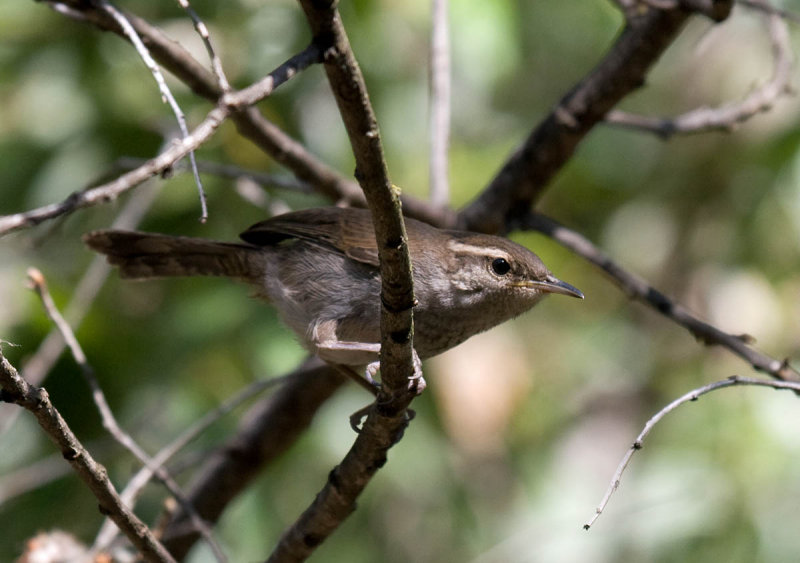
Bewick's Wren
Bewick's Wren. Fallbrook, California. May 4, 2014. Greg Gillson.
I haven't done a lot of bird photography lately. Here's a juvenile Bewick's Wren near Fallbrook that I managed a few weeks ago.

How do I know it's a juvenile? The fleshy yellow corners of the mouth (the "gape"). The inside mouth linings on many young birds are bright orange or yellow, making a target for the parents to "insert food here" into the little beggar's mouth.