Friday, September 12, 2014

Birding Site Guide: Fort Rosecrans National Cemetery

Fort Rosecrans National Cemetery
Fort Rosecrans National Cemetery, San Diego, California. August 31, 2014. Greg Gillson.
Recently, I posted a question to the San Diego Region Birding email list about how to bird the Fort Rosecrans National Cemetery. I am beginning to discover that a large portion of the rare birds that are found in San Diego County each fall and winter are from this location on the peninsula of Point Loma. I had driven through twice, but was unsure how, or exactly where, to bird. After more than 40 years of bird watching, I had never birded in a cemetery until last winter. In Oregon, cemeteries and golf courses are birdless grass "deserts"; in real desert areas they are green oases for birds!

In her web site to birding San Diego County (last updated about 2008?), Mary Beth Stowe gave brief directions to birding here, but I wasn't sure where to even park the car. Somehow, the directions were unclear. The first thing I had to do was reorient myself--the peninsula runs from the north almost straight south (not west, as I was trying to make it in my mind). Once that transition was made, compass directions made sense.

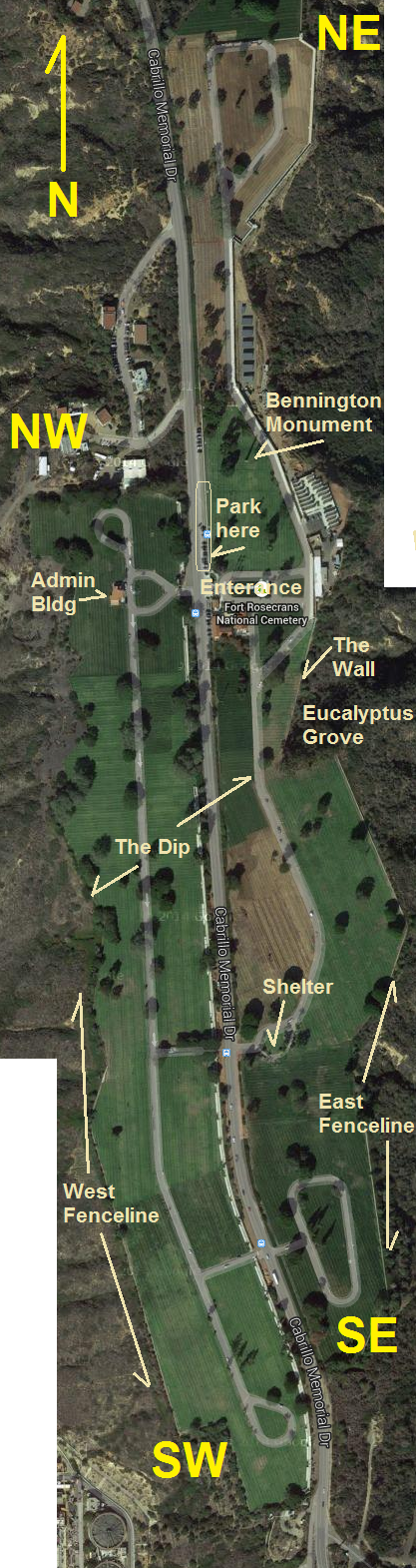
I received several replies to my request to the email list--some offering to show me around, others giving me directions and tips, including 3 maps. From these I made a huge map (below). Thank you, especially, to Annie Stockley, Nancy Christensen, Sara Mayers, Jennifer Baldwin, Susan Smith, and Geoff Rogers.


Getting there: From Hwy 8: Take it west until it ends into Sunset Cliff Blvd, then continue on to Nimitz Blvd. In 1/2 mile take the Famosa Blvd exit and follow the signs to Catalina Blvd/Fort Rosecrans National Cemetery/Cabrillo National Monument. From San Diego Airport: Take N Harbor Dr to Nimitz Blvd, turn left on Chatsworth until it ends at Catalina Blvd. Take Catalina left to the Cemetery. Parking: No charge. Most birders park on the east side of Cabrillo Memorial Drive in a dirt lot just outside the main entrance (see map below) and walk into the cemetery grounds. Some birders also drive into the cemetery proper (see "other notes" below). Hours: The Cemetery seems to be open at least dawn to dusk now. In the past the Cemetery grounds did not open on weekends until 9:00 AM, but was open much earlier on weekdays. Map Navigation: 1800 Cabrillo Memorial Drive, San Diego, CA 92106.

Where to bird: The main birding locations are noted on the map below. The ficus trees on the Northeast Loop and the pines along "The Dip" west of Cabrillo Memorial Drive are two popular locations to find rare birds. Birders move from tree to tree, examining each one. Many birds are also found along the perimeter fence line. Though probably best at dawn, a recent birder found different rare birds from dawn to late afternoon, apparently on several visits during the same day.

Other notes about birding this cemetery: Apparently there are no interments on weekends any longer, thus some birders drive into the cemetery area and park on the sides of the road. There are restrooms at both the Entrance and Administration buildings. Respect the privacy of any mourners. At dawn and dusk you may hear the National Anthem played from the nearby military base as the flag is raised or retired for the day. In 2004 the Palomar Audubon Society wrote up a Visitor Conduct Guide.

So using this map I can now figure out where all this week's rare birds were!
9/1/2014: 
Swainson's Thrush at The Wall
Rose-breasted Grosbeak outside perimeter fence in far NE corner
Northern Waterthrush in the ficus trees in NE
American Redstart in the ficus trees in NE
Prairie Warbler in SE
9/3/2014:
Tennessee Warbler in ficus in NE loop
American Redstart (continuing) same ficus tree in NE
Prairie Warbler (moved) Torrey Pine north of The Dip on the west side of Cabrillo
Olive-sided Flycatcher fence at the top of the hill north of The Dip
Brewer's Sparrow on west side along N Fence under pines
9/4/2014:
Prairie Warbler (continuing) same area north of The Dip on west side
9/8/2014:
Green-tailed Towhee (#1) west of NW loop
Green-tailed Towhee (#2) south of NE loop
Tennessee Warbler pines just north of The Dip on west side
Yellow-green Vireo in NE corner near Registrar of Graves
9/10/2014:
Grace's Warbler southeast of Admin Bldg
(And yes, I misspelled "Entrance" on the map. I had "Enter" and then changed it.)

Tuesday, September 9, 2014

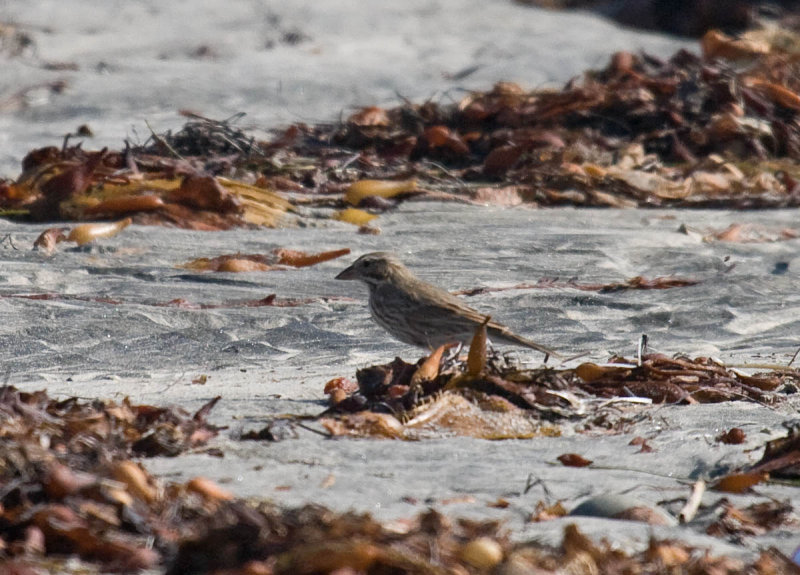
Large-billed Savannah Sparrow

Large-billed Savannah Sparrow
Large-billed Savannah Sparrow. San Luis Rey River Mouth, Oceanside, California. September 7, 2014. Greg Gillson.
While looking at shorebirds at high tide at the San Luis Rey River mouth I noted additional shorebirds in the beach-cast seaweed between the river and the ocean. (The river doesn't quite reach the ocean as the beach blocks the river mouth with sand.) Also, a small bird was running around chasing flies among the piles of seaweed. It was pale and plain brown above--barely showing a few streaks on the back, heavily streaked below. It had a pale eyebrow and submustachial stripe, both bordered with darker brown. The way it was behaving reminded me of a pipit--but the tail was also pale, not black with white outer tail feathers as in pipits.

It was soon apparent by its rather large conical bill that it was a sparrow--looking very much like a pale Song Sparrow. But it lacked Song Sparrow's very heavily streaked back, and the facial stripes weren't quite right. I then knew what it was: Large-billed Sparrow, a primarily Mexican race of Savannah Sparrow. It differs from other Savannah Sparrows in generally lacking the yellow lores that help beginners recognize Savannah Sparrows.

Large-billed Savannah Sparrow

In 2009 there was a proposal before the checklist committee of the American Ornithologists' Union to split Savannah Sparrow into 3 or 4 species: 1) the main North American group of Savannah Sparrows, 2) Belding's of the salt marshes of southern California, 3) Large-billed Sparrows of coastal NW Mexico, and 4) San Benito Sparrow of an island off the coast of Baja.

DNA evidence actually groups Belding's and Large-billed. At first this may seem strange. Belding's, after all, is quite dark and Large-billed pale. But both are birds of salt marshes and both have rather large bills compared to other races. At any rate, the proposal to the AOU didn't pass. They wanted more studies on Belding's from north of San Francisco and more study of the San Benito form. Future research may answer the gaps in knowledge, so a split could come one day soon--if nothing else, splitting the Belding's/Large-billed group from the main Savannah Sparrows.

See my previous post on Belding's Savannah Sparrows, that also pictures a western form of the main continental Savannah Sparrow.

Monday, September 8, 2014

Closet Vikings fan


I began watching birds for a Junior High School science project in November 1972. It was also in November 1972 that I remember watching a Minnesota Vikings football game versus the Los Angeles Rams.

As I was born in Minnesota, the Vikings were a natural choice to follow. I remember the "One eyed, one horned, flying, Purple People Eater" song from grade school about 1967. The Vikings strong defensive unit of the late 1960's and early 1970's with Page, Marshall, Larsen, and Eller was named the Purple People Eaters.

In that 1972 game the Rams led 20 to 10 at half time. I think that is about the time I started watching the game. It was in the TV department of some store. That's all I really remember about where I was. It must have been in Albany, Oregon. As that is where I lived.

In the 3rd Quarter, Paul Cruse returned a Rams fumble for a touchdown for the Vikings. Then, Fran Tarkenton threw a touchdown pass that went for 76 yards to Bill Brown to put the Vikings in the lead for the first time. The Rams answered back with a touchdown of their own to take back the lead. It was now 27 to 24 in favor of the Rams and things got a bit crazy.

In the 4th Quarter, Tarkenton threw another long touchdown of 70 yards to put the Vikings up again. Both the Rams and Vikings scored twice more. When it was all over, the Vikings won, 45 to 41.

The Minnesota Vikings have been to four Super Bowls, losing in all of them, much to the delight of heckling fans of division rivals the Packers, Bears, and Lions.But those weren't the only heartbreaks for fans of the Vikings.

There were many years when I didn't watch football. But I remember the losses at the NFC Championship Games that prevented the Vikings from playing in additional Super Bowls. Former Green Bay quarterback Brett Favre played for Minnesota in 2009. After beating the Giants 44-7 and the Cowboys 34-3, they faced the New Orleans Saints in the Championship game. The Vikings were still playing tough until their 5th turn-over of the game: Favre's ill-advised throw near the end of the game was intercepted, when he could have ran a few feet for the first down and a win! Overtime ensued and the Saints won, 31-28. In 2000 the favored Vikings met the New York Giants and were embarrassed 41-0. And who could forget the 1998 game (following a 15-1 season) with the Atlanta Falcons. Kicker Gary Anderson hadn't missed a kick all year. With less than 2 minutes left he missed a game winning 38 yard field goal! There were 30 seconds left and the Vikings were driving for the winning score! With dynamic receivers Randy Moss and Chris Carter a win was almost assured! What's this? Vikings coach Denny Green had quarterback Randall Cunningham take a knee to end the game in a tie and force overtime! Of course, the Falcons naturally won.

The Vikings have been losing a lot in recent years. At the end of last year it was so bad the coaches were fired (again).

So, yesterday, in the first game of the 2014 season, under new coach Mike Zimmer, the Vikings played the favored Saint Louis Rams (moved from Los Angeles in 1995). Minnesota dominated throughout the game, not losing in the final minute as they did 4 or 5 times last year. The final score was 34-6. Will they keep winning? If this was the last 2 or 3 years the answer would be definitely not. But this year? There is hope. The schedule is tough. Several pundits said the Vikings were likely to be zero wins and 8 losses to start the season. Not. But then, again, dashed hopes are the modus operandi of the Minnesota Vikings. Next week the Vikings face the heavily favored New England Patriots and Tom Brady. We'll see....

Saturday, September 6, 2014

Point Loma and Cabrillo National Monument

Old Point Loma Lighthouse
Old Point Loma Lighthouse. Pretty, but too high up on the peninsula, thus often socked in with fog and low clouds.
Another lighthouse is placed on the tip of the peninsula, low down near the water where it is more useful.
Point Loma, San Diego, California. August 31, 2014. Greg Gillson.
This past Sunday Marlene and I visited Point Loma--the large peninsula that juts out into the ocean to create the northern edge of San Diego Bay.

San Diego Bay
San Diego Bay looking east as viewed from Point Loma.
We visited Cabrillo National Monument at the very western tip ($5 entry fee is good for an entire week!). It was in the bay just below here, in 1542, that Portuguese explorer Juan Rodriguez Cabrillo made landfall--the first Europeans to visit California.

After a brief tour of the visitor center we went back to the marina area at the base of the peninsula and had lunch at Harbor Town Pub. They had some yummy fish and chips that Marlene had been craving since leaving Oregon a year ago. I had the seared Ahi Club sandwich. Both were very good.

Point Loma
New Lighthouse (center and a bit right) and the Pacific Ocean at the tip of Point Loma.
After lunch we went back to Cabrillo and visited the tide pool areas. It was not low tide, so the tide pools were under water. I was hoping for Black Oystercatcher. This is a reliable spot for this shorebird that is fairly rare and local this far south. But it was not to be.

Point Loma tide pools
Tide Pools.
When we spent some time with the splashing surf, we went back up near the visitors center and walked around the Old Point Loma Lighthouse.

Cabrillo National Monument, Point Loma
Visitor Center with San Diego Bay in the background.
To reach Cabrillo National Monument you have to drive through Fort Rosecrans National Cemetery, which is probably the best spot in San Diego for rare land birds during migration (and through winter), since it sticks out a couple miles into the Pacific, is covered in flowering trees and bushes, and usually does not freeze in winter (often stays in the 60's through much of winter winter). I still haven't figured out how to bird it, but am gathering information.

Wikipedia for Point Loma.

Monday, September 1, 2014

Image Gallery: juvenile Western Sandpiper

Western Sandpiper. San Elijo Lagoon, Cardiff-By-The-Sea, California. August 17, 2014. Greg Gillson.
The first juvenile Western Sandpiper of the fall that I have noted. Adults first appeared in early July. These are abundant migrants in the West on ocean beaches and mudflats inland.


The dark wing covert centers with broad, pale edges and hints of rufous on the shoulder indicate juvenile plumage--a bird perhaps 6 weeks old, just arrived from the Arctic. All 6 week-olds can migrate alone from the Arctic and find their way south to join the earlier migrating adults in South American, can't they?

Map of range of Western Sandpiper throughout the year.


Bill long (longer than head) and drooped at the tip, and black legs identify Western Sandpiper from among the smaller shorebirds of the West. Baird's Sandpiper and the rare Semipalmated Sandpiper, and the larger Dunlin are similar.


The Western Sandpiper above shows the partial webs between toes, called "semipalmated."


The scientific name of Western Sandpiper is Calidris mauri, given in 1838 by Charles Bonaparte for his friend Ernesto Mauri. Think how different European history might have been had Napoleon taken up ornithology like his nephew Charles.