Thursday, April 5, 2018

Brown Booby

Brown Booby
Adult male Brown Booby. Off San Diego, California. January 1, 2018.
Brown Booby

Tuesday, April 3, 2018

A dozen Sage Thrashers! Desert Avicaching

I scored two points!

While birding in Borrego Springs recently, I remembered that I had previously entered some locations on my maps application to search for desert thrashers this spring for something called "Avicaching." Of course, I had forgotten most of the details. But I knew that birding surveys usually happen at dawn. So we were too late in the day to make an "official" survey. But why not check out the location in case we get another opportunity this spring? So Marlene and I headed south from Borrego Springs after lunch. We stopped at Yaqui Well where I walked in and found the two Long-eared Owls (no photos) that have been present this winter. Then we continued on to Scissors Crossing and headed south about 12 miles to Blair Valley.

We easily found the survey sites on two miles of sandy dirt roads that were no problem for our Kia Soul--two wheel drive but about 10 inches of clearance. We didn't have much time, so we only visited two of the three survey sites for less than a half hour each.

What is Avicaching? The details for this Desert Avicaching survey is here. Basically, this is eBird + Geocaching. Survey sites in under-birded areas or habitats are set up as eBird Hotspots. Record birds here during the survey period (February 1 to June 15, 2018). Surveys should be 20-60 minutes and travel less than 1 mile to be valid.

Even though I wasn't there before 10:00 am, I noted that my eBird list was automatically entered into the Desert Avicaching Leaderboard. I scored two points!

Sage Thrasher
Sage Thrasher. Blair Valley, California. March 18, 2018.
Avicaching is fun! This particular project contributes to knowledge of birds in remote desert areas that may be impacted by solar farms. In this case, Sage Thrashers migrate through this area in large numbers. And who knows, perhaps Le Conte's Thrashers may be resident here. Further north, in San Bernardino County, breeding Bendire's Thrashers may be impacted. Other Avicaching points continue in the Mojave Desert to Death Valley and Las Vegas, Nevada.

Birdless. That's the first impression one has of Blair Valley survey points. The low spot on the valley is a dry lake bed. Last year spring rains brought a "Super-Bloom" to the desert. Very little moisture this winter, so just year-old dry grass in the lake bottom. At the edges, sparse well-spaced creosote bushes begin. Then some Gander's cholla and Mojave yucca (like smaller Joshua trees). That's the vegetation of one of the survey sites.

Sage Thrasher

But scanning across the creosote I spy several solitary robin-like birds hopping on the ground--Sage Thrashers! And they are more common than one would think. After I entered 2 birds on the checklist the rarity flag in eBird popped up. I quickly reached 9 birds, and finally 12 birds after walking a couple hundred feet out and then returned to the car in a large loop around the survey point. That surpasses the total number of Sage Thrashers I've seen total in the Anza-Borrego desert the past 3 years!

Sage Thrasher

Driving out past the camping area there were several Mourning Doves, a Verdin called, and several Black-throated Sparrows flitted about. There were certainly birds here, especially up next to the rocky hill, but it requires work to find them.

Sage Thrasher

The second survey point was closer to the highway. There was more vegetation here. Some gravelly areas included cholla, barrel and hedgehog cacti, California juniper, and desert agave. As the gravel gave way to sand, it was again creosote, cholla, and Mojave yucca.

Blair Valley

The gravel/cactus area seemed good for Black-throated Sparrows. But none revealed themselves. I walked a couple hundred feet without encountering any sign of any birds. I was really thinking I was going to submit a 20-minute checklist with no birds recorded! Then I heard a very distant raven. Looping around back to the car I heard the chugging of a far-off Cactus Wren. When I reached the car I heard the caroling melody of a singing Sage Thrasher back where I had been. Three species, three total individuals, none seen. Then two ravens flew up right over me!

First eBird checklist.

Second eBird checklist.

Even though birds were sparse, I enjoyed visiting a new area for me and contributing to the knowledge of birds in a very under-birded location. I hope to get out there again a time or two this spring. I would really enjoy it if there were more avicaching projects to participate in. Perhaps it could be done as a follow-up to the bird atlas project that was done about 20 years ago in San Diego County. I know I really enjoyed the Oregon Breeding Bird Atlas project done about the same time. Fun!

Western Grebe

Western Grebe. San Diego Bay, California. January 1, 2018.

Wednesday, February 14, 2018

Site Guide: Felicita County Park, Escondido

Just off Hwy 15 in Escondido, in San Diego's North County, is Felicita County Park. It is a seldom-birded but lovely hillside park covered in sycamore and ancient oak woodlands. It is a compact 53 acres with two small streams running through it. It has typical southern California oak woodland birds such as Acorn and Nuttall's Woodpeckers, Mourning Doves, Anna's Hummingbirds, Western Bluebirds, Lesser Goldfinches, Red-shouldered Hawks, White-breasted Nuthatches, Hutton's Vireos, Oak Titmouses, Black Phoebes, and California Towhees.

The park's official website is here.

And here is a map of the west half of San Diego County with Felicita Park marked.

Map of Felicita County Park

Getting there: From downtown San Diego it is about 28 miles north on Hwy 15 to Escondido. South of town get off the freeway at Exit 27, Via Rancho Parkway. Turn left (west) on E Via Rancho Pkwy and continue 1.1 miles, then turn right (north) onto Felicita Rd. Go 0.4 miles to the park Entrance on the left and park in the parking lot. $3 Parking. Hours: Gates open at 9:30 am for parking, however, pedestrians may access via the north fence line sunrise to sunset. Restrooms may not be open until 9:30 am. Map Navigation: 742 Clarence Lane, Escondido, CA 92029. However...

Early arrival Parking Notice/Warning: Before 9:30 am, if the park is not open yet (preferred), follow the above directions and continue 0.2 miles north on Felicita Rd and turn left onto Park Dr. Drive 0.1 miles to the curve and turn around and park on the narrow residential shoulder where there is room for only 2-3 cars, right in front of the "Begin No Parking" sign. [This could change in the future; be sure to obey signs.] At this time this is the only nearby parking and access from outside the park. Free Parking here. As always, do not leave any valuables visible in your car.

As noted above, the parking lot gates don't open until 9:30 am. So if you arrive at dawn and park outside on the quiet neighborhood street (Park Drive) and walk in, you can have the park mostly to yourself for the first couple of hours after sunrise. There will be a few dog walkers and maintenance workers you may have to share with. Two hours is probably all that is needed to stroll a mile-and-a-half of trails through and around the park and see all the birds.

Park Drive. North pedestrian entry.
Parking is the biggest concern before the park opens. For this photo I am standing at a pedestrian entry (not wheelchair accessible) on Park Drive, on the north side of Felicita County Park, facing west. You may be able to make out my car 200 feet down the road, parked on the edge of this narrow, but very low-trafficked street. No parking is allowed right here on this nice wide shoulder, of course. This is the only parking spot outside the park, with room for 3 cars, barely off the pavement. And you'll have to walk down the street part ways.
Have I covered the parking situation well enough for you to decide whether early arrival is for you? Good. Then on to the birds....

How seldom-birded is Felicita County Park? Well, there were only 5 eBird checklists submitted in all of 2017--two of those were for the Escondido Christmas Bird Count in January and then again in December. No one reported birds between January 8th and November 29th of 2017. If it weren't for a Brewer's Sparrow and Gray Flycatcher found this past December 28th, there probably wouldn't be the additional 4 checklists added since then, either. It has been almost unbirded between April and October, especially in recent years. If you visit Spring though Autumn you are almost assuredly going to add new species to the only 89 species on the eBird Hotspot list sighted so far. [eBird bar chart is here.]
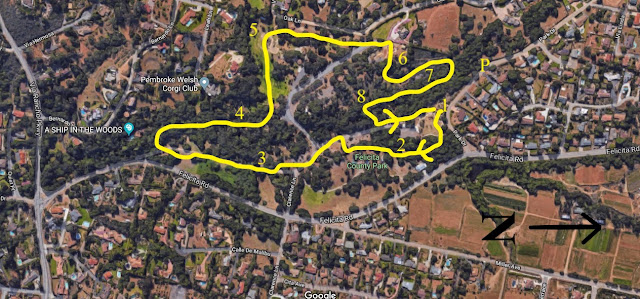
Map of birding trail in Felicita County Park
Birding map for Felicita County Park (see text). North is to the right. Click to enlarge.
Where to bird: The above satellite image displays the birding path I take. Enlarge to better view, but you can make out Felicita Road snaking across left-to-right (north is right on this map). The yellow "P" in the upper right indicates the parking location outside the park on Park Drive for early morning birding.

Enter the Park through the pedestrian entry on the north fence line on Park Drive ("1" on map). Cassin's Kingbirds twitter over the residences across the street, a distant Northern Mockingbird is singing. Anna's Hummingbirds buzz in the edge landscaping. Crows fly over noisily.

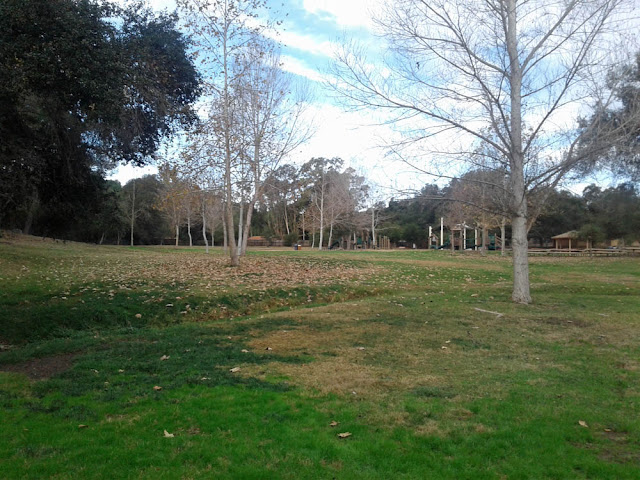
Felicita County Park
Picnic Area 6. Covered playground and artificial turf at north end of park.
Passing the covered playground in the photo above you proceeding on to map label "2" where you come to the edge of one of the small creeks. Yellow-rumped Warblers fly about the tops of the Eucalyptus trees lining the creek. A Common Yellowthroat calls from the weedy wet edge. A family of Bewick's Wrens crawls through the low branches of a small, dense tree.

Eurasian Collared-Dove
Eurasian Collared-Doves have invaded the residential areas along the park's boundaries.
Follow the main entry road past the entry booth and head south on an abandoned park road ("3" on map). A family of Western Bluebirds sallies out into the meadow. Hutton's Vireos buzz in one of the oaks lining the road. A couple of Oak Titmouses chatter. A White-breasted Nuthatch works over the branches with nasal calls. Acorn Woodpeckers whoop it up in the taller oaks. Nuttall's Woodpeckers rattle. House Finches chirp from high up in one of the tall trees. A Spotted Towhee trills from the top of the brambles. A harsh "check" reveals a Hermit Thrush in a tangle of trees.

Felicita County Park
Abandoned road through southeast end of park.
At the end of the abandoned road you will come to a bridge over the creek to the west. Cross and head north on the west side of the stream. ("4" on map.) If you are stealthy you may spot a Great Egret before it spies you. A harsh rattle tells you that the Belted Kingfisher is flying away before you spotted it.

Stream through Felicita County Park
A stream separates the east and west half of the park. See the Egret and Mallard?
After a short distance head up the hill to the picnic areas.

Great Egret at Felicita County Park
 A Great Egret enjoys the stream and little waterfall.
Belted Kingfisher at Felicita County Park
Hard to see against the bright sky, a Belted Kingfisher calls the creek home during this past winter.
Felicita County Park
Picnic area 2. The southwest corner is the highest part of the park.
Picnic Areas 1-5 are in view of the above photo ("5" on map). A museum and stage is visible, too. A flock of sparrows feeding on the ground contains White-crowned and Lark Sparrows, as well as a couple of Dark-eyed Juncos. A Black Phoebe flies out, grabs an insect, and returns to its perch with a tail bob and loud chip. A flock of Lesser Goldfinches whine and whistle from a sweetgum tree.
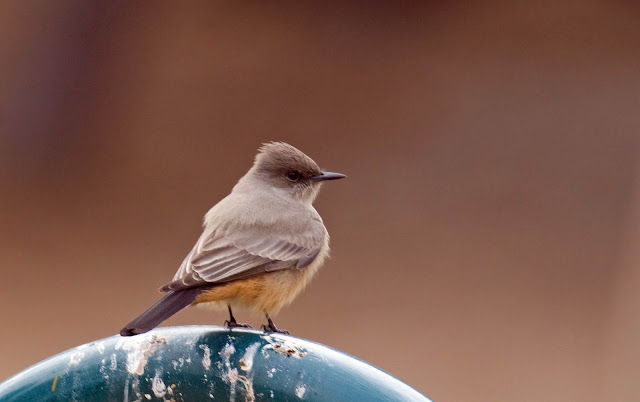
Say's Phoebe at Felicita County Park
A Say's Phoebe finds a practical use for the playground equipment.
Orange-crowned Warbler at Felicita County Park
A wintering Orange-crowned Warbler
Cooper's Hawk at Felicita County Park
A Cooper's Hawk enjoys the park for her own nefarious devices. Those little winter sparrows and finches taste like chicken!
Follow the west fence line north until you come to the Chapel area ("6" on map). From the east side of the Chapel parking lot a trail takes off to the north into the sage scrub habitat.

A group of Purple Finches darting in and out of the parking lot trees is rather unusual for this lowland area. The loud "chink" call lets you know a California Towhee is hiding in the brush. A rising short whistle calls your attention to a Phainopepla. A repeated kicking call comes from a distant Red-shouldered Hawk.

Keep to the left until the trail finally descends to the creek ("7" on map). Then follow the creek back to a footbridge ("8") on map). Then make your way to the exit.

Felicita County Park
Upper Knoll. A trail leads north from the chapel on the west side of the park through a bit of native sage scrub habitat.
Phainopepla at Felicita County Park
A pair of Phainopeplas spent the winter in the less-manicured part of the park.
Notice that this route circled the park, but didn't cover all the roads and trails on both sides of the streams. There is more to explore here if you wish.

Thursday, February 1, 2018

My first year of Nature Journaling

A little over a year ago I began seriously looking into the nature journaling concept--learning about nature by carefully and deliberately observing and sketching and note taking. I wanted to do something more with my birding than just playing tag by checking off birds from the checklist.

In November 2016 I started with the post: I notice..., I wonder..., It reminds me of... Nature Journaling where I gave a brief overview. I bought materials in December and began sketching in my own journal.

By January 2017 I had bought two books on the subject and wrote a review on the best: Book Review: The Laws Guide to Nature Drawing and Journaling. The author of this book, Jack Laws, teaches classes and continues to post articles and YouTube videos of his classes. His best video on Nature Journaling as a subject is here: Deep Observation and Nature Journaling. This video predates his book by about 2 years, but is very much an overview of what his book would become. Excellent, excellent, excellent!

As a whole, I've kept the Nature Journaling practice in the manner Jack Laws presents, but personalized it to fit my already-established style of nature observation. The prescribed method would be to take the journal with me and record my observations immediately in the field. However, I find it works better for me to take numerous photos of my nature observations and put down my observations and drawings later at my desk. I sacrifice some immediacy and prolonged observation for more drawing and art time--often creating several drawings for weeks after the field trip.

While Nature Journaling is about recording what you see, and not creating "pretty pictures," I find I'm enjoying the artistic part of it. I did some pen-and-ink drawings many years ago. Now, however, I find that I enjoy graphite sketching and colored pencil artwork. Colored pencil is a very slow and detailed process--perfect for me in the evening in my studio.

Online I have found a highly-skilled artist who teaches colored pencil art (and many other mediums). Lisa Clough of Lachri Fine Arts uses YouTube to great advantage. I've been tempted to sign up as a Patreon supporter for only $4 per month for access to her full-length tutorial videos. But her shorter free versions provide great instruction for now. Her style is "painterly" colored pencil art, blending with mineral spirits and many, many layers. It creates artwork like a painting with photo-realistic detail.

There is quite a quality difference between my recent works and when I started a year ago. In fact, I actually see improvement from piece to piece in recent works. And I can see plenty of room for future improvement. I don't really have a "style" of my own yet in technique or composition. Following are some recent examples of entries into my nature journal.

Nature Journal page: Dixon Lake and Yucca drawings
Page scan 1. Part of a nature journal entry for Dixon Lake.

Nature Journal page: Buckwheat and Yellow-rumped Warbler eating Laurel Sumac seeds
Page scan 2. Another journal page for a trip to Dixon Lake.

Baird's Sandpiper graphite drawing
Baird's Sandpiper at Imperial Beach, California. Graphite drawing.

Black-and-white Warbler gesture sketches
Page scan 3. Quicker graphite gesture sketches of Black-and-white Warbler compiled from rather poor-quality photos.

Black-crowned Night-Heron colored pencil drawing
Black-crowned Night-Heron at Vista, California. Colored pencil painting.
First time using Fabriano Artistico paper.