Thursday, August 30, 2018

Masked Booby off San Diego

On pelagic trips birds can approach fast and be gone in a short period of time. It is easy to miss seeing smaller birds. Sometimes larger birds can approach unseen and only be glimpsed as they streak past the boat.

Fortunately, this Masked Booby was spotted and called out to passengers with enough time for all to attain decent looks. Nevertheless, all my photos occurred during the same one-minute period according to the clock in my camera. Here it comes... there it goes!

This near-adult seems to have greenish-yellow bill of the Masked Booby, not the pinkish-yellow of Nazca Booby. Nevertheless, the identification is not always so straight-forward--especially on the more-frequently encountered younger birds, both of which species have more of a pale gray bill.

Masked Booby
Masked Booby
Masked Booby
Masked Booby
Masked Booby. Off San Diego, California. August 19, 2018.

Wednesday, August 29, 2018

Black-footed Albatross

Black-footed Albatrosses are not frequently found in warm southern California waters. They are rare, but most expected in late spring (April-June). So this August bird was a welcome surprise.

The wings are just barely longer than a Brown Pelican, making this one of the smaller albatrosses. Brown Pelicans have longer necks and a very long bill, thus are much longer. The pelican also has very wide rounded wings, and is a much heavier bird. It's no contest with a White Pelican (which is rarely found along the beach and never(?) offshore. The White Pelican is huge, even compared to the Brown Pelican.

There is considerable wear on the wing coverts and some signs of flight feather molt. So the bird is not a juvenile. On the other hand, there is no hint of white on the rump or under tail coverts, so the bird is no more than 2 years old. So an age of 1-1/2 years old (hatched January or February) seems correct. Birds get more white on the rump and under tail coverts as the bird ages.

Black-footed Albatross
Black-footed Albatross. Off San Diego, California. August 19, 2018.

Tuesday, August 28, 2018

Red-footed Booby at sea

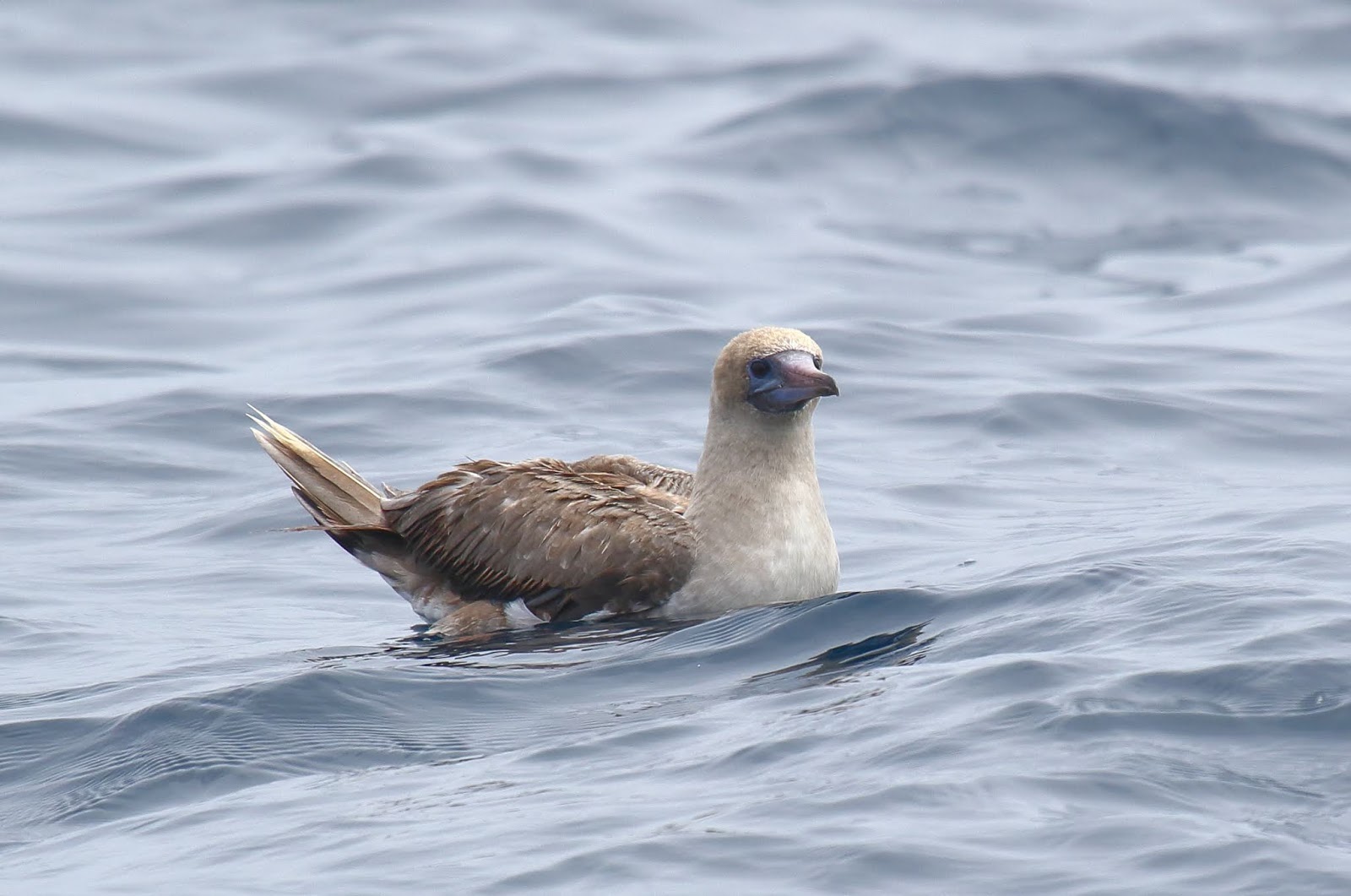
With over 200 West Coast pelagic trips on my birding resume, it is rare these days that I get any life birds at sea. I attend pelagic trips because I enjoy them thoroughly, not to get life birds (although I will gladly accept them if they come my way). Nevertheless, on August 19th we came upon a Red-footed Booby off San Diego. It is a bird I had never seen before. I added Masked and Nazca Booby to my California list earlier this year. Now the only booby I haven't seen in California is the Blue-footed, which really is probably the second most likely after Brown Booby.

As you can see from the photos, Red-footed Booby is a bit larger than Western Gull. All the boobies are close to the same size. The body size is similar to a large gull, but the pointed tail and conical bill and pointed wings are longer. So they are larger than gulls but smaller than pelicans. And, remember, pelicans have broad rounded wings and a short tail.


The distal parts of the mandible are pink with a dark tip. The basal mandible and face is kind of a lilac-blue. The body is dark cream, tail pale brown, wings darker. This is a common coloration for this species, though white-bodied morphs occur. The bright bill and fully red feet indicate this is an adult. The wing plumage is pretty tattered and worn. This could indicate that this bird spent time recently nesting on land?

Red-footed Booby
Red-footed Booby
Red-footed Booby
Red-footed Booby
Red-footed Booby
Red-footed Booby
Red-footed Booby
Red-footed Booby
Red-footed Booby. Off San Diego, California. August 19, 2018.

Monday, August 27, 2018

Reddish Egret at San Diego River mouth. Part 2: Sunny

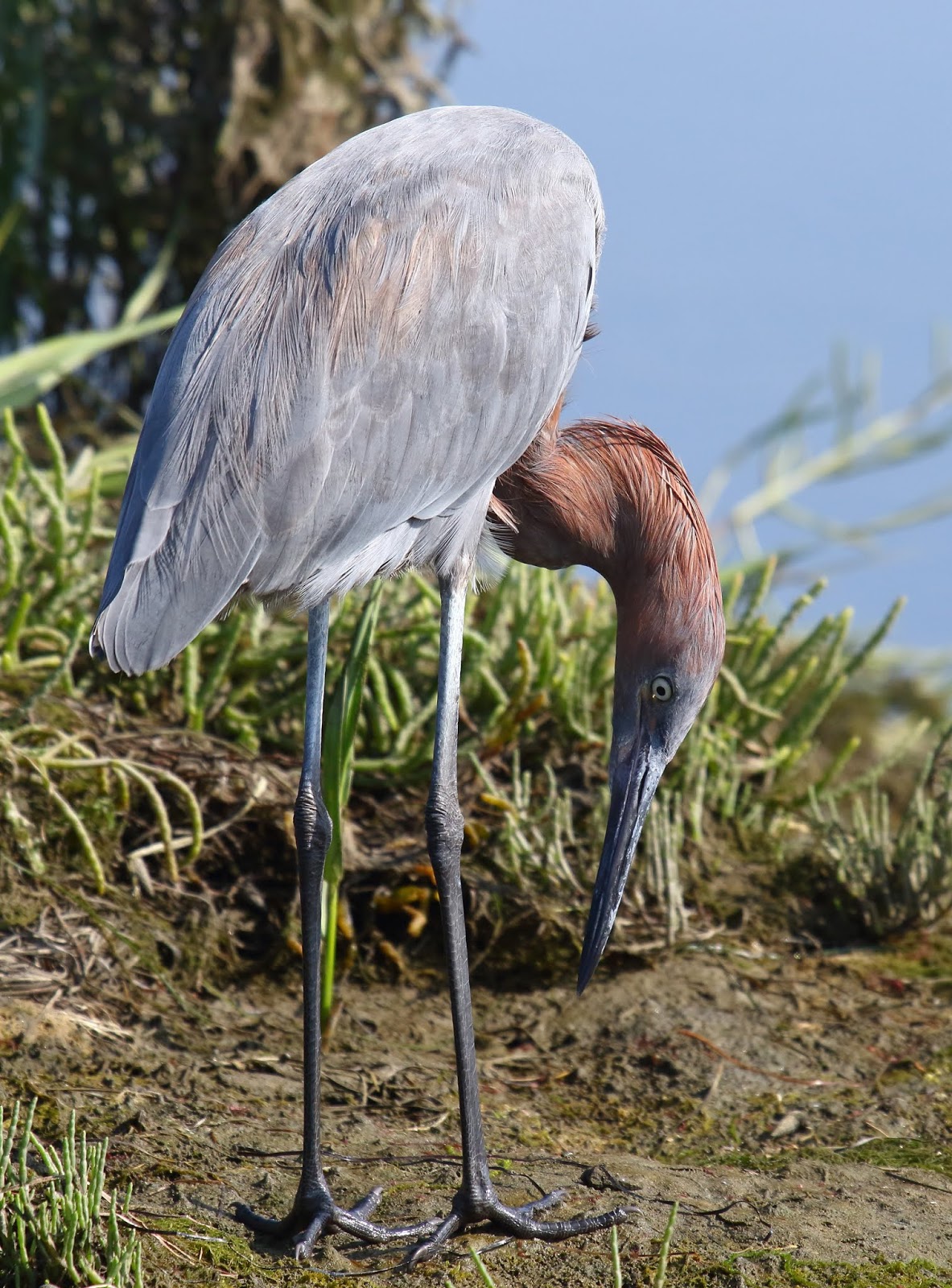
The post for yesterday was of a Reddish Egret under overcast conditions. Today's post is the set of photos after the sun came out. Whether coincidence or not, the bird soon stopped hunting in the shallows and rested on the bank. There were still many interesting poses, but the background was more distracting, and the light harsh. So these photos aren't as artistically pleasing as the first batch.

Reddish Egret
A heron running frantically around on the mudflats with its wings open--Reddish Egret.
Reddish Egret
A typical pose
Reddish Egret
Reddish Egret
Reddish Egret
Reddish Egret
Reddish Egret
Reddish Egret. San Diego, California. August 12, 2018.
Reddish Egret
Reddish Egret
Reddish Egret
Reddish Egret

Sunday, August 26, 2018

Reddish Egret at San Diego River mouth. Part 1: Overcast.

It took me over two years to find my first Reddish Egret in San Diego. My first was December 31, 2015. Since then I've seen them almost a dozen times. A recent bird was feeding close to shore at the San Diego River mouth allowing an amazingly close photo opportunity.

Reddish Egret high key
Reddish Egret. San Diego, California. August 12, 2018.
Guess what photo is now my screen saver?
A note on this photo: The camera settings for the above photo was 1/1250 and f/7.1. The camera chose Auto-ISO 1000, but I brightened it one full stop up so the final image was shot at ISO 2000. However, when I got it back on my computer the water was still dark gray. I decided it would look better as a "high key" photo, so I pushed it up at least another full stop (equivalent to ISO 4000 or higher). I increased contrast and color intensity. Then I adjusted the white balance to about 6000K, which warmed up the strong blue cast caused by the overcast skies.

Here is an account of my photos of this single bird, in order.

After arriving at Robb Field I walked up on the dike, recording the species I saw. Almost immediately I noted the Reddish Egret working the channel below me. Thus, this first series of photos is looking down on the egret from about 60 feet away and about 20 feet above the water.

I didn't make any immediate adjustments to my "generic birding" camera settings: 1/1250 f/7.1 Auto-ISO. The second photo in the series I adjusted the exposure, lightening the original photo in post-processing at home. These photos show well the hyperactive feeding method of this species: running, hopping, chasing with wings held open to provide shade to better peer into the water.

Reddish Egret
Reddish Egret
Reddish Egret
Reddish Egret
Reddish Egret
Reddish Egret

After these initial shots I clambered down the dike to sit on a rock near the water's edge and take these lower-angle photos. I also bumped the exposure up a full stop, doubling the ISO, which I kept on Auto-ISO mode.

Reddish Egret
Reddish Egret
Reddish Egret
Reddish Egret
Reddish Egret
Reddish Egret

I wanted to get both the Reddish Egret and Snowy Egret in the same shot. I had to set negative exposure to not over-expose the bright white of the smaller egret. This, of course, causes the water to appear darker, as the next shot shows.

Reddish Egret and Snowy Egret

And I kept shooting...

Reddish Egret
Reddish Egret
Reddish Egret high key
Reddish Egret
Reddish Egret
Reddish Egret
Reddish Egret
Reddish Egret

At this point I saw other birders looking over the Elegant Tern flock on the sand bar mid-channel. I left the egret and walked over to talk with Susan Smith who had picked out a single Common Tern amid more than 500 Elegant Terns in one flock. Another birder whom I had not met before was there. The eBird report for the morning indicates it must have been Yonghee Lee. Soon thereafter Terry Hurst arrived.

My eBird list for this spot.

After this the sun came out. I finally left my birding companions and walked back to the Reddish Egret. So I have another dozen photos to share in Part 2: Sun.