Always photogenic, here are some photos of Brown Pelicans off San Diego on January 1, 2019.
These happened to be all adults photographed this day. They are in breeding plumage with the dark hind-neck, which is white in non-breeding plumage.
You will note some birds with bright red gular pouches. This is typical for breeding California Brown Pelicans. Gulf Coast and Atlantic birds generally have gray or brown gular pouches, rarely red. But I note some of these birds have green gular pouches, so I don't know what to make of this supposed difference. Maybe it's an "average difference," and not an "absolute difference"? I do notice, now, that the head is yellower on the birds with red pouches. Perhaps the birds with the dull pouches are just not yet fully in breeding plumage? Perhaps their pouches will yet turn red and the tops of their heads yellow?
Perfectly, the term for a group of pelicans is a "platoon" or "pouch."
Thursday, January 31, 2019
Tuesday, January 15, 2019
Red-shouldered Hawk at Lake Wohlford
I took a couple of trips to Lake Wohlford this past fall and winter. I'll be preparing a birding site guide soon. In the mean time, please enjoy these photos of a Red-shouldered Hawk found there.
| Red-shouldered Hawk. Lake Wohlford, California. December 2, 2018. |
Tuesday, January 1, 2019
My 10 best bird photos of 2018
Welcome to my second annual list of best bird photos from the past year.
My best photos from 2017 here.
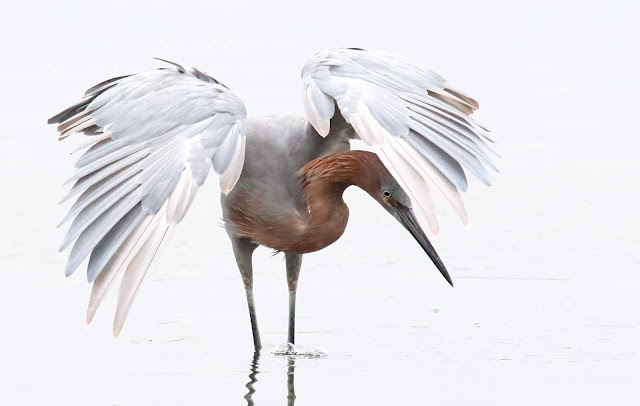
This high key photo of Reddish Egret is the one I'm most proud of for the year. It captures this rather rare bird in a typical, but exciting, pose. More photos of this bird are here.
This immature Brown Pelican was photographed from the boat as we were coming back from a pelagic trip. The bird is photographed at eye level with warm afternoon light. It generally meets all the qualifications of an "artistic" bird photo. More.
It's not perfect. The shadows of the noon sunlight are a bit harsh. There's no obvious catchlight in the eye. But I like it, perhaps because the species is uncommon. I especially like the pattern of the feathers across the breast and neck. More.
I chose this slightly smaller-in-the frame composition over a very similar one cropped a bit closer where the bird appears larger. The background grasses fade pleasingly away and the reddish-brown plumage of the bird stands out against the overcast sky reflected in the waters of the pond. More.
The dove is in more shadow than I would like, so I opened up the crop so the bird is small-in-frame in order to show more of the blooms on the ocotillo bush--a habitat shot. The mottled background of the out-of-focus desert hillside provides a nice texture contrast to the thorny bush. More.
I have so many photos of hummingbirds, especially this common Anna's. Nevertheless, this is probably my best Anna's on a natural perch, even if it is a stereotypical bird-on-a-stick (BOAS). The focus, the light, the pose, and the background are all good. More.
Okay, maybe it's the backstory and not the photograph itself. The bird is in harsh sun and shade, aided by some reduction of contrast in post-production. But to encounter such a shy and reclusive bird right out in the open was a special treat. The backstory.
My first high key photograph. Not bad for standing on the footbridge taking shots of herons and egrets as they flew up river against dark overcast skies. Practicing camera settings with my new camera. More about this photo and the High Key style.
The small-in-frame and backlit sparrow is perched on a twisted creosote bush. The three main branches all lead the eye back to the bird in the center. This bird-in-habitat shot is more about the composition than the bird itself. The bird alone would be a poor shot. More.
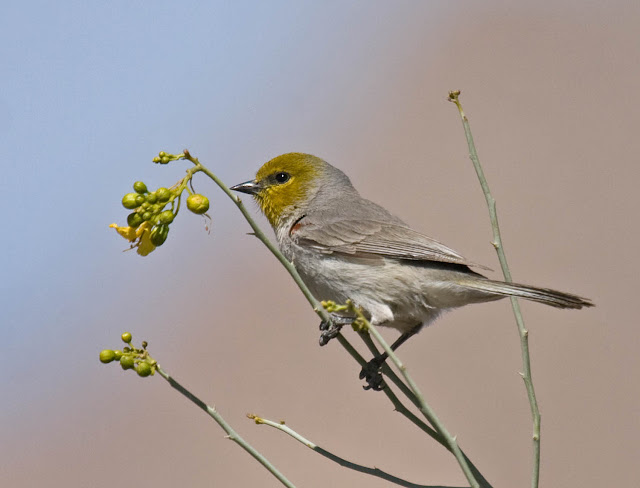
The head angle looking back at me is good and there is a wonderfully pleasing out-of-focus pastel-colored gradient background that complements the soft gray plumage of the bird. More.
Honorable mentions:
The photo of this tern is not exceptional, with somewhat harsh overhead light. The head is in sunlight and the bird is in focus, but there is no catchlight in the eye. The background is solid blue sky which some find boring. But Gull-billed Tern is rather uncommon in US waters. And this photo captures it well. More.
A pleasant but not exceptional photo of Acorn Woodpecker in the shade of the mountain forest. The diagonal perch adds some visual interest. It might have done better in warm early morning sunlight. More.
This is an easy bird to photograph on southern California beaches. And photogenic, too, with those long legs and impossibly long upturned bill. There's nothing wrong with this photo, it's just such a common subject in a common pose. More.
One of my favorite birds. If only its head had been turned more toward the camera!
My best photos from 2017 here.
| Reddish Egret. San Diego River mouth, San Diego, California. August 12, 2018. |
| Brown Pelican. San Diego Bay, California. August 19, 2018. |
![]() |
| Common Ground-Dove. Borrego Springs, California. March 18, 2018. |
| Scaly-breasted Munia. Escondido, California. August 10, 2018. |
![]() |
| White-winged Dove. Anza-Borrego Desert State Park, California. April 15, 2018. |
![]() |
| Anna's Hummingbird. Lake Hodges, California. January 21, 2018. |
| Mountain Quail. Palomar Mountain, California. June 17, 2018. |
| Great Egret. Lake Hodges, California. July 4, 2018. |
![]() |
| Bell's Sparrow. Borrego Springs, California. January 7, 2018. |
![]() |
| Verdin. Borrego Springs, California. March 18, 2018. |
Honorable mentions:
Gull-billed Tern. Imperial Beach, California. July 29, 2018.
|
| Acorn Woodpecker. Mount Laguna, California. October 7, 2018. |
| Marbled Godwit. Imperial Beach, California. September 30, 2018. |
![]() |
| Phainopepla. Borrego Springs, California. March 18, 2018. |
Saturday, December 22, 2018
Costa's Hummingbird in Borrego Springs
The Costa's Hummingbird is the species that is most closely linked with the deserts of the American Southwest.
In San Diego County they breed throughout, but most abundantly in spring in the Anza-Borrego Desert and in summer in the white sage of the coastal slope. They follow flower blooming. That is seasonally and elevationally. They move into recently-burned areas as the flowers bloom, but are less common after a year or two as the brush grows up.
In wet winters they are more abundant in the desert as flowers bloom and they arrive before December, so "wintering" and spring breeding numbers are about the same. The Borrego Springs Christmas Bird Count often records the nation's highest numbers. On the coastal slope they are more numerous in winter in lower residential areas with ornamental plantings. (San Diego County Bird Atlas)
There is usually a pair at the ABDNHA Borrego Botanical Gardens (link). That's where I photographed this colorful male recently.
In San Diego County they breed throughout, but most abundantly in spring in the Anza-Borrego Desert and in summer in the white sage of the coastal slope. They follow flower blooming. That is seasonally and elevationally. They move into recently-burned areas as the flowers bloom, but are less common after a year or two as the brush grows up.
In wet winters they are more abundant in the desert as flowers bloom and they arrive before December, so "wintering" and spring breeding numbers are about the same. The Borrego Springs Christmas Bird Count often records the nation's highest numbers. On the coastal slope they are more numerous in winter in lower residential areas with ornamental plantings. (San Diego County Bird Atlas)
There is usually a pair at the ABDNHA Borrego Botanical Gardens (link). That's where I photographed this colorful male recently.
| Costa's Hummingbird. Borrego Springs, California. November 22, 2018. |
Friday, December 7, 2018
Greater Roadrunner in Borrego Springs
On November 22 Marlene and I took off for a day at Borrego Springs.
We enjoyed the drive up over the mountains past Lake Henshaw. Even in San Diego there's a bit of "fall color." The sycamore leaves turn yellow, then brown. Some ash trees in the stream beds provide some yellow-green. The live oaks are dark green. Many chaparral species have yellow stems. And the California buckwheat have rusty dried flower clumps.
It was a typical short-day trip for us: stopping first out in the desert at the waste water treatment facilities. Then we drove through the Borrego Springs and Club Circle resorts. We headed into town for a picnic brunch at the tiny little garden with the big name: Anza-Borrego Desert Natural History Association Borrego Botanical Garden (652 Palm Canyon Drive next to Carlee's restaurant). Web site here. Finally, we drove through the Roadruner Club and The Springs at Borrego RV Resort to see what birds were in the residential areas surrounding the golf courses.
We spotted this Greater Roadruner at the Club Circle Resort. The photos aren't that great, but it's always a fun bird to see.
We enjoyed the drive up over the mountains past Lake Henshaw. Even in San Diego there's a bit of "fall color." The sycamore leaves turn yellow, then brown. Some ash trees in the stream beds provide some yellow-green. The live oaks are dark green. Many chaparral species have yellow stems. And the California buckwheat have rusty dried flower clumps.
It was a typical short-day trip for us: stopping first out in the desert at the waste water treatment facilities. Then we drove through the Borrego Springs and Club Circle resorts. We headed into town for a picnic brunch at the tiny little garden with the big name: Anza-Borrego Desert Natural History Association Borrego Botanical Garden (652 Palm Canyon Drive next to Carlee's restaurant). Web site here. Finally, we drove through the Roadruner Club and The Springs at Borrego RV Resort to see what birds were in the residential areas surrounding the golf courses.
We spotted this Greater Roadruner at the Club Circle Resort. The photos aren't that great, but it's always a fun bird to see.
Subscribe to:
Posts (Atom)


