Monday, November 10, 2014

Dead bird mystery... or not

dead avocet

Oh, dear!

As I was walking around San Elijo Lagoon last August I encountered this dead bird. Do you recognize it by its long blue-gray legs, upturned bill, and white body with black wings? That's right. It is an American Avocet. How did it die? The clue is in the next photo.

dead avocet
Dead American Avocet. San Elijo Lagoon, California. August 17, 2014. Greg Gillson.
Unfortunately, power lines cross the mouth of the river, separating the ocean beach from the lagoon, a major flight path. It's a poor location choice for the placement of those power lines. Young birds, such as this juvenile avocet, are unfamiliar with the hazard that wires present. Experienced birds can still strike the wires if frightened or flushed at twilight or dark.

Birds strike man-made objects frequently. Many smaller birds migrate at night, navigating by the stars, and are confused by bright lights on the ground.

Annual bird mortality estimates for the United States only:

Bird deaths from power line collisions and electrocution: 12 to 64 million
Bird deaths from antenna towers: 5 to 50 million

Bird deaths striking glass (all buildings): 300 million to 1 billion

Even "environmentally friendly" sources of energy kill an unknown but growing number of birds:
Solar energy farms cook birds in flight
Wind turbines are giant "bird blenders"

You know what? By and far, most people do not care. It's true.

Take for example this blog post about a request to change the proposed Minnesota Vikings football stadium to make it more bird friendly. The author thinks the topic of bird collision deaths is joke-worthy. The comments from readers are generally disgusting and show a real lack of compassion, respect, or understanding for the other living creatures that share our planet.

 Want further proof that people don't really care about the earth and its life?

Outdoor cats in the United States alone kill up to 3.7 billion birds annually. Yet the resistance to keeping cats indoors is strong. No, they are not "natural," a common excuse. Birds are no match for domestic feline killing machines.

How long do you think bird populations can withstand the mortality of almost 5 billion annually--in just the United States--from the causes listed above?

One would think the blood of 5 billion Passenger Pigeons would be enough to fill our ignorance, indifference, selfishness, and greed. But apparently not.

(Sorry to be so depressing...)

Friday, November 7, 2014

Common Tern photos

Common Tern
Common Tern. Off San Diego, California. September 21, 2014. Greg Gillson.
Here are some photos of Common Terns from September. The first 3 are of one of the birds we had offshore on a pelagic trip. This particular bird uncharacteristically flew around and followed the boat for several minutes, allowing close views and photos, albeit primarily from below and strongly backlit by the sun.

Common Tern
Common Tern. Off San Diego, California. September 21, 2014. Greg Gillson.
Common Terns and Arctic Terns are very similar and have a similar migration timing on the West Coast. Common Terns are "front heavy," with a longer bill and longer appearing neck. Arctic Terns, on the other hand, have a shorter bill and short-appearing neck, thus appearing more long-tailed. It is perhaps analogous to Cooper's and Sharp-shinned Hawk head projection shape (Cooper's Hawk = Common Tern, Sharp-shinned Hawk = Arctic Tern).

Generally speaking, Common Terns are found within 15 miles of shore and Arctic Terns more than 30. However, Common Terns are more expected in the Southern California Bight--an area of warm shallower water from Santa Barbara southeast past San Diego, and inside the outer islands. At Santa Barbara the coastline faces south. This particular water mass is isolated from the colder California Current that runs from the middle of Baja to Washington State.

Common Tern
Common Tern. Off San Diego, California. September 21, 2014. Greg Gillson.
The second bird is below. It was one of two flying around the Oceanside pier the end of September. The prominent dark carpal bar on the rather silvery upper wing indicates this bird is a juvenile. Juvenile Arctic Terns have a barely noticeable dark carpal bar.

Common Tern
Common Tern. Oceanside, California. September 28, 2014. Greg Gillson.

Saturday, November 1, 2014

Pink-footed Shearwater offshore San Diego

Pink-footed Shearwater
Pink-footed Shearwater. Off San Diego, California. October 4, 2014. Greg Gillson.
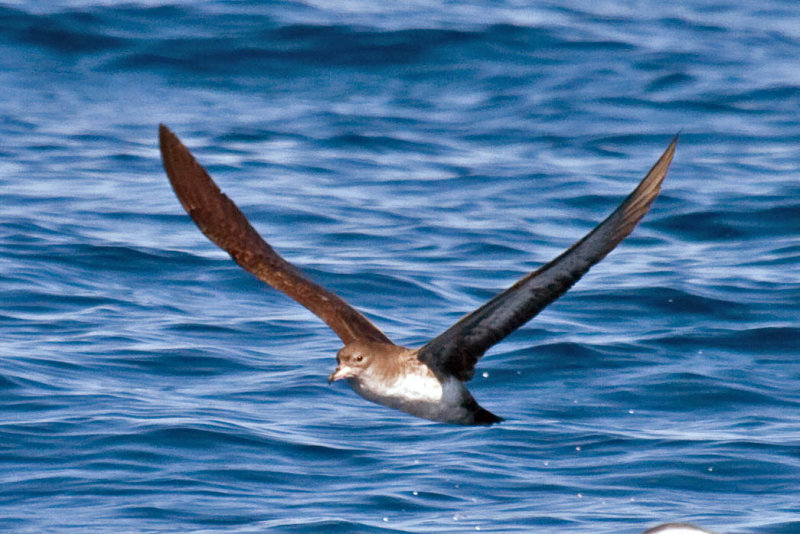
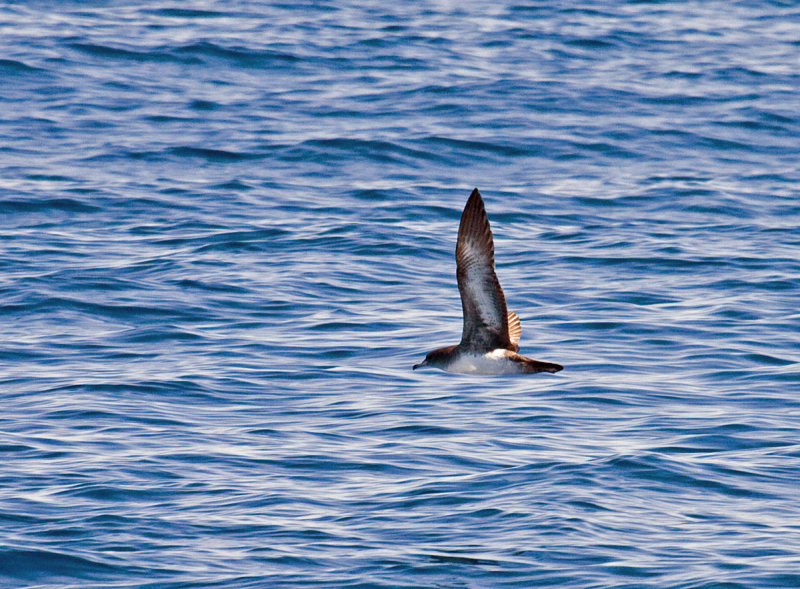
The Pink-footed Shearwater has a very similar plumage to Black-vented Shearwater, which I discussed earlier. Grayish-brown above and generally white below, this bird has a grayish hood, dark vent, and extensive dark markings under the wings, including all the flight feathers.

Unlike all other West Coast shearwaters (except the closely-related, but all-dark, Flesh-footed Shearwater) Pink-foots are larger and fly higher off the water with deep, slow wing beats and extensive gliding. The thick bill is pink with a dark tip. The pink legs and feet are not unique to this one species of shearwater.

They breed December-February in the southern Hemisphere and migrate north as far as southern Alaska from April-October. On West Coast pelagic trips they can be found singly or up to a few thousand in flocks mixed especially with Sooty Shearwaters, often around commercial fishing vessels pulling in their nets of fish or shrimp. They are infrequently seen from shore, but occur regularly from 3-30 miles offshore. I counted 6 individuals on the October 4th pelagic trip from San Diego, and got these two photos. Of course, you're often not certain whether you are seeing the same individual over and over again or different ones when at sea over the period of several hours and quite a bit of traveling.

These birds breed on only 3 islands off South America owned by Chile. Thus, while they are fairly numerous (perhaps 100,000 individuals), their population is at risk due to common island threats to burrow nesting birds such as habitat destruction due to feral pigs, goats, or rabbits or even invasive plants. Rats invade nest burrows and eat eggs and kill young chicks. Ocean conditions affecting food (El Niño, or climate change), over-fishing, by-catch in fishing nets, oil spills, plastic ingestion, and other similar threats can cause sudden drops in population to all ground-nesting seabirds scattered about the world's oceans.


Pink-footed Shearwater

Tuesday, October 21, 2014

Sabine's Gull offshore San Diego pelagic trip

Sabine's Gull
Sabine's Gull. Off San Diego, California. September 21, 2014. Greg Gillson.
The Sabine's Gull is probably the most beautiful of the world's gulls. To see one you need to either visit the Arctic in summer or go offshore of the West Coast of North America in spring and fall. Otherwise, they winter in the SE Pacific and SE Atlantic oceans. They are prone to vagrancy--even in inland lakes, especially young birds in the fall with their scaly brown backs. So even if you are unable to go to sea you may be able to see one of these striking birds if you pay attention to the rare bird hotlines.

The difficulty in seeing them only adds to the pleasure when they are encountered. Most gulls are not beloved, but the Sabine's Gull is the exception.