Tuesday, November 13, 2018

Last pelagic trip of fall

Well, unlike most of the earlier trips this year, the pelagic trip from San Diego on October 22, 2018 lacked exciting rarities. But, I guess, if rarities occurred on every trip, they soon wouldn't be rarities, would they?

But the trip was unique in its own way.

We loaded onto the boat about 6:00 am. We started out in fairly heavy fog in the bay. That made for some interesting sunrise pictures.

Fog as we loaded up
Foggy ocean sunrise
Foggy San Diego Bay sunrise
Boat in the fog

Once offshore it quickly became lighter and the fog less dense. So it became possible to get the first few usable bird photos.

Heermann's Gull
Juvenile Heermann's Gull.
Black-vented Shearwater
The fog lifted

Flocks of Black-vented Shearwaters were diving into the water chasing bait fish chased to the surface by tuna.

Sardines boiling from the water
Bait fish!
Flock of Black-vented Shearwaters
Black-vented Shearwaters
California Gull chasing bait fish
California Gull chasing bait fish forced to the surface.
Later in the morning as we moved farther offshore we left the larger number of birds. Sporadic sightings of Cassin's Auklets happened throughout the day, some eventually closer to the boat.
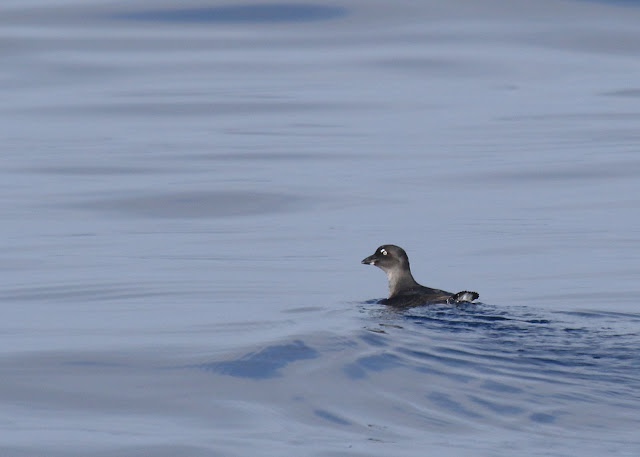
Good looks at a Cassin's Auklet
Cassin's Auklet
California Gull
California Gull
Then, in deeper water we spied a few California Flying Fish! They soared along for a couple of hundred feet before plunging back into the warm water. If the started flying too close to the surface they would stick the bottom of their tail into to the water and wiggle it back and forth to gain speed.

Flying fish getting up speed
Flying fish soaring high!
California Flying Fish
Pink-footed Shearwater
Brown Booby
Brown Booby
Red Phalaropes
Red Phalaropes
Nothing exciting showed up far offshore. After noon we turned the boat around and headed back toward shore. That's when we spotted a Northern Fulmar in heavy molt.

Ratty Fulmar
Fulmar takes flight
Northern Fulmar
Then, we spotted this...

Elephant Seal snout

If you can't make it out, it is the snout of an Elephant Seal. The animal is facing directly away and its head is flipped over backwards looking at us upside down! The bulbous tip of the nose is up in the air and the forehead is at water level with both its eyes looking at us from just above the water.

As we neared shore again a group of dolphins raced us.

Pacific White-sided Dolphins
Pacific White-sided Dolphin
And a third-for-the-day Brown Booby passed over the boat before continuing on.
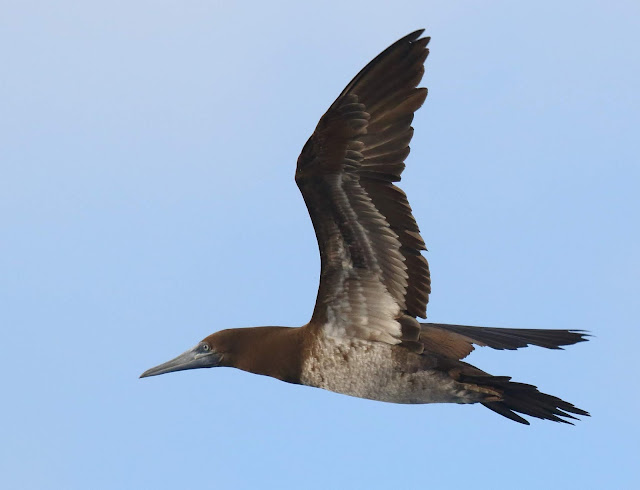
Immature Brown Booby
Brown Booby
The day was quickly ending. The gulls were getting a late afternoon snack.

Heading for home
Gulls at sunset

We entered the bay at dusk and it was quite dark by the time we reached the dock.

The moon over San Diego Bay
Moon over San Diego Bay.

Sunday, November 11, 2018

Birds in three dimensions

The majestic bird spreads its great wings and gracefully launches itself from the cliff into powerful flight.

Or not.

More than likely the bird steps off the ledge of its high-rise home and when it reaches the correct floor opens its wings to get off its self-imagined elevator. Or, like a day-old Wood Duck chick, fledging from its nest 35 feet up in a tree cavity, it jumps out, bouncing when it hits the ground, and waddles away to the pond.

J.B.S. Haldane, On Being the Right Size (1928) wrote:
"To the mouse and any smaller animal [gravity] presents practically no dangers. You can drop a mouse down a thousand-yard mine shaft; and, on arriving at the bottom, it gets a slight shock and walks away, provided that the ground is fairly soft. A rat is killed, a man is broken, a horse splashes.
"For the resistance presented to movement by the air is proportional to the surface of the moving object. Divide an animal’s length, breadth, and height each by ten; its weight is reduced to a thousandth, but its surface only to a hundredth. So the resistance to falling in the case of the small animal is relatively ten times greater than the driving force. 
"An insect, therefore, is not afraid of gravity; it can fall without danger, and can cling to the ceiling with remarkably little trouble. It can go in for elegant and fantastic forms of support like that of the daddy-longlegs."
As humans we are strongly bound to the ground. We're not as solidly bound to the ground as an earthworm, perhaps, but our experience isn't as unbounded as a bird. We are only now starting to get used to seeing video shot from drones, floating off from the ground up over the roof tops uninterrupted. Yet that is the world that most birds live in.

Birds have the freedom of flight because of their strong breast muscles and wings. Additionally, because smaller birds don't weigh much compared to their surface cross-section, they have no fear of falling. A fall won't hurt them, because the air holds them up. Gravity is still the same 32 feet per second squared, in a vacuum, but in the open air they flutter down gently like a leaf.

Because of their ability to fly, and the lack of fear of hurting themselves in a fall, birds necessarily perceive the 3-dimensional world in a different way than we do. They live more fully in a 3-dimensional world than we can even imagine.

House Finch
House Finch

Watch this funny Suicidal Pigeon video on YouTube.

Friday, November 9, 2018

Green-tailed Towhee in Laguna Mountains

I have previously photographed Green-tailed Towhees twice in San Diego. Those photos were so poor and out-of-focus that they were unusable. On a recent visit to the Laguna Mountains I was able to view a couple of birds together that weren't as camera shy as usual. Now I finally have some good photos of Green-tailed Towhees!

San Diego is near the southern edge of this large sparrow's breeding range and the northern edge of their wintering range. San Diego's mountains are also near the altitudinal edge of their preferred habitat: montane chaparral above 5000 feet (San Diego County Bird Atlas, Unitt, 2004). The highest peaks in San Diego are 4900-6500 feet of elevation.

Green-tailed Towhees breed on certain brushy mountains within San Diego County, specifically Cuyamaca Peak. Their primary habitat is Greenleaf manzanita (Arctostaphylos patula) and various shrubs in the genus Ceanothus known collectively as California Lilac. Although there appears to be no evidence for it, I have to wonder if towhees might have increased as breeders after the 2003 fires in the Cuyamacas. Certainly, potential breeding habitat increased, though now beginning to grow back up into forest.

These birds also are found rarely in migration and winter in shrubby landscapes along the coast. Nevertheless, they can really be considered rare, both in absolute numbers and because they are shy and hide very well in thick brush.

I was alerted to the presence of migrant Green-tailed Towhees at Agua Dulce Creek during my visit in October. Two birds were actually not difficult to find. They were feeding out in the open on the trail as Tuck Russell and I found.

Green-tailed Towhee
Green-tailed Towhee

Fortunately, they showed some curiosity as to our activities and we were able to get some decent photos. I'm not sure of the shrub--perhaps California Coffeeberry (Frangula californica)?

Green-tailed Towhee
Green-tailed Towhee
Green-tailed Towhee
Green-tailed Towhee
Green-tailed Towhee
Green-tailed Towhee. Mount Laguna, California. October 7, 2018.

Thursday, November 8, 2018

Orange-crowned Warbler in Laguna Mountains

I obtained some decent photos of an Orange-crowned Warbler at Agua Dulce Creek. I love how round and short-necked this bird looks. They don't always look so round. My tendency in sketching is always to make the body too long. I should practice with this one as a model.

Orange-crowned Warbler
Orange-crowned Warbler. Mount Laguna, California. October 7, 2018.

Monday, November 5, 2018

Acorn Woodpecker in Laguna Mountains

Three photos of Acorn Woodpeckers from a recent trip to the Laguna Mountains.

Acorn Woodpecker
Acorn Woodpecker. Mount Laguna, California. October 7, 2018.
Acorn Woodpecker
Male Acorn Woodpecker. White forehead, red crown.
Acorn Woodpecker
Female Acorn Woodpecker. White forehead, black forecrown and then red hind-crown.