Thursday, September 6, 2018

Coot photography challenge

If you live in North America like I do you probably see American Coots every time you visit a pond or other wetland. If you photograph birds you probably have a bunch of photos just like this one:

American Coot
Typical coot photo.
There's nothing wrong with the photo above. It's just common. It looks like any other photo of American Coot on a sunny day.

Only a couple of minutes after I took the above photo, I took the photo below. What changed?

American Coot
American Coot. Dixon Lake, Escondido, California. August 31, 2108.
First of all I got down a lower so I wasn't shooting down at the bird, but joined it on its level. I wasn't able to get down completely to water level, such as laying on my belly on the shore. I sat on a low rock. But since the bird was a bit farther away the angle was more horizontal than the first photo where I was standing up on a bank.

Second, I chose a more muted background. In this case the bird was in a little inlet. The brown water color is the reflection of the nearby curving shore.

Because I wasn't photographing the bright reflected sky, I was able to adjust the exposure properly. This third change is that the white bill isn't over-exposed and blown-out as on the first photo.

The next time you are looking at a coot, grebe, or duck in your viewfinder I want you to remember this. If you find it looks like the first photo, then stop. Change your shooting angle. Change your composition and background. Change your exposure. I challenge you to take a more interesting shot!

Wednesday, September 5, 2018

Osprey at Imperial Beach

Generally I schedule to get out birding locally one morning per week before work. And I often get out on a day-trip with Marlene during one or two weekends per month. While I take lots of photos to document the birds I see on each excursion, I don't always get pictures I'm proud to share. Here are three photos of an Osprey from a trip last week--the only photos that I really felt were good enough to share. It was flying nearly overhead along the beach in Imperial Beach.

Osprey
Osprey
Osprey
Osprey. Imperial Beach, California. August 26, 2018.

Tuesday, September 4, 2018

Bow-riding Red-footed Booby

This is the seventh and final post showcasing photos from the full day pelagic trip off San Diego on August 19th. We were mostly done birding at the end of our trip. But there was one more rare bird we wanted to see and photograph.

The Captain got word that a fishing boat that was about 15 minutes behind us had a bow riding Red-footed Booby! Even though we had all gotten great looks at a different Red-footed Booby only 4 hours earlier at sea, this was too rare of a bird to pass up.

As we dallied in the mouth of the bay, we soon spotted the Liberty and could make out the booby. The boat then pulled alongside and we rode together for 20 minutes back to the dock. This bird remained at least 3 days on this boat, riding out to sea and back to the dock each day. Evidently on the 4th day it flew from the boat while at sea. I hope that means it survived. Ship riding is not unusual behavior for boobies, frigatebirds, and some other seabirds. But a bird remaining aboard for several days likely means the bird is ill.

Fishing Vessel Liberty, San Diego Bay

I took over 300 photos of this bird. These are the only ones I kept. Most were quite similar. I just tried to get less distracting and blurred backgrounds with the bird looking my direction. Failing that (for the most part) I then tried quite a few shots with small aperture to see if I could get the bird with the San Diego skyline in focus too. Here are my shots.

Red-footed Booby, San Diego
Red-footed Booby. San Diego, California. August 19, 2018.
Red-footed Booby, San Diego
Red-footed Booby, San Diego skyline

Monday, September 3, 2018

Brown Pelicans photographed in golden light

Returning from the August 19 pelagic trip I noted that we had excellent warm "golden hour" light. As our boat entered the bay I obtained several photos of Brown Pelicans specifically to practice creating artistic photos in this soft light. I present them here with some commentary on the artistic aspects of each photo. [Read "7 elements of an artistic bird photo"]

Brown Pelican

#1. The photo above has soft light, is in focus, and has a good pose. The wind-rippled water background is perhaps just a bit too strongly patterned and distracting. This is alleviated in the following photos by getting closer to the bird and having more distance between the bird and the background elements.

Brown Pelican

#2. I really like the pose in the above photo. The background is clear blue sky. But the shadow on the underwing might be a touch too distracting for some. I'm shooting up at the bird just slightly, which isn't ideal.

Brown Pelican

#3. This photo above doesn't have quite as an interesting wing pose as the previous photo. But it is better in two other regards. It doesn't have a distracting shadow across the breast and the perspective is perfect at eye level. This might be the most technically "correct" of the photos here, though it is not my personal favorite.

Brown Pelican

The photo above really has nice warm golden light without any harsh shadows. The background has a couple of slightly distracting "blobs" on the water, and the brighter shoreline is a bit distracting too.

Brown Pelican
Brown Pelican. San Diego, California. 19 August 2018.
This final photo is one I really like. It really catches the golden glow of the late afternoon sun on it's brown feathers. The pose is really interesting. The wing is extended down and forward for added lift, the hand twisted slightly to reduce air drag as it is just beginning the upstroke. The wing is pleasingly patterned with all the parallel lines of the perfect juvenile flight feathers. The almost scale-like body feather texture is replicated on the wing coverts. You can really see this well if you click on the photo and bring up a size about 3 times larger than what appears on the screen. The shoreline is so subtle at the top that I don't think it detracts. The original had more shoreline, but I cropped as much out as I could. I could wish the faint darker wake shadow didn't go all the way across the frame and through the head. That's my only "complaint."

Saturday, September 1, 2018

New birding trails on Bayshore Bikeway, Imperial Beach

This post updates my February 2015 birding site guide to the Bayshore Bikeway, in Imperial Beach.

That site guide covered birding opportunities between 7th and 13th Streets, plus down the Bikeway a half mile or so beyond 13th Street to the Saltworks. Please see that original site guide for general birding and expected species.

This information adds 3 new (since June 2016) access points (paths) that should increase the value of this birding location.

Bikeway map
eBird map: Bayshore Bikeway map 7th to 13th Street. Click for full-sized image.
Key for map above:

Green P: Parking at 7th Street, 10th Street (lot next to Public Works), 13th Street

Yellow path: Bayshore Bikeway existing path.

Red Path 1: Designated birding trail. In June 2016 a walking path of 0.4 miles was completed between 7th Street and 10th Street, in Imperial Beach. This footpath follows the edge of the marsh at the south end of San Diego Bay. It parallels the Bikeway and makes it safer to watch birds and set up your spotting scope without impeding bike traffic.

Red Path 2: Some improvements have been done at the end of 13th Street (13th and Cypress), including some new retail shops (Bikeway Village). There are fewer parking spaces, but they are now paved. Street parking is also available on 12th Street, and also on Florence Street--which is between 12th and 13th Streets. A new city park botanical garden has been installed that looks over San Diego Bay between 12th and 13th Streets. It's a good place to scan the bay. Look for nesting Elegant Terns by the multi-thousands, Black-necked Stilts, Willets, and Black Skimmers.

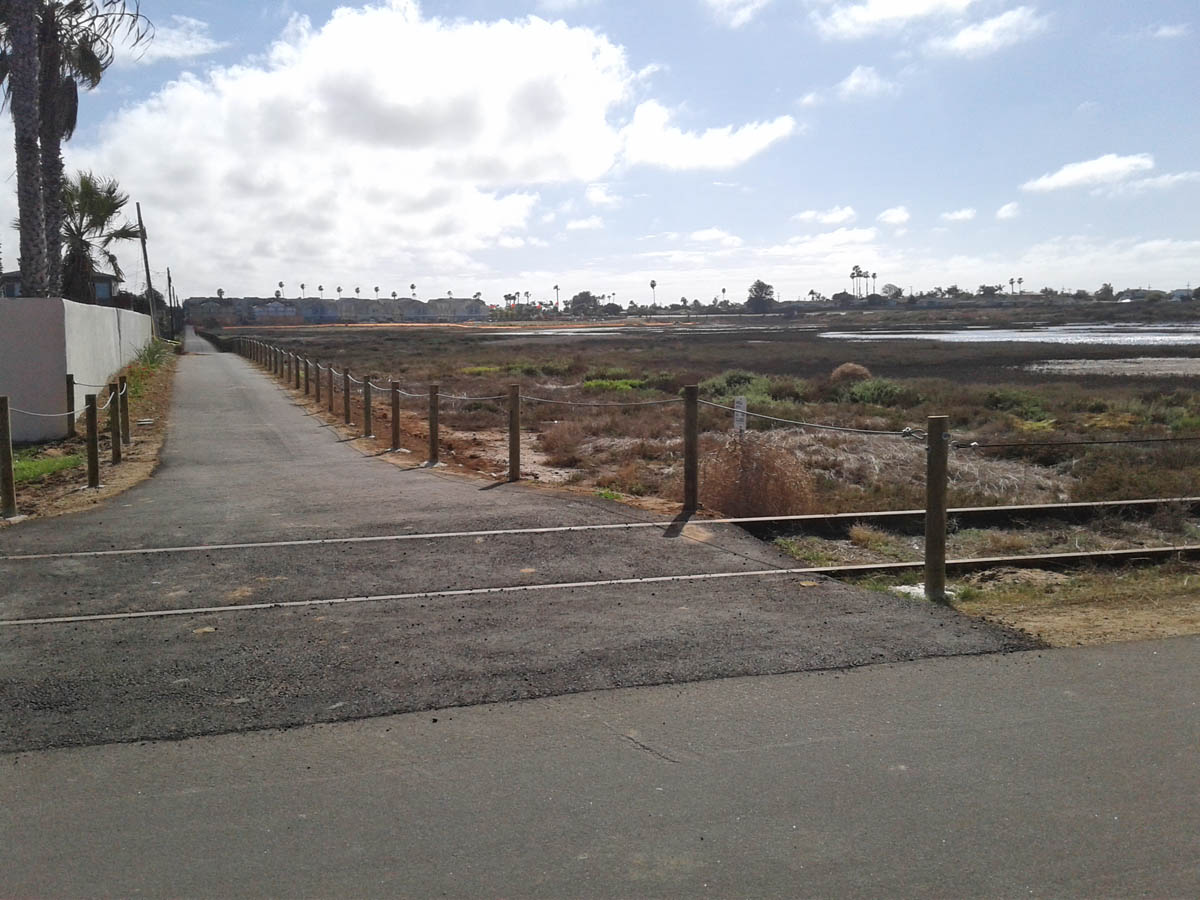
Red Path 3: There is a new paved accessway behind the homes on the west side of 7th Street. It may come from the new condominium development called Bayshore Landing. To access this path, drive to the north end of 7th Street and park on the street. Walk to the edge of the marsh. Walk the Bayshore Bikeway west about 150 feet. The new paved path leads south and has good light for morning shorebirding.

Yellow A: eBird Hotspot: "Bayshore Bikeway--7th St."

Yellow B: eBird Hotspot: "Bayshore Bikeway--13th St."

Yellow C: eBird Hotspot: "Pond 23 island & Otay River channel"

Yellow D: eBird Hotspot: "San Diego NWR--Pond 10A"

Yellow E: eBird Hotspot: "Saltworks--pond 20"

Bayshore Bikeway walking path at 7th Street
The new walking path/birding trail parallels the Bayshore Bikeway between 7th (here) and 10th Streets.
Bayshore Bikeway
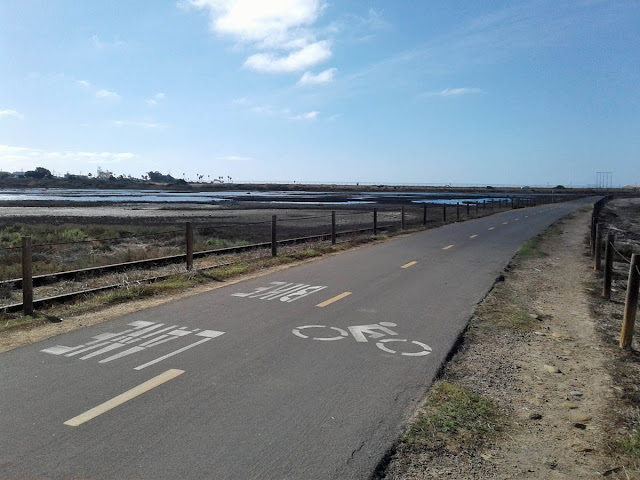
West from 7th Street you still have the irregular shoulder of the Bikeway as a walking option. Pond 10A to left.
Bayshore Bikeway
West of 7th Street is a new paved pathway bordering the marsh (Pond 10A).
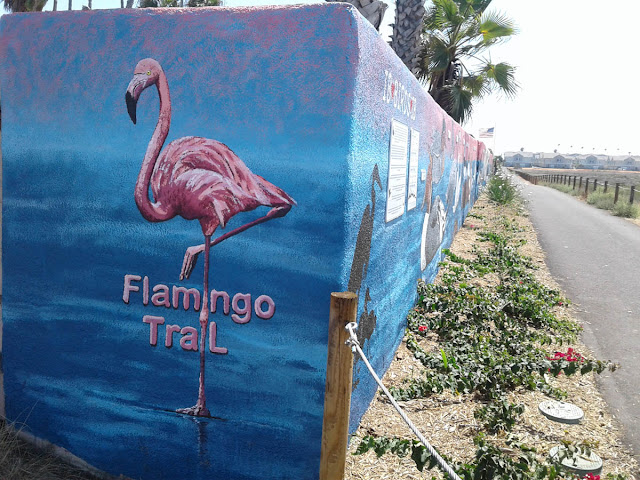
Flamingo Trail. Bayshore Bikeway Pond 10A
Oh look! Same view in August 2018. Famous local escaped bird gets its own trail!
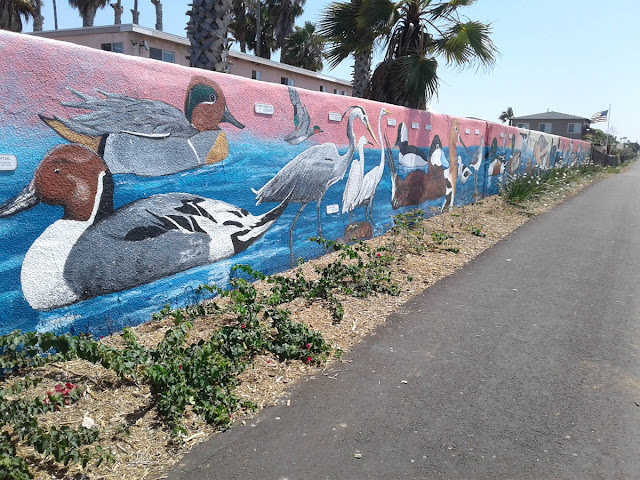
Flamingo Trail mural. Bayshore Bikeway Pond 10A
Beautiful mural. How long before it gets tagged with graffiti? August 26, 2018.
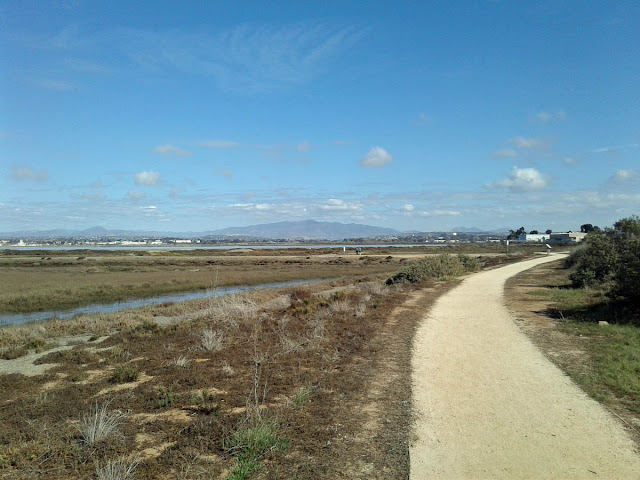
Bayshore Bikeway walking path
Path near the end of 8th Street.
Bayshore Bikeway walking path
Path near end of 8th Street looking west toward end of 7th Street.