Friday, September 14, 2018

Rare bird: Greater Pewee

Well, it's not a very good photo. The best that could be said of it is that it is a diagnostic documentation photo.

Here it is, a Greater Pewee I discovered at Fort Rosecrans National Cemetery. I put the word out and several people were able to view it later that day and even to the next morning. Several people obtained better photos. [eBird photos here]

rare Greater Pewee in San Diego
Greater Pewee. San Diego, California. September 2, 2018.
It is always more exciting to me to find a rare bird to share with others than to go and see a rare bird someone already found (a so-called "stake-out").

I had looked for a long-staying wintering Greater Pewee last December (2017) in Balboa Park, but missed it on the one morning I tried for it (see what I mean about my lack of enthusiasm for finding "someone else's" rare bird?). The previous San Diego sighting was in 2005, and just over a dozen birds since the first in 1974 (San Diego County Bird Atlas, Unitt, 2004). This is the first Greater Pewee for me in the United States (new "ABA bird" for me). My only other sighting was in Puerta Vallarta, Mexico, in 2003 (6 birds on a hike through the "jungle").

The bird looks like an Olive-sided Flycatcher. But the wispy crest and long bill with bright orange lower mandible clinches the identification. It is found from the pine-oak mountains in SE Arizona and SW New Mexico south into Nicaragua.

My first field guide (Field Guide to Western Birds, Peterson, 1969) has this bird listed as Coues' Flycatcher, named after Elliott Coues, 1842-1899 (pronounced "cows"), a naturalist and ornithologist trained as a medical surgeon and working for the army in Arizona (a frequent occupation for ornithologists of that period, it seems).

So, even if the photo is less than good, I hope the story makes it interesting none-the-less.

Wednesday, September 12, 2018

Up Close with a Pacific-slope Flycatcher

Pacific-slope Flycatchers are San Diego County's most numerous resident and migrant Empidonax flycatchers--those little (4.75-6 inches long) olive-green look-a-likes with wing bars and eye rings.

Pacific-slope Flycatcher

I was able to get these photos recently at Fort Rosecrans National Cemetery which is a location where many migrants pass through in fall.

Pacific-slope Flycatcher

Key field marks for this species include the long primary extension, wide bill all-yellow underneath, teardrop-shaped eye ring, and yellow throat. The buffy wing bars--rather than white--indicate this is likely an immature bird.

Pacific-slope Flycatcher
Pacific-slope Flycatcher. San Diego, California. September 2, 2018.
Usually they are tucked up under the lower shady branches of forest trees--miserable conditions for photography. I was delighted to find this bird out in the open.

Monday, September 10, 2018

Female Hermit Warbler at Fort Rosecrans National Cemetery

Autumn is the time migrant birds across North America wing their way south at night. Many of these birds are heading southwest to Mexico, but sometimes they (especially the young of the year) overshoot too far west. Thus, they may find themselves out over the ocean--especially on overcast nights. As the sun rises and the low fog lifts they spy land....

Point Loma sticks out into the ocean and it is covered with trees and bushes. The lush residential yards are inviting to migrants, but many birds first make landfall at the tip of Point Loma. The top and outer portion of Point Loma is the Fort Rosecrans National Cemetery. It is here that birders poke around from late August through October, hoping for rare lost birds that nest in the north or northeastern portion of the continent, and typically don't show up in southern California. [Birding site guide for FRNC]

I went birding there last week. There had been a marine layer covering the ocean. But migration during the previous night evidently wasn't heavy. There were actually not that many birds present. I did encounter a couple flycatchers and a tanager. I spent a couple of hours but birded only about a third of the large cemetery area.

My photo today, though, is a rather common migrant Hermit Warbler, a female or immature bird. Hermit Warblers nest primarily in the Cascades from southern Washington through Oregon to northern California, then down the Sierra-Nevada range. They pass through the San Diego region in the spring and fall, but you really have to be looking specifically for migrant warblers in order to find them. As you can see, they love pines. So in San Diego you can look for them in spring on the forested tops of the highest mountains or eastern desert oases. In fall, the residential plantings along the immediate coastline are your best bet.

Hermit Warbler
Hermit Warbler
Hermit Warbler. San Diego, California. September 2, 2018.

Saturday, September 8, 2018

Juvenile Yellow-crowned Night-Heron in Chula Vista

There are several regularly-occurring herons and egrets that are at the extreme northern edge of their range in San Diego. These include Little Blue Herons and Reddish Egrets, which are increasing, and Tricolored Herons, which have been decreasing in recent decades. It also includes Yellow-crowned Night-Herons.

There was a single resident Yellow-crowned Night-Heron in the San Diego area from 1981-2001. And there were several records of individual visitors that showed up occasionally during this same period of time.

juvenile Yellow-crowned Night-Heron
Juvenile Yellow-crowned Night-Heron. Chula Vista, California. September 2, 2018.
I'm not sure of the history between then and when I arrived in 2013, but in the past 5 years or so these stocky herons have nested at Sea World. This colony accounts for sightings at Mission Bay, San Diego River mouth, and Famosa Slough. Another smaller nesting site is in Imperial Beach accounting for sightings at the Tijuana River mouth and, perhaps, the south end of San Diego Bay.

[eBird records of Yellow-crowned Night-Heron 2013-2018 in San Diego County]

There was a one-year-old bird in July 2018 here at Bayfront Park (known to birders as the "J Street Marina"). Otherwise, this juvenile is the only other reported Yellow-crowned Night-Heron from this well-birded site in the middle east side of San Diego Bay. I wonder which local breeding site it came from?

Friday, September 7, 2018

Sora in low light

This past weekend I wanted to get in a full morning of birding and photography. So I timed my arrival at the Dairy Mart Ponds for sunrise: 6:15am. I was kind of hoping for the first lovely golden rays of dawn's light.

 As often happens in San Diego, though, a marine layer forms at night and overcast skies are frequent into late morning. So "sunrise" in the Tijuana River Valley this morning was a very gloomy dark gray.

Well, okay, I've also been watching YouTube videos extolling the virtues of the even light produced by overcast skies or fog. At least there shouldn't be any harsh shadows. And newer cameras can shoot at high ISO without too much graininess. If I take lots of shots , a couple of them might have acceptable sharpness, even at slower shutter speeds--especially with my image stabilized lens.

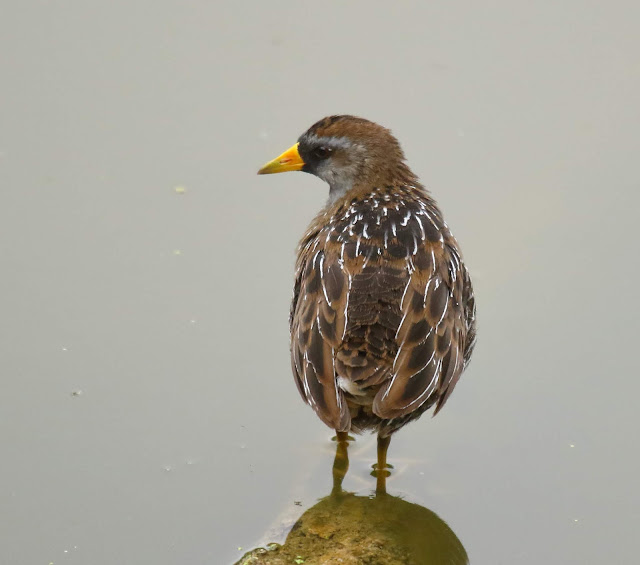
There was a cooperative Sora out in the open on a pond. Unfortunately, the little trail gave me only one view through the foliage. The bird was 20 feet away and below me about 10 feet. I had to stand up and shoot down at the bird below me. So these aren't artistic shots. They only show the exposure possible with my bird photography gear: Canon EOS 7D Mark II camera with Canon EF 100-400mm f/4.5-5.6L IS USM lens.

I attempted several photos early, 6:38 am. Only the one below turned out acceptably. I've been doing a lot of Manual Mode photography. But in this low light I didn't want try to guess the difficult exposure in Manual mode with the Evaluative exposure metering mode and dialing in a couple of stops of Exposure Compensation. Instead I chose Aperture Priority and Spot Metering and let the camera do all the hard exposure work as the bird moved from dark background to backlit.

Sora
6:38am, heavy overcast: 1/60 sec, f/5.6, 400mm, ISO 4000
I set ISO to 4000. The camera can go higher. But anything more than 2000 produces notable grain--especially in darker areas. The sweet spot on my zoom lens at 400mm is f/7.1. But I set it down 2/3 of a stop to f/5.6, which is wide open at 400mm. That does three things. It lets in more light (good), gives a very shallow depth of field (bad for focusing on a bird more than an inch or two in depth-front to back of focal plane [tail is too far away and out of focus]), and isn't the sharpest lens setting (bad). With me choosing ISO and aperture, I let the camera choose the shutter speed, to make the exposure correct.

At only 1/60 of a second, the above photo suffers a bit of blurriness from camera shake and bird movement. It's not very sharp, but it's the best that could be done with the available light. Handheld at 400mm I should be shooting at least 1/800 of a second or faster, but the image stabilization on the lens helps greatly. Still, I shouldn't shoot that long lens handheld at less than 1/250. I don't use a tripod so it is unlikely I can take those "blue light" bird photos before sunrise or after sunset unless I really change my birding/photography technique and habit.

It was an hour later when I went back and got additional photos with the bird still out in the open!

Sora
Heavy overcast, 7:42am: 1/320 sec, f/5.6, 400mm, ISO 2000.
So, the light came up enough I could set the ISO to 2000. I left the aperture at f/5.6. The shutter speed came up to 1/320 of a second. That is sufficient for stationary birds only.
Sora
Sora
Sora
Sora. Tijuana River Valley, San Ysidro, California. September 2, 2018.
Later in the morning I was able to photograph some other birds under bright overcast skies. I'll share those in future posts.