In January there was a King Tide in San Diego, appearing on the news.
What, exactly, is a King Tide?
Well, according to NOAA (
here), a King Tide is the unofficial name for an unusually high tide. It may also be known as a Spring Tide that "springs forth" with no relation to a particular season that comes to mind with that particular word.
There are always higher tides twice a month as the sun and moon line up (New moon and Full moon). When accompanied by storms or high waves or wind, these tides can be especially high, flooding coastal areas that are usually above the high water line. Thus, during the December to February "winter" in southern California, any new or full moon accompanied by high waves will create conditions of a King Tide.
Since the beaches are submerged and the tidal marsh is flooded, why should birders care? I'll tell you. But first, some photos...
 |
| Seacoast Drive in Imperial Beach closes during King Tides. |
 |
| Ocean waves splash over the breakwater and run down the street. |
 |
| Residents take in the view from their back deck. |
 |
| King Tide running down the street. |
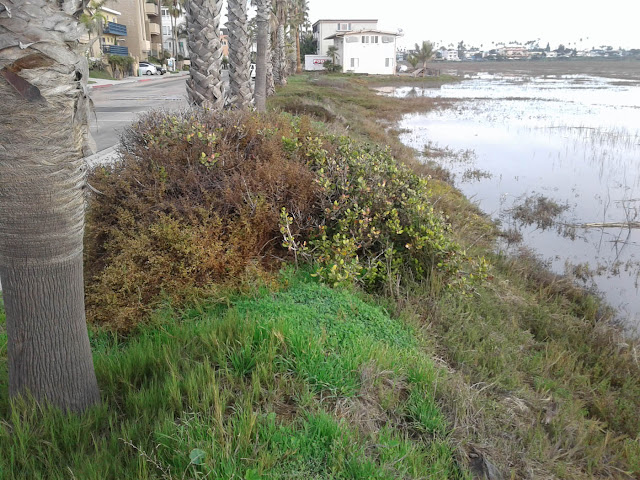 |
| Famous Lemonade Berry bush on edge of Tijuana Slough along Seacoast Drive. |
Why is the lemonade berry (
Rhus integrifolia Wikipedia page here) above famous? Well, last year during very high tides, a couple Nelson's Sparrows were flooded out of the marsh. That bush was the only place to hide! And hide they do. One could be in that bush right now for all I know. But it's not budging, nor giving itself away.
The nearest nesting Nelson's Sparrows breed from extreme north central US into the Canadian Prairie region. They winter in the coastal marshes of the Gulf Coast (other populations in Hudson Bay and SE Canada and NE US winter along the Atlantic coast). A very few end up every year wintering in California's few remaining salt marshes. Some of those winter in San Diego.
I stumbled upon one in San Elijo Lagoon a couple of years ago. I hadn't paid any attention to the tides when I made my birding plans. So,
luck one,
intention zero. That's the way birding is sometimes.
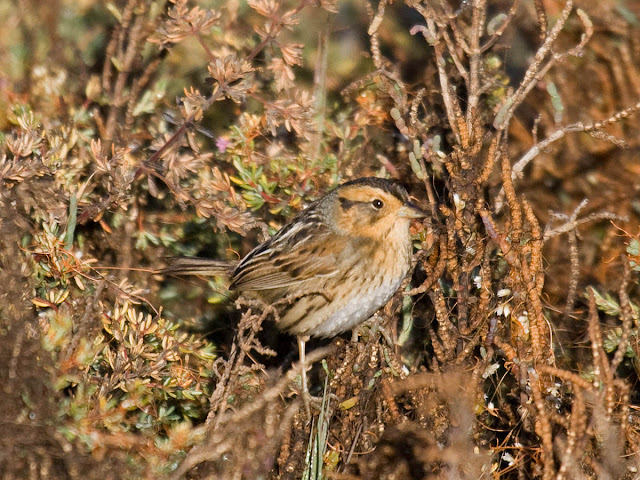 |
| A Nelson's Sparrow briefly comes out of hiding. San Elijo Lagoon, California. January 1, 2014. Greg Gillson. |
I should mention that other birders were watching a Nelson's Sparrow about 15 miles away at Mission Bay. But views were distant and it had already been seen, and I'm
picky proud lazy (pick your own adjective)--I generally prefer to find my own rarities!
What I did find on my recent King Tide Adventure were lots of other sparrows, especially Savannah Sparrows, including this dark resident form, Belding's Savannah Sparrow.
 |
| Belding's Savannah Sparrow. Imperial Beach, California. January 20, 2019. |
I was hoping for Large-billed Savannah Sparrows. They are at the extreme northern edge of their range in San Diego County, I find them occasionally in winter on beach-cast seaweed piles, apparently feeding on flies (kelp flies?). I figured with the beaches under water and the marsh grasses providing no cover that these birds might be right out on the edge of the marsh. But what do I know? I didn't find any. [Previous post on
Large-billed Savannah Sparrows is here.]
And King Tides are well known for pushing rails into view. The local Ridgway's Rails were visible in the tops of the grass.
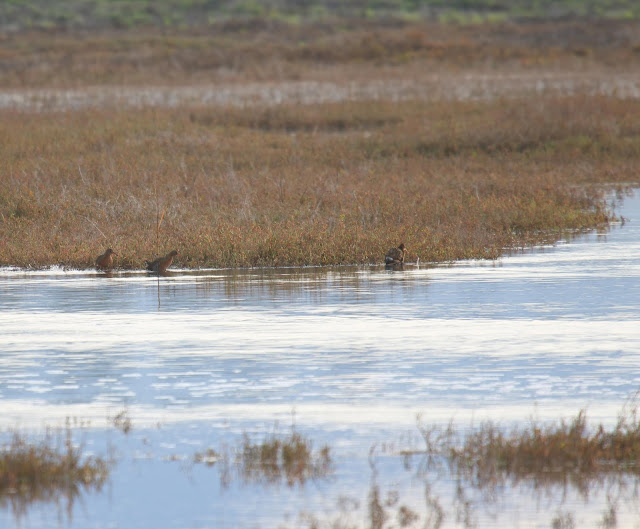 |
| Zoomed in... they were way out there! |
 |
| Cropped too far, but you can make their shape out a bit. |
Such high tides may also reveal Virginia Rails and Soras, as well as push all the herons and egrets up to the edge. And this day a Merlin was hunting the marsh edge for sparrows. You never know what you might find.
Next winter you may want to mark the new and full moon on your calendar in advance. If the seas are stormy, you may want to visit your nearest tidal wetland during a King Tide.


