Showing posts with label backyard birds. Show all posts

Monday, June 24, 2019

A final 10 common backyard birds in San Diego

This series started with The 10 most common backyard birds of San Diego, California. It was followed by Another 10 common backyard birds of San Diego.

Here, then, are a final 10 common birds you will likely be able to find in your backyard. Of course, depending upon what trees and plants you have, what habitats border your home, and exactly where you live, many more are possible--especially during spring and fall migration. And if you include the airspace above your home, then you may spot even more as they fly over. But these final ten are likely in most backyards within the region.

Combined with the previous 20 species, these 30 total common birds will provide the beginner with a manageable starting point for learning the backyard birds of San Diego and, indeed, most of southern California.

So let's get right to it. Here are more birds to find in your backyard in the San Diego region.


21) European Starling

European Starling
Adult European Starling. Escondido, California. January 14, 2018.
European Starling
Juvenile European Starling. Forest Grove, Oregon. August 18, 2007.
Introduced to North America in the late 19th century, European Starlings are pretty much resident across North America from southern Canada to northern Mexico in rural and urban areas. Because of their aggressive behavior most birders do not want starlings in their backyards. Don't feed birds human food scraps and you likely won't have many European Starlings. Otherwise they may take over your feeders.


22) White-crowned Sparrow

White-crowned Sparrow
Adult White-crowned Sparrow. Poway, California. April 8, 2018.
White-crowned Sparrow
Immature White-crowned Sparrow. Lake Hodges, California. December 14, 2014.
White-crowned Sparrows from northern areas are common from October to April in southern California. They should come to your tray feeders or feed on the ground under them. They sing a cheerful series of notes and trills in late winter and on their northward journey in spring to their breeding grounds.

Thursday, April 18, 2019

Another 10 common backyard birds of San Diego

This post adds 10 more backyard birds to the initial list of 10 I felt were most common.

Now, as Tito mentioned in his comments to the last post, every backyard is a bit different. He thought Song Sparrow should definitely be one of the 10 most common. He lives near the beach, so that's to be expected. I don't have that species in my dry inland backyard, and only hear them about 3 times a year in my neighborhood. But Tito's yard is evidently different. Not to worry, though! Song Sparrow is definitely in the top 30. Today, though, I list the species I deem #11-20 most common backyard birds in the San Diego area. The final 10 (yes, including Song Sparrow) is coming in a future post.

If you found the first ten species in your yard, can you now find the next ten? The first 10 tended to be ones that were easily attracted with food or water. This next set of 10 is attracted primarily by habitat--they are attracted to our landscaping, or they are birds of native chaparral that brushes up against the edges of towns, if you happen to live on the edge of more rural, open areas.


11) Red-shouldered Hawk

Adult Red-shouldered Hawk
Adult Red-shouldered Hawk. December 25, 2014. Ramona, California.
Immature Red-shouldered Hawk
Immature Red-shouldered Hawk. October 7, 2018. Mt Laguna, California.
Red-shouldered Hawks prefer woods and riparian edges more so than Red-tailed Hawks. Thus, town edges, pastures, creek sides, oaks, sycamores, and eucalyptus groves all support Red-shouldered Hawks and their loud, repeated "keer" calls. Even if none visit your yard, you'll likely see them soaring overhead--perhaps chased by noisy crows!


12) Nuttall's Woodpecker

Male Nuttall's Woodpecker
Male Nuttall's Woodpecker. February 2, 2014. Lake Hodges, California.
Female Nuttall's Woodpecker
Female Nuttall's Woodpecker. February 8, 2017. Escondido, California.
If your backyard has any oaks or sycamore trees, you'll likely have a pair of Nuttall's Woodpeckers that frequents it with their rattling calls.


13) Hooded Oriole

Male Hooded Oriole
Male Hooded Oriole. April 6, 2014. Escondido, California.
Female Hooded Oriole
Female Hooded Oriole. April 16, 2017. Vallecito County Park, California.
Do you have a tall palm tree in your yard? Then you have Hooded Orioles that visit for the summer, late March into September. Listen for their chatters and chirps and flute-like whistled notes. There is a feeder for orioles--similar to a hummingbird feeder but with orange slices and jelly--for closer views. They will also be attracted to water features--bird baths or fountains.


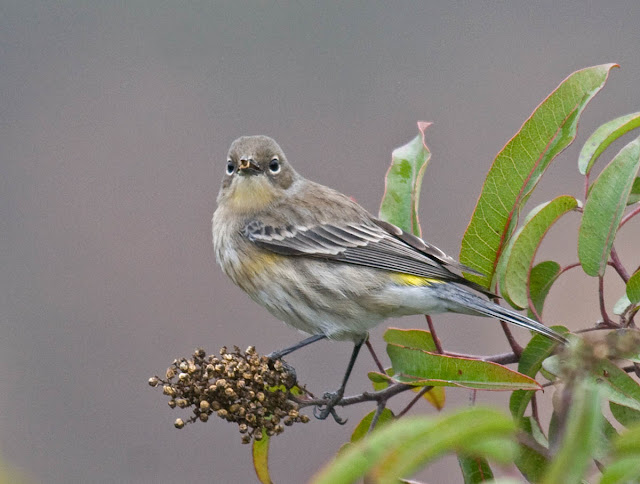
14) Yellow-rumped Warbler

Breeding Yellow-rumped Warbler (Audubon's form)
Breeding Yellow-rumped Warbler (Audubon's form). April 29, 2010. Forest Grove, Oregon.
Non-breeding Yellow-rumped Warbler (Audubon's form)
Non-breeding Yellow-rumped Warbler (Audubon's form). November 17, 2017. Escondido, California.
This abundant warbler may breed in small numbers in San Diego's highest forested mountains, and from here northward to Alaska. In winter it is found in lowlands from the Pacific Northwest into Mexico. Unlike most warblers, this species can switch from insects in summer to fruits in winter. Thus, it can remain farther north in winter than other warbler species. You may find it in most deciduous backyard trees in "winter" (October to April).


15) House Sparrow

Male House Sparrow carrying nesting material
Male House Sparrow carrying nesting material. March 18, 2019. Borrego Springs, California.
Female House Sparrow
Female House Sparrow. February 16, 2011. Beaverton, Oregon.
House Sparrows are urban dwellers--except when they are farm dwellers. They are less common in suburban residential. Because they are often messy and noisy, most people don't actively try to attract this species to their backyards. They will take over bluebird nest boxes, but have weaker feet. Thus, other cavity nesting birds (bluebirds, swallows, wrens, nuthatches, titmouses) will have a chance against them if there is no perch on the nest box. Likewise, these birds eat millet, the "filler" seed in bags of generic "mixed seeds" that many native birds don't like. So, if you feed black oil sunflowers, rather than "mixed seeds," you may have less problem with these birds taking over.


16) Say's Phoebe

Say's Phoebe
Say's Phoebe. December 22, 2013. Mission Bay, California.
The Say's Phoebe prefers dry pastures and chaparral. In winter you may find them in open lawn spaces and parks around your neighborhood. There they chase flying insects low along the ground. If you live in a more rural area, they may nest in an open corner of an outbuilding, or perhaps on top of a light fixture on your porch.


17) Eurasian Collared-Dove

Eurasian Collared-Dove
Eurasian Collared-Dove. March 12, 2017. Borrego Springs, California.
Perhaps the fastest colonizing bird in the world. After taking over Europe in the last century they repeated their conquest in the New World. Escaped cage birds apparently flew from the Bahamas to Florida in the 1980's. Their method of colonizing is to breed for a couple of years in one area and build up large numbers, then many of the colony disperse, flying 500 miles or more and do it again. They tend to spread in a northwesterly direction first, then back fill. Their breeding sites also tend to change over the years. You'll find these loud pigeons around human habitation, residential areas and farms, similar to where Mourning Doves are found, but not so much in the open country.


18) Cassin's Kingbird

Cassin's Kingbird
Cassin's Kingbird. November 3, 2018. Ramona, California.
The Cassin's Kingbird is a year-round resident in southern California. It prefers the lowlands, pastures, and lone tall trees over large expanses of lawn. They flycatch at tree-top level.


19) Bushtit

Male Bushtit
Male Bushtit. October 4, 2015. San Elijo Lagoon, California.
Female Bushtit
Female Bushtit. October 9, 2009. Forest Grove, Oregon.
"What are those tiny gray mouse-like birds crawling around my shrubs under the window?" Those are Bushtits. They are likely searching for spiders to eat. It's the eyes! Females have pale eyes, males are dark. Otherwise they appear the same. A pair builds a gray sock-like nest of lichens and spider webs that hangs down under a branch about 6 feet off the ground. For the rest of the year, though, they are found in flocks of 20-50 birds.


20) House Wren

House Wren
House Wren. July 4, 2018. Lake Hodges, California.
This is a common bird of chaparral and residential bushes and brush piles. Resident birds are supplemented by winter visitors from the north. They eat insects and grubs. The more overgrown your yard with mature shrubs, the more likely your yard will host House Wrens in winter. If your yard is brushy enough, a pair may stay throughout the year and nest in a nest box or other cavity.

Want more? The final 10 common backyard birds of San Diego is here!

Monday, February 18, 2019

The 10 most common backyard birds of San Diego, California

The following 10 species of backyard birds are the most frequent in the San Diego region. In fact, these 10 would be common backyard birds nearly anywhere in California away from mountains and driest deserts. From Redding south to Bakersfield, and San Francisco south to San Diego, it might be difficult to find a residential backyard where all these birds do not occur, year-round.

These birds, then, would certainly serve as an introduction to backyard bird watching in California.

Can you spot these 10 in your backyard? Which one is your favorite?


1) Lesser Goldfinch

San Diego, California Backyard bird: Lesser Goldfinch
Male Lesser Goldfinch. Fallbrook, California. May 4, 2014.
San Diego, California Backyard bird: Lesser Goldfinch
Female Lesser Goldfinch. Forest Grove, Oregon. August 28, 2007.
The tiny Lesser Goldfinches like weedy fields with oak savannas where they eat small seeds. To attract them to your yard, hang up a "thistle sock" stocked with Nyjer seed.


2) House Finch

San Diego, California Backyard bird: House Finch
Male House Finch. Imperial Beach, California. January 30, 2016.
San Diego, California Backyard bird: House Finch
Female House Finch. Escondido, California. June 20, 2018.
House Finches are found in residential areas and farms with scattered trees. To attract them to your yard put up a tube feeder with black oil sunflower seeds.


3) Mourning Dove

San Diego, California Backyard bird: Mourning Dove
Mourning Dove. Solana Beach, California. May 17, 2017.
Mourning Doves are birds of open residential and farmlands. To attract them to your yard feed sunflowers, cracked corn on a tray feeder. They nest in covered corners--carport beams, on porch lights, etc. Listen for their mournful crying song (boo, hoo-hoo) on spring mornings.


4) Anna's Hummingbird

San Diego, California Backyard bird: Anna's Hummingbird
Male Anna's Hummingbird. Rancho Bernardo, California. January 21, 2018.
San Diego, California Backyard bird: Anna's Hummingbird
Female Anna's Hummingbird on nest. Cardiff, California. February 1, 2016.
These pugnacious little sprites love flowering plants and small insects. To attract them to your yard plant flowers and hang a hummingbird feeder with 4 parts water to 1 part table sugar. They nest very early, late December to March).


5) Northern Mockingbird

San Diego, California Backyard bird: Northern Mockingbird
Northern Mockingbird. Borrego Springs, California. January 7, 2018.
Mockingbirds hang out in residential areas with large dense shrubs. They eat insects and berries. They'll sing from telephone lines and low trees, nearly non-stop, day-and-night, all year long.


6) California Scrub-Jay

San Diego, California Backyard bird: California Scrub-Jay
California Scrub-Jay. Hillsboro, Oregon. April 21, 2010.
Jays are bold and brash and eat animals and vegetables as food. Because they are large and take lots of food away from the feeder to hide it for later (called caching), you may not want too many Scrub-Jays in your backyard. If you have an older field guide you may find this bird listed as Western Scrub-Jay.


7) American Crow

San Diego, California Backyard bird: American Crow
American Crow. Newport, Oregon. April 20, 2008.
Frequently found in cities, crows are smart enough to get into nearly any kind of trash container to find human food scraps. In residential areas they may only visit during the day, flying off at dusk to roost in the hundreds in orchards or other dense patch of trees. They frequently gang up on hawks and owls, making a noisy mob.


8) Black Phoebe

San Diego, California Backyard bird: Black Phoebe
Black Phoebe. San Diego, California. May 10, 2015.
Frequenting quiet ponds and wet places, large expanses of grass lawns make a great substitute for this flycatcher that feeds on low-flying insect. Their sweet chip note, bobbing tail, and unfearing nature makes them a favorite backyard bird.


9) California Towhee

San Diego, California Backyard bird: California Towhee
California Towhee. Poway, California. April 8, 2018.
This large sparrow is rather plain brown. It will feed on sunflower seeds on a tray feeder or, more likely, on the ground under it. They hide under bushes in residential areas, kicking leaves with both feet to see what's under them. When they do this in your feeder they can scatter seed everywhere!


10) Western Bluebird

San Diego, California Backyard bird: Western Bluebird
Male Western Bluebird. Beaverton, Oregon. March 9, 2013.
San Diego, California Backyard bird: Western Bluebird
Female Western Bluebird. Santee, California. October 11, 2013.
While they might be more abundant in an open oak woodland, Western Bluebirds don't mind putting up with residential human activities if there is an expanse of lawn or pasture they can search nearby for bugs. They also need a gnarled tree with a cavity to use as a nest. Placing a nest box on your property may make it more enticing, if there is ample lawn nearby.

Want more? Here are Another 10 common backyard birds of San Diego.
And... A Final 10 common backyard birds of San Diego.

Tuesday, January 5, 2016

Birds to know in San Diego: Introduction (Backyard)

You may not believe it--because it certainly was a surprise to me when I found out--but not everyone is as fanatical about bird watching as I am. Shocking, I know.

Over 500 species of birds have been recorded in San Diego County. About 300 of those are regular. I am starting a new little feature to 50 or 60 easily viewable and interesting birds in San Diego County. Towns, beaches, mountains, lagoons, oak woodlands, deserts--each different habitat has different kinds of birds. While some birds are found in nearly every habitat, others are restricted to only a few, or even just one specific habitat.

My hope is that this feature will appeal to those with some general interest in the natural world. Each monthly post will take you to a different location and habitat within the county and highlight 5-9 birds that can be found there. The birds I chose are rather obvious, often large or colorful, and I try to explain something about the life history which I think a general reader would find interesting.

Our first location is the residential backyards. Birds on this list can be found nearly throughout the county in residential areas without much effort. So no specific location is given for this first selection of birds. There are many backyard birds in San Diego. These are a few that I consider most typical.


Update: July 2019: When you are done with this article (and the 6 backyard birds presented here) you may also like my 3-part article on the 30 most common backyard birds of San Diego; the first 10 are here.


Anna's Hummingird. Anza-Borrego Desert, California. January 26, 2014. Greg Gillson.
Anna's Hummingbird
This large hummingbird was formerly nearly a California and northern Baja California endemic. But in the 1970's, following hummingbird nectar feeders and non-native winter-flowering plants, they extended their range northward. They are now resident north to British Columbia, and have expanded eastward to Arizona. There are several other hummingbirds in the West, but this is the only one that is widespread throughout the year. The back and rump are green. Similar San Diego birds: Costa's Hummingbird, Allen's Hummingbird, Rufous Hummingbird, Black-chinned Hummingbird.

House Finch. Imperial Beach, California. March 2, 2014. Greg Gillson.
House Finch
These finches are very common around human settlements in loose flocks where they frequent backyard bird seed feeders. Formerly found only in the West and Mexico, they have expanded into nearly the entire Eastern United States, too. They reach only to the southern edge of Canada. Brown-striped, the males show reddish-orange on forehead, breast, and rump. The bird shown above is a rare yellow variant. [See a more recent photo of a typical red-colored House Finch here.] Similar San Diego birds: Purple Finch.

Lesser Goldfinch. Julian, California. July 3, 2015. Greg Gillson.
Lesser Goldfinch
These are tiny flocking birds of chaparral and tree-edged grasslands. They are found from Oregon and southern Idaho south to Middle American and east to western Texas. They are found in residential gardens where they eat thistle seeds and are attracted to water. They have a pleasant lilting song. Similar San Diego birds: American Goldfinch, Lawrence's Goldfinch.

Northern Mockingbird. San Elijo Lagoon, California. March 7, 2008. Greg Gillson.
Northern Mockingbird
This robin-sized gray bird sings nearly non-stop throughout the year and throughout the day and night. The repertoire is practically unlimited, each phrase repeated a few times then on to another one, without any pattern. These mimics often copy the songs of other birds but also mechanical noises. One neighborhood bird in Ventura, California, several years ago did an exact imitation of a gas-powered lawn mower starting on the third pull: "trumm, trumm, trrrrrrrrrrr...." When it flies, it may spread its wings and tail to display the big white wing patches and white outer tail feathers. It eats berries and insects. Look for it singing from tall garden trees and residential wires from the NE US, across the southern plains to California and southward into Mexico and islands of the Caribbean. Similar San Diego birds: Loggerhead Shrike, Western Scrub-Jay, California Thrasher.

Mourning Dove. San Elijo Lagoon, California. March 7, 2008. Greg Gillson.
Mourning Dove
The sad-sounding refrains of this dove are one of the first memories I have of birds. They are found from southern Canada into Middle America in a variety of open habitats, including residential backyards. They primarily eat grain. The long pointed tail helps separate this dove from other similar doves. Similar San Diego birds: Rock Pigeon (Domestic Pigeon), Eurasian Collared-Dove, White-winged Dove, Band-tailed Pigeon, Common Ground-Dove.

Western Scrub-Jay. Santee, California. October 11, 2013. Greg Gillson.
Western Scrub-Jay
This brash and noisy backyard bird is usually obvious when present. Plump and long-tailed, the head, wings, and tail are blue, the back dark gray and the breast and belly pale gray or whitish. They are found from western Washington State south to Mexico and east to Texas. Often aggressive against other backyard birds, these omnivores eat nearly any animal or vegetable matter small enough to swallow. Peanuts are a favorite food. They cache food, carrying it away to bury and hide for later. Similar San Diego birds: Northern Mockingbird, Steller's Jay; perhaps also the smaller Western and Mountain Bluebirds.

Next: Birds to know in San Diego: San Elijo Lagoon