Showing posts with label fieldcraft. Show all posts

Monday, July 8, 2019

Stalking Birds: 25 tips: How to get close to birds without scaring them away

In my previous post I discussed whether it was really necessary to get closer to a bird. In some cases, to protect the welfare of the bird, it may be best not to approach closer. Likewise, if other people are desiring to see the bird, it would be rude to scare it off so that others couldn't enjoy it. And you don't want to harass birds, or give the impression that you are to onlookers.

You can learn to approach birds more closely without frightening them. Then again, you can remain still and have the birds come to you! Both these outcomes start with the same premise: Don't look threatening.

Approaching birds

Perhaps you have noticed in a park that some birds habituated to people remain only a few feet off the trail as bicyclists, hikers, and even dog walkers pass by. Yet you don't get as close as they did and don't even get your binoculars raised before the bird flies off! Why?

Think about it from the bird's perspective. People pass by all day, most paying them no attention. They are not a threat. Yet here come you, straight at the bird. Not only that, you are staring at the bird with these large unblinking glass eyes. Threat!

So your first fieldcraft tip is (#1) not to approach a bird directly. Make as if to pass the bird by. Meander. Curve your path gradually toward the bird. Don't stare at the bird while moving toward it. Look away. Watch it out the corner of your eye until you are closer. Then stop.

Next, (#2) as you approach carry your binoculars or camera up to your face. Birds are often spooked by arms raising suddenly or pointing. Rest your optics on your cheek as you approach, then slowly tilt your optics to your eyes.

Third, (#3) watch your step! Don't break a twig or scrape the gravel. A sudden noise and off they fly! Move slowly and steadily.

Watch the bird. (#4) Is it alert and watching you? Stop. Let it get used to you and get back to whatever it was doing before you showed up. Is it fidgeting? Twitching its wing? Standing up straighter? Nervously scratching? Raising the tail? It may already be too late. Back off. Wait. If the bird is comfortable singing, feeding, and just being a bird while you take photos, then you are the correct distance.

Diving water bird tip ("Dive and Dash") (#5): Diving ducks, loons, grebes--wait for the bird to dive. Count how long the bird stays down. Next time it dives, run forward, crouch down. Wait for it to resurface. It may move closer. If it resurfaces farther out and facing away, you've been spotted. It won't return.

Singing bird tip (#6): Singing males are more easily approached during the time they are belting out their song. In between phrases is when they fly. If they are singing you may be better off walking forward at that time. Avoid over-pursuing singing birds during this sensitive breeding season time.

Blue Grosbeak
Territorial Blue Grosbeak.
Auto tour tip (#7): Some refuges and nature reserves may have auto tour routes. Even some country roads with wide shoulders along fields or wetlands may have bird viewing and photography opportunities from inside your car.

Monday, July 1, 2019

Fieldcraft: Stalking Birds: Do you really need to get close?

Eyeball to eyeball with Greater Roadrunner
Back off buster!
Before I post the techniques for approaching birds closely, I must ask the question: "Do you really need to get closer to the bird?" Let's discuss two reasons not to approach the bird more closely.

Today's optics are good enough that you can happily observe a bird from a distance that does not disturb it. Therefore, I can only assume that if you want to get even closer to a bird, you probably are trying to photograph it.

If you can approach closely, take your photographs, then back away--without the bird flying--then you have been successful. If the bird flies, you've failed; you have disturbed it. Once you flush a bird it is not going to let you get that close again. There's no sense chasing after it. You had your chance, but it's over. Move on. Any further stalking becomes harassment.

Monday, June 3, 2019

Fieldcraft: Choosing your birding direction. Literally.

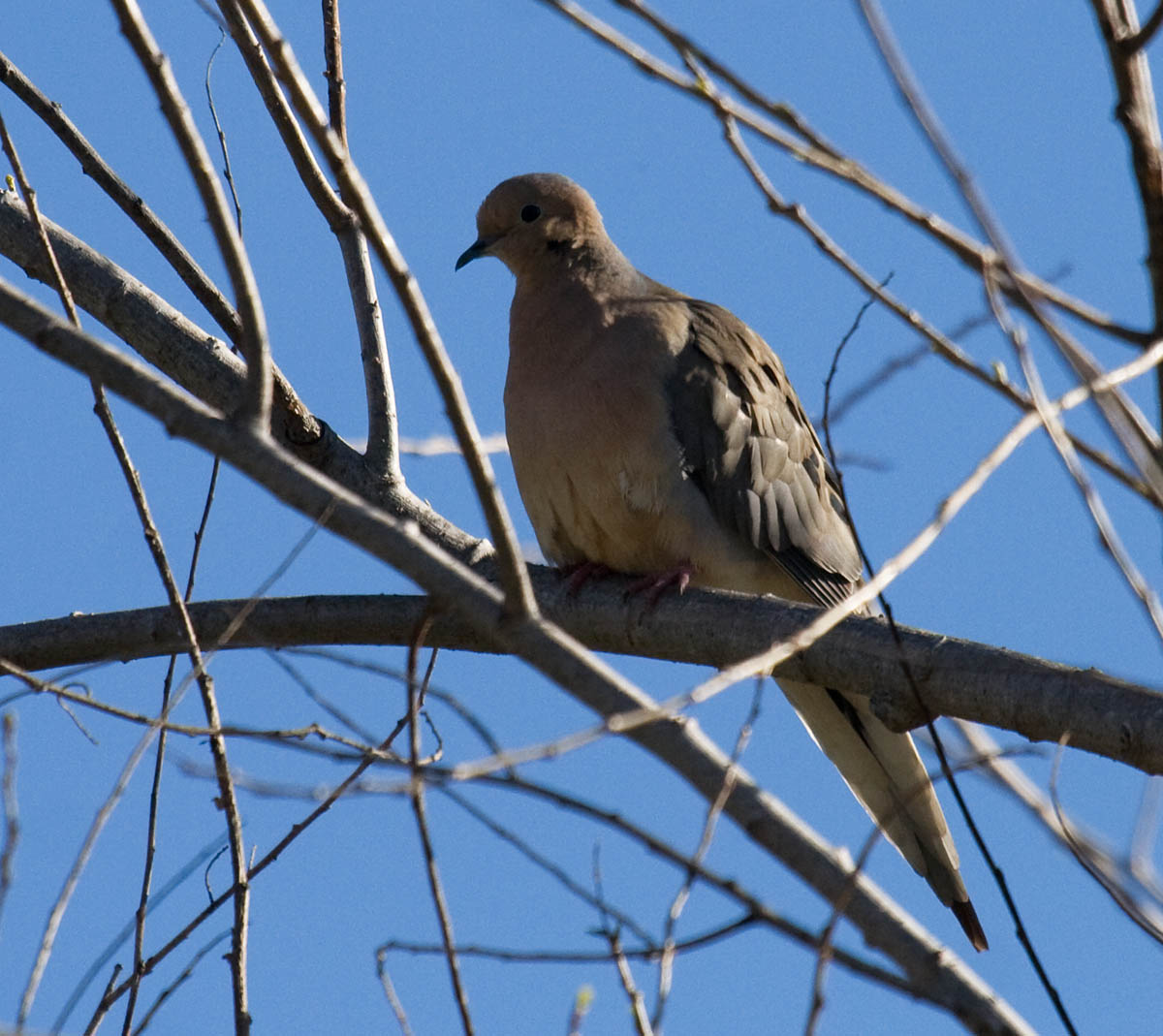
Mourning Dove in good light
Mourning Dove. Lake Hodges, California. December 1, 2013.
I can't be the only one. When I go bird watching I prefer loops to out-and-back spur trails. Don't you?

My thinking is: "I've already seen most of the birds on the trail I was just on. My chance for additional species seems higher to me on a different trail than to repeat the one I was just on."

So, when you start your birding walk and come to that fork in the loop path, which path will you take? If you say: "It's a loop; it doesn't matter," you would be wrong from a birding fieldcraft perspective.

The question is this: Do you want to glory in the beautifully colored birds lit warmly by the morning light? Or do you want to be squinting and see mostly silhouettes? I want you to think like a photographer now: point your shadow at the bird!

The sun rises in the east, more or less. In the northern hemisphere it rises in the northeast in spring and the southeast in winter. At dawn (and winter) the sun is low. If you start your birding by traveling east you'll be looking directly into the sun. However, if you start your loop by heading in a westerly direction first, looping to the right to the north, you'll start and stay in good light. Later, when you have to loop around toward the east and south, the sun will be higher, and less in your eyes.

So that's my advice to you. When you start your birding loop in the morning, choose to head off in a westerly direction first, then clockwise.

The difference can be night and day,... compare the first photo with this one:

Mounring Dove backlit
Mourning Dove backlit. San Elijo Lagoon, California. March 1, 2017.

Thursday, May 2, 2019

Fieldcraft: How to choose the birding field guide that is best for you

Short-billed dowitchers molting into breeding plumage
Short-billed Dowitchers starting molt into breeding plumage. San Diego, California. April 2, 2017.
Do you want your field guide detailed enough to identify these birds transitioning into breeding plumage?
Or, is, "some kind of dowitcher" good enough for you?
First of all, there is no "best" bird field guide. There are many excellent field guides available on the market. One of these just might be the best field guide for you.

You have four decisions to make first, however, regarding how you will use your guide and what you want it to show. Consider these four decisions carefully.

First, is usage. How will you use this guide? Is this an identification guide that sits at home or in the car for reference, or is it a field guide that you will carry with you to put a name on the bird before you? A true field guide is compact enough to carry easily. To be compact means that it will be brief compared to some identification guides. Thus, to be useful, it must be very well-organized to actually find the bird quickly.

Second, how detailed must it be? Or, rather, how much detail do you want left out? Do you want it to show only breeding males? Females if different? Non-breeding plumage if different? Juvenile and immature plumage if held for the fall and winter? Subspecies variation where field-identifiable? How much information do you want about habitat? Songs? Behavior? Nesting? Similar species? Range in text or maps?

Third, how inclusive must it be? Must it show every species ever seen in your region or just the most likely? Or even fewer--just the most common and obvious? And what is your region? A state? A geographic province? A continent?

Fourth, is the visual medium. Do you want photos or artistic illustration? A photograph is one individual on one day of it's life, in the light conditions of the day, time, and location, with the camera settings of the photographer (and the computer post-processing), doing whatever the bird was doing at the time of the photograph (probably being slightly alarmed by being stalked by this human with this giant glass eyeball staring at it!). No two birds are exactly alike. In fact, with continuous molt, wear, and body fat changes, that one bird will never again look exactly the way it does today. Some drawings are very lifelike, others are more patternistic so you don't get lost in feather details that don't help with the identification. Most drawings are an "average," and can show a typical posture and habitat or, alternatively, might show all birds in identical posture with no shadows in order to emphasize only the pattern differences.

If you can provide definite answers to as many of these field guide "trade-offs" ("style choices"?) as possible, you will be able to pick out your own best field guide, now and in the future. The answers to the level of detail needed and how inclusive it must be are very important. Are you okay letting some female or immature birds go unidentified? Do you care about the identification of very rare look-a-likes that are possible but not likely? Do you only care about a very small region or will you be birding more widely?

At first, every bird will be new and unfamiliar to you. So you may want to start with a simple guide. After a couple of months you will learn the common birds in your area. If you reach this point and have too "simple" of a field guide, you will quickly note many birds that aren't depicted. Fortunately, field guides are inexpensive and you can "move up" to a more comprehensive guide.

Starting with a "simpler" guide might be preferable, though, to being overwhelmed by the more detailed and inclusive guides. A field guide should encourage identification. If it's too complicated it will discourage.

On the other hand, if you've been bitten by the "birding bug," you will quickly out-grow a simpler guide and would gladly take on the challenge of the more detailed guides, so that as few birds as possible get away unidentified.

Here are a few popular books in North America and others on my bookshelf and how I rate them using the 4 criteria above.

Field Guide to the Birds of North America (Seventh Edition). Jon L. Dunn and Jonathan Alderfer. 2017. National Geographic Society, Washington DC.
Buy it at Amazon.com.

Slightly larger and heavier than the standard field guide; may fit in a coat pocket. Very detailed; numerous illustrations of over 1000 species. Textual descriptions of plumage, voice, habitat, range, some behavioral notes. North America, excluding Mexico, but including Greenland. Painted by different artists but most are highly detailed, feather-sharp, with plumage annotations, and some habitat illustrated.

The Sibley Guide to Birds (Second Edition). David Allen Sibley. 2014. Alfred A. Knopf, New York.

The "Big Sibley" (there are several smaller regional guides). Larger and heavier, won't fit in most pockets. Very detailed; numerous illustrations of each species; maps; textual descriptions of identification marks, habitat, behavior, and voice. All species also shown in flight. North America, excluding Mexico and Greenland. All paintings by the author, with excellent posture and proportions, many in life-like poses with annotations and a very few habitat hints. [Get the 2nd printing of July 2014 that fixes color and text contrast issues.]

A Field Guide to Western Birds (Third Edition). Roger Tory Peterson. 1990. Houghton Mifflin Harcourt, Boston.

I know there are more recent editions (Fourth Edition to all of North America, exclusive of Mexico), but this may be the last in the 5x7.5 inch traditional Peterson pocket-sized field guide. It is less detailed than the guides above, with fewer illustrations per species, so less overwhelming for beginners. Text describes identification, voice, habitat, and, helpfully,  similar species. Maps are all together in the back. This includes half a continent--the Western US and Canada (not Hawaii as earlier editions), so perhaps 100 fewer species than the entire continent. It uses Peterson's more patternistic art style and stiff right-facing poses with arrows pointing to the field marks. This simplifies the identification process for beginners.

The Stokes Field Guide to the Birds of North America. Donald and Lillian Stokes. 2010. Little, Brown and Company, New York.
Buy it at Amazon.com

Larger and fat. Very heavy with 790 pages and a CD of bird songs that I have never used. Very detailed desk reference; this book may average 5 illustrations per species. Much text. Rather than Peterson's "field marks" approach, this guide teaches identification first with shape, a very effective way to quickly narrow down your identification to the correct family of birds. All major plumages are described in the text, along with habitat and voice. Maps are very accurate. Subspecies are described. 850 species in North America, excluding Mexico and Greenland. This guide uses 1/6th to 1/8th page size photographs with no annotations--read the text. For more advanced birders.

Birds of Oregon. Roger Burrows and Jeff Gilligan. 2003. Lone Pine Publishing, Auburn, Washington.

At 5.5x8.5 it might fit in a pocket. It skips detailed illustrations and averages about 1-1/2 illustrations per species. So this makes it more of a car reference for beginners who want to find and identify the common birds. However, it is fairly detailed in the text, beginning with a full paragraph life-history overview of each species. ID text telegraphs main plumage marks, size, status, habitat, nesting, feeding, voice, similar species, best sites, and summer/winter maps. It includes only the most frequent 75% (328 species) of Oregon's birds, forgoing those that have less than maybe 5 records per year. It is illustrated with fairly large paintings.

These example field guides should give you an example of how to analyze field guides and help you choose the birding field guide that is best for you.

Tuesday, April 2, 2019

Fieldcraft: 5 reasons to start birding at dawn

Looking down on Kitchen Creek
Kitchen Creek just after sunrise
It's not necessarily easy to rise early and begin bird watching with the first rays of the morning sun. It's so tempting to sleep in just a bit and let it warm up outside. Being in the field at dawn is beneficial, though, for seeing more birds.

My favorite quotation concerning the benefits of dawn birding comes from Tim Rodenkirk: "If you don't want to see birds, always arrive a few hours after sunrise."

Here are five reasons why you (and I) should get up a little earlier to start birding at dawn.

1) Birds are more active at dawn

In the introduction of one of Peterson's first field guides (perhaps 1947 version of original Field Guide to the Birds?--I can't locate the quotation), he noted that birders saw more sunrises than anyone else except perhaps milkmen. (Does anyone born since 1970 even know what a milkman is?) Why did he say this? Because, to see more birds you've got to go where the birds go and get up when the birds get up.

Birds are most active in the morning. After a long cold night they want breakfast. The early bird gets the worm, the seeds, and the insects. In spring... well, we'll talk about song below.

It's sad, really, but many wildlife refuges, nature centers, and parks don't even open until the bird activity is already done for the day. 10 AM? In many places in late spring or summer the birding is effectively over by then, or earlier. The birds have eaten breakfast and will rest quietly in the shade until a brief flurry of activity near sunset.

If you start birding at 10:00 AM, you'll see less than half the birds than if you started at sunrise. Here are more reasons to start bird watching early.

2) The lovely "Golden Hour"

Professional bird and nature photographers want to catch the first rays of soft horizontal light without the harsh shadows of sunlight later in the day. That golden glow over the landscape is very special. Photographers stop taking pictures even earlier than birders end their primary birding stop.

However, I've tended to live in places with a "marine layer" of fog or overcast conditions that doesn't burn off until later morning. "May gray" and "June gloom" are terms for this weather in southern California, but it's not just a summer phenomenon. And, the San Diego area has some close taller hills and mountains so that the sun doesn't show itself until an hour or two after sunrise in some places. So I sometimes get frustrated in my attempts at "golden hour" photography. That said, though, overcast conditions can extend the activity of birds, while clear and hot weather can curtail bird activity earlier.

3) Less people and noise

You and I aren't the only ones that don't always like to get up early. If you can get to a popular nature preserve or trail before the crowds, you'll be able to find parking and see more birds than others arriving later.

But make sure public access is allowed before the official opening hours. Some of my dawn birding starts by parking outside on the street and walking in before the lot is open. Then I only have to share such locations with dog walkers... or the maintenance crew mowing the lawns, which defeats the purpose of arriving early to beat the noise.

4) Calmer winds

Whether it is the coast, mountains, or desert, mornings are usually calm compared to the afternoons. Frequently, by late morning, winds are starting to really blow along the beach. This is especially true in summer when the air temperature passes above the water temperature. Just like you and I, birds tend to hide from the winds. And the winds affect both our ability hear the birds and the birds' ability to hear each other. That leads us to the final reason to start bird watching at dawn.

5) Birds sing at dawn

Many birds have a varied repertoire of breeding songs they sing before sunrise. After sunrise they may sing only a single song-type. By mid-morning most birds have stopped singing altogether. If you are interested in birdsong, I recommend Kroodsma's Singing Life of Birds. [Amazon affiliate link to this book. If you buy from this link I earn a small fee, with no additional cost to you.]

Have you heard of the Breeding Bird Survey (BBS)? It was started in 1966 to track breeding birds in North America along roadside routes in early June. All birds seen and heard are recorded at 50 stops a half-mile apart. (More information on the BBS here.) The survey starts 30 minutes before sunrise and each stop is 3 minutes in duration. That's 2-1/2 hours of counting birds, an hour of driving, and perhaps another hour of getting in and out of the car. 4-1/2 hours. Okay, on June 1st, sunrise is 5:11 AM in Vancouver, BC, and 5:41 AM in San Diego, California. So, 4-1/2 hours of BBS, starting 1/2 hour before sunrise, means these routes are finished before 10:00 AM. Why not count all day? Most roadside birds stop singing and moving around by mid-morning.

Where do I watch birds later in the day?

You may wish to keep birding after 10:00 AM. What types of birding might be better later? Ducks out in the lake are likely to be visible all day. Soaring hawks may wait until the thermals are created mid-day. Sandpipers and other shorebirds may be active on the lakeshore mudflats all day. Likewise, shorebird activity in tidal marshes will be scheduled based on the tides--high tide pushes them from the middle of the estuary to the edges. Visiting a shaded water feature in a hot dry landscape might offer some relaxed bird watching mid-day.

Of course, you can keep watching birds all day. I do, when I get the chance. But know that from late morning to early evening you are going to have to work harder to find birds than you did in early morning.

Saturday, March 2, 2019

Fieldcraft: What is a King Tide? What good is it for birding?

In January there was a King Tide in San Diego, appearing on the news.

What, exactly, is a King Tide?

Well, according to NOAA (here), a King Tide is the unofficial name for an unusually high tide. It may also be known as a Spring Tide that "springs forth" with no relation to a particular season that comes to mind with that particular word.

There are always higher tides twice a month as the sun and moon line up (New moon and Full moon). When accompanied by storms or high waves or wind, these tides can be especially high, flooding coastal areas that are usually above the high water line. Thus, during the December to February "winter" in southern California, any new or full moon accompanied by high waves will create conditions of a King Tide.

Since the beaches are submerged and the tidal marsh is flooded, why should birders care? I'll tell you. But first, some photos...

King Tide flooding at Imperial Beach
Seacoast Drive in Imperial Beach closes during King Tides.
King Tide flooding at Imperial Beach
Ocean waves splash over the breakwater and run down the street.
King Tide flooding at Imperial Beach
Residents take in the view from their back deck.
King Tide flooding at Imperial Beach
King Tide running down the street.
King Tide flooding in Tijuana River Estuary
Famous Lemonade Berry bush on edge of Tijuana Slough along Seacoast Drive.
Why is the lemonade berry (Rhus integrifolia Wikipedia page here) above famous? Well, last year during very high tides, a couple Nelson's Sparrows were flooded out of the marsh. That bush was the only place to hide! And hide they do. One could be in that bush right now for all I know. But it's not budging, nor giving itself away.

The nearest nesting Nelson's Sparrows breed from extreme north central US into the Canadian Prairie region. They winter in the coastal marshes of the Gulf Coast (other populations in Hudson Bay and SE Canada and NE US winter along the Atlantic coast). A very few end up every year wintering in California's few remaining salt marshes. Some of those winter in San Diego.

I stumbled upon one in San Elijo Lagoon a couple of years ago. I hadn't paid any attention to the tides when I made my birding plans. So, luck one, intention zero. That's the way birding is sometimes.

Nelson's Sparrow. San Elijo Lagoon, California. January 1, 2014. Greg Gillson.
A Nelson's Sparrow briefly comes out of hiding. San Elijo Lagoon, California. January 1, 2014. Greg Gillson.
I should mention that other birders were watching a Nelson's Sparrow about 15 miles away at Mission Bay. But views were distant and it had already been seen, and I'm picky proud lazy (pick your own adjective)--I generally prefer to find my own rarities!

What I did find on my recent King Tide Adventure were lots of other sparrows, especially Savannah Sparrows, including this dark resident form, Belding's Savannah Sparrow.

Belding's Savannah Sparrow. Imperial Beach, California. January 20, 2019.
I was hoping for Large-billed Savannah Sparrows. They are at the extreme northern edge of their range in San Diego County, I find them occasionally in winter on beach-cast seaweed piles, apparently feeding on flies (kelp flies?). I figured with the beaches under water and the marsh grasses providing no cover that these birds might be right out on the edge of the marsh. But what do I know? I didn't find any. [Previous post on Large-billed Savannah Sparrows is here.]

And King Tides are well known for pushing rails into view. The local Ridgway's Rails were visible in the tops of the grass.

Ridgway's Rails flooded out by King Tide in Tijuana River Estuary
Zoomed in... they were way out there!
Ridgway's Rails flooded out by King Tide in Tijuana River Estuary
Cropped too far, but you can make their shape out a bit.
Such high tides may also reveal Virginia Rails and Soras, as well as push all the herons and egrets up to the edge. And this day a Merlin was hunting the marsh edge for sparrows. You never know what you might find.

Next winter you may want to mark the new and full moon on your calendar in advance. If the seas are stormy, you may want to visit your nearest tidal wetland during a King Tide.

Sunday, February 17, 2019

Fieldcraft: How to use and improve eBird Media Search bird photos

You may have noticed when I present some of my recent bird photos that I provide a link to eBird photos. You may just enjoy looking at bird photos, but these photos can help you improve as a birder. I also encourage rating those photos. Here is the why and how.

Why use eBird Media Search Tool?

eBird Media Search is an indispensable tool to help learn what local birds look like. What do I mean--what's wrong with a field guide?

The immediate example that comes to mind is a rare seabird to the West Coast of North America--Short-tailed Albatross. If you look at Sibley or the National Geographic guide, what do you see? In the recent versions (Editions 2 and 7, respectively), 5 or more illustrations of a giant white-and-black bird with golden head and big white wing patches (in older field guide versions only 1-2 illustrations of the adult, or just the head). However, the only place in North America you are likely to see this bird with any white on it at all is the Aleutians on special birding cruises. Only juvenile and birds less than 2 years old are found south of Alaska--all dark chocolatey brown. Take a look at the eBird photos from Oregon: here.

For a more recent example, there was a Chestnut-sided Warbler reported wintering not far from my home. What does it look like? Well, it happens to be a first-year female. It doesn't even have chestnut sides! But it does have a nice lime green crown and white eye ring. I knew exactly what to look for (now and in the future). See photos here.

Choose your location (or intended location, if planning a trip) and choose the month you will be there. See what the birds looks like at that time of year! If it is far away, you may not even recognize the common local Song Sparrows from that region!

How do you view the Media Search Tool?

Start at the eBird home page (www.ebird.org). Choose the Explore tab. Scroll down to the Search Photos and Sound link. This brings you to the eBird Media catalog of Macaulay Library. Ooh, 10 million bird photos... and growing!

We need to filter this.

1) First limit the location, say, to a county, perhaps San Diego, California (United States). You can limit it to as small as an eBird Hotspot or as large as the world.
2) Change the View Results icons from Gallery (default) to Grid. Now you can see the 5-star rating of each photo and other details.
3) Reorder the photos. There is a filter for Recently Uploaded (default), Best Quality, Least Rated, oldest, and newest. These reorder the photos in useful ways that I'll explain in a moment.

The world's highest rated photos in eBird.
The world's highest rated photos in eBird. They're nice, but are they really the best? Over 200 ratings!

What do the Photo Ratings mean?

There is a 5-star rating system for the photos. eBird has a help file, but I tend to remember it this way:
1) Awful. There's a bird in that photo?
2) Poor photo (tiny, out-of-focus, more than half hidden)
3) Average point-and-shoot type photo, small in frame, slightly out-of-focus or partially hidden in foliage.
4) Very good, but not perfect. Often the bird is large and sharp, perhaps blocked by a small stick or cast with a harsh shadow, or the background is distracting.
5) Magazine cover quality. Sharply focused. Eye level. Frame-filling. Looking at the camera. No distracting shadows. Pleasantly blurred or non-distracting background.

Most of the photos in eBird are 3s and 4s. The only time anyone should put in a 1 is for documentation of a rare species. Okay, eBird tracks your photo list as it does your sightings list. Some people may enter a 2 for their first photo of a species, but shouldn't put in bunches of 1s and 2s. But that's my opinion, not an eBird rule. Photographers always try for a 5, but that quality rarely happens without planning your photoshoot in advance.

How are the Photo Ratings used?

eBird uses the better-rated photos in illustrated checklists at a local, county, country, or world level. And you can sort the photos by "best rated" first for your general viewing pleasure.

Sample eBird Illustrated Checklist at Buddy Todd Park, Oceanside, California.
Sample eBird Illustrated Checklist at Buddy Todd Park, Oceanside, California. More photos needed!

What happens in practice?

1) No rating.
2) "Improper" rating.

Some photographers do not rate (any or some of) their personal photos. Or they may not rate their poorer photos. Others might tend to rate poorer photos as better than they are, especially if the bird is rare or charismatic and colorful.

So, then, one of two things happens. A great photo is not shown because no one rated it. A poorer photo is shown as "Best" when it clearly is not, and then is served up by eBird in illustrated checklists instead of an actually better photo. These are not important in the big scheme of things, I know. But I really like eBird and want it to be the best it can be.

How can you improve the eBird Photo Rating?

The more people that rate a photo, the better the result. Here's what I do when looking at eBird photos in media search.
1) I reorder the photos to "Best Quality." Then I rate the first dozen or so that may already be marked as 5 stars, asking: "Is this magazine cover quality?" If not, I give a lower rating, as appropriate, so the best rise to the top.
2) I reorder the photos to "Least Rated." Many of these aren't rated at all. I may "pick and choose" looking for treasures--a top photo with no ratings yet. That starts them up the listing to where they deserve. But it is important that all photos in eBird are rated because they are really in the Macaulay Library--like a museum collection of photographs. Who knows where they may be displayed someday.

Note: You may also come across a misidentified photo. You can report those in the Media Search tool. I just found a good photo of Townsend's Solitaire accidentally added as a Townsend's Warbler--an easy mistake to make! So that's another way you can improve the data... catch mistakes.

Wednesday, February 13, 2019

Fieldcraft: How can you find more birds?

Has this ever happened to you after coming home from a day of birding? You read the local online birding list only to find that others had been to the same places as you, but recorded many more species? Or maybe you've made several trips to see a reported rarity, but it just didn't seem to be around--but others found it just before or after you?

If you are familiar with the local birds--so that identification skill is not the issue--then somehow these other birders found more birds in the same area. How? The answer might not be luck. It might be... fieldcraft. What is fieldcraft?

Hide-and-seek: Wilson's Snipe. Oregon, October. Greg Gillson.
I see you. Do you see me? Wilson's Snipe. Oregon, October. Greg Gillson.
Birding can be broken into two parts: 1) Identifying a bird, and 2) Finding a bird in the first place.

Identification is about the bird: how it looks, sounds, behaves. Bird finding is more about the observer: how you look, listen, and behave.

These days there are many tools for identifying birds. There are field guides, online apps, and specialty books and articles dedicated to those hard-to-identify pairs or groups of birds. You know them: Accipiter hawks, Empidonax flycatchers, waterfowl in flight, hawks in flight, female hummingbirds, white swans, streaky sparrows, and more, depending upon where you live in the world.

There isn't a lot of information, though, on fieldcraft--finding birds that may be near you, but hidden from your view at the moment. Today people are more isolated from nature than ever. People don't understand the behavior of other wild living things, as perhaps did our ancestors. To remedy that need this article introduces the topic. It is my intention to create a series of articles on fieldcraft and post them here regularly. When, where, and how to find birds. How to approach birds without frightening them away. Equipment and tools. And more. (I've added a widget in the sidebar (web view) that leads to all posts labeled "fieldcraft." Check them out!)

If one article a month, or so, is too slow for you, there is one book I recommend every birder own in their personal library. It is the National Geographic Birding Essentials, published in 2007 and written by Jonathan Alderfer and Jon L. Dunn, both co-editors of recent versions of the National Geographic birding field guides. This 224 page book is nearly evenly split between identification and fieldcraft. It is a great overview of the topic.


Amazon Affiliate Link: (I receive a small portion of the sale if you buy from this link, with no additional cost to you!)

Tuesday, April 3, 2018

A dozen Sage Thrashers! Desert Avicaching

I scored two points!

While birding in Borrego Springs recently, I remembered that I had previously entered some locations on my maps application to search for desert thrashers this spring for something called "Avicaching." Of course, I had forgotten most of the details. But I knew that birding surveys usually happen at dawn. So we were too late in the day to make an "official" survey. But why not check out the location in case we get another opportunity this spring? So Marlene and I headed south from Borrego Springs after lunch. We stopped at Yaqui Well where I walked in and found the two Long-eared Owls (no photos) that have been present this winter. Then we continued on to Scissors Crossing and headed south about 12 miles to Blair Valley.

We easily found the survey sites on two miles of sandy dirt roads that were no problem for our Kia Soul--two wheel drive but about 10 inches of clearance. We didn't have much time, so we only visited two of the three survey sites for less than a half hour each.

What is Avicaching? The details for this Desert Avicaching survey is here. Basically, this is eBird + Geocaching. Survey sites in under-birded areas or habitats are set up as eBird Hotspots. Record birds here during the survey period (February 1 to June 15, 2018). Surveys should be 20-60 minutes and travel less than 1 mile to be valid.

Even though I wasn't there before 10:00 am, I noted that my eBird list was automatically entered into the Desert Avicaching Leaderboard. I scored two points!

Sage Thrasher
Sage Thrasher. Blair Valley, California. March 18, 2018.
Avicaching is fun! This particular project contributes to knowledge of birds in remote desert areas that may be impacted by solar farms. In this case, Sage Thrashers migrate through this area in large numbers. And who knows, perhaps Le Conte's Thrashers may be resident here. Further north, in San Bernardino County, breeding Bendire's Thrashers may be impacted. Other Avicaching points continue in the Mojave Desert to Death Valley and Las Vegas, Nevada.

Birdless. That's the first impression one has of Blair Valley survey points. The low spot on the valley is a dry lake bed. Last year spring rains brought a "Super-Bloom" to the desert. Very little moisture this winter, so just year-old dry grass in the lake bottom. At the edges, sparse well-spaced creosote bushes begin. Then some Gander's cholla and Mojave yucca (like smaller Joshua trees). That's the vegetation of one of the survey sites.

Sage Thrasher

But scanning across the creosote I spy several solitary robin-like birds hopping on the ground--Sage Thrashers! And they are more common than one would think. After I entered 2 birds on the checklist the rarity flag in eBird popped up. I quickly reached 9 birds, and finally 12 birds after walking a couple hundred feet out and then returned to the car in a large loop around the survey point. That surpasses the total number of Sage Thrashers I've seen total in the Anza-Borrego desert the past 3 years!

Sage Thrasher

Driving out past the camping area there were several Mourning Doves, a Verdin called, and several Black-throated Sparrows flitted about. There were certainly birds here, especially up next to the rocky hill, but it requires work to find them.

Sage Thrasher

The second survey point was closer to the highway. There was more vegetation here. Some gravelly areas included cholla, barrel and hedgehog cacti, California juniper, and desert agave. As the gravel gave way to sand, it was again creosote, cholla, and Mojave yucca.

Blair Valley

The gravel/cactus area seemed good for Black-throated Sparrows. But none revealed themselves. I walked a couple hundred feet without encountering any sign of any birds. I was really thinking I was going to submit a 20-minute checklist with no birds recorded! Then I heard a very distant raven. Looping around back to the car I heard the chugging of a far-off Cactus Wren. When I reached the car I heard the caroling melody of a singing Sage Thrasher back where I had been. Three species, three total individuals, none seen. Then two ravens flew up right over me!

First eBird checklist.

Second eBird checklist.

Even though birds were sparse, I enjoyed visiting a new area for me and contributing to the knowledge of birds in a very under-birded location. I hope to get out there again a time or two this spring. I would really enjoy it if there were more avicaching projects to participate in. Perhaps it could be done as a follow-up to the bird atlas project that was done about 20 years ago in San Diego County. I know I really enjoyed the Oregon Breeding Bird Atlas project done about the same time. Fun!

Wednesday, November 2, 2016

I notice..., I wonder..., It reminds me of... Nature Journaling

The concept of nature journaling has always intrigued me. If you are unfamiliar with the concept of the nature journal, click on this link to Google images for nature journaling. Scroll down a ways to see the many varied journal examples.

Nature journaling at its core is studying nature through art. It involves observing nature and then drawing what you observe (usually field sketches) and then writing about it (and, perhaps, how it makes you feel). It combines science, art, and language arts into a great teaching tool for educators, and an interesting and fun way to learn for students. But it's not just for outdoor science camps.

The title of this post comes from Three prompts for deeper nature observation by John Muir Laws, a naturalist, artist, and educator living in the San Francisco Bay area. Laws teaches nature journaling and sponsors a Nature Journal Club. [As an aside, for a wonderfully useful birding tip, his Sketch Bird Songs video is a fantastic resource for describing and remembering bird songs (the 8 minute and 20 second video is worth a view).]

For an overview of what nature journaling is all about, John Muir Laws has this 1 hour and 16 minute video presentation from one of his workshops: Introduction to Nature Journaling. He explains the goals of nature journaling as paying attention to nature and in this way...
  • To notice something you would not have seen
  • To remember details you would have forgotten
  • To stoke the fires of curiosity and have a tool to explore
  • To fall more deeply in love with the world

Coyote
Coyote. Ramona, California. October 30, 2016. Greg Gillson.

Is this blog a nature journal? Perhaps. At least some of my posts relay specific behavioral observations, and sometimes--though rarely--I delve into my thoughts, questions, feelings, and reminiscences about what I observe, including in these posts...
Black-throated Sparrow on Cholla,
Dead bird mystery... or not,
Flexible bills,
Come flop down on the beach with Black Skimmers.

In general, though, my posts are more informative than reflective. I don't sit still long enough when I am out in nature--I'm often trying to see as many different birds as possible--especially unexpected ones, rather than concentrating on the interesting behaviors of the common one before me now. This is why sketching is a major part of nature journaling--it forces you to stop and really observe and take your time and think about it long enough to ask questions. Sketching also focuses attention to one aspect, while a photo includes everything in the frame.

But I may try to make more of my future posts more like a nature journal. I could start by turning my camera to non-bird parts of nature--like this coyote that I noticed a couple of days ago.Then I'd also need more than just one best "pretty picture." I'd need context, surroundings, details, actions. That's not so easy to get with just my strong zoom lens.

Actually, to my mind, "Jo's Morning Walk" blog is a great photographic nature journal by a local San Diego birder. See if you don't agree, by checking out one of her most recent posts on Apple Harvest time at Lake Cuyamaca.

Wednesday, December 9, 2015

BirdLog is dead! Long live eBird Mobile!

eBird Mobile for Android just came out, joining eBird Mobile for iOS that has been available for about 5 months. These Apps replace BirdLog.
eBird Mobile Review

eBird is a real-time online checklist program by the Cornell Lab of Ornithology and the National Audubon Society. It was first introduced in 2002. Frankly, I wasn't enamored with it until 2010-2011 when useful tools showed up that allowed anyone to view recent bird sightings maps and frequency and abundance bar charts anywhere in the world. Other enhancements that followed included selectable alerts and photos embedded in the checklists. In December 2011 I called eBird "an absolutely indispensable real time world-wide bird status and distribution tool." eBird can even make you a better birder.

The power of eBird was greatly enhanced in 2012 by the introduction of BirdLog by BirdsEye Nature Apps. I called BirdLog the "'killer app' for eBirders!" Now one could submit bird sightings directly from the field on their smart phone! No more transcribing field notes into eBird on your computer at the end of the day. It is so easy that you just start a new checklist for each new location during your birding trip and keep track of the birds as you see them. In July 2013 I wrote an eBird best practices post on using BirdLog. These best practices apply equally to the new eBird Mobile.

You know what's even better? eBird Mobile is 1) FREE! and 2) one App covers the whole world! Previously, BirdLog for each region (North America, Mexico and Central America, Australia and New Zealand, etc.) was priced at $10 each, while a world App was $20. eBird Mobile is now available in 5 languages.

In February 2011 I wrote: "Just as binoculars and field guide has defined a birder for the past 75 years, I believe eBird will define what it means to be a birder in the coming decades."  I believe this to be more true than ever, and now with eBird Mobile it is free and so much easier!

Many thanks go to the developers of BirdLog for making field data entry into eBird so wonderfully easy. Now that this functionality is moved directly to the eBird team, I expect even smoother integration and regular enhancements. Well done to all involved! Congratulations.

Monday, December 7, 2015

How to identify birds in flight

Birds fly. At least, most can. In fact, “flight is the defining characteristic of birds” (as Jonathan Alderfer and Jon Dunn and Kenn Kaufman write). Then why don't field guides teach us to identify birds in flight?

How to identify birds in flight

Depending upon the type of birding you are doing, your first detection of a bird may be of a bird in flight. For instance, you are walking along a hedgerow and previously unseen sparrows fly up from the grass and disappear into the brambles. You turn a corner and a bird takes off from a tree and flies away. Movement catches your eye and you see a flock of birds flying in formation overhead. You scope out the ocean from a promontory and view numerous birds winging by offshore.

How to identify birds in flight

These are the common ways that we see birds. It only makes sense that your field guide should tell you how to identify these birds in flight. But they don’t. Oh, some occasionally mention the unique flight styles of a certain few birds. There are a few specialized guides for hawks and ducks in flight. But these books are often based only on shape and pattern, not actually the behavior of flight that might help you to identify distant or quickly-viewed birds.

How to identify birds in flight

This manual teaches you the basic mechanics of flight and gives you the vocabulary necessary to describe a bird in flight in such a way that you may identify it to family or even species by flight alone. Combine flight style with flight call notes or key observable plumage field marks, and most birds in flight are readily identifiable.

How to identify birds in flight


The above text is the introduction to my 38-page manual on how to identify birds in flight. As far as I know there is no other book or manual that explains how to go about describing flight characters in order to identify birds. Flight style mechanics, silhouette and shape, flapping and flight path progression, and other ID clues are all brought together in a "Bird flight style identification worksheet." This is followed by 11 examples describing the flight style differences between such groups and species as West Coast Shearwaters, European Starling versus Cedar Waxwing, Crows and Ravens in flight, Late autumn sparrows in the weedy marsh, Flight style comparison: Red-winged Blackbird and Brown-headed Cowbird, Flight of American Robin, and several more.

How to identify birds in flight

Using what you learn here, and the examples given, you will be able to describe flight characters and learn the ID of flying birds you observe.

The entire manual is now loaded into a stand-alone page on my Greg in San Diego blog. It is here: How to Identify Birds in Flight.

Saturday, August 22, 2015

On taking field notes

Guess what's in this blue tub?

blue tub

Van Remsen in American Birds September 1977 wrote an article that greatly influenced my birding: "On Taking Field Notes." Following this article I changed the way I kept track of birds I saw. In fact, I kept field notes based on this article faithfully for 28 years, until 1996. After that my field notes kind of sputtered and were irreglular until 2006. Then I started using BirdNotes online for some of my birding trip lists. 

tub full of field notes
A tub full of Greg's bird field notes dated from 1972 to 2006.
In 2010 I started using eBird and became a strong advocate (one might even say "evangelist") of this great program (click here for "What is eBird?" that I wrote in 2010). This real-time online checklist program allows me to take field notes in the way that Remsen recommended. Locations can be mapped precisely. Time and distance are recorded. I can note mere presence or exactly count numbers. Rare birds are flagged (and vetted) so that I must write a description before they'll be accepted into the database. One of the problems of my paper field notes is that I would underline rare birds on my day's list, but then not say anything more about them. Thus, years later, even I can't vouch for some of the sightings of rare birds that I listed but did not describe. I can even add photos to my lists.
birding field note books

The reason I bring this all up (again)? Just this week I finished a 5 year project of entering all those 37 years of my bird notes (1972-2010) into eBird. Yes, every bird that I've ever seen for which I have notes that contain exact locations and dates, are now in eBird. In total, including these old notes and bird lists directly into eBird from 2010 to date, they number over 7000 checklists. 4000 of those lists are complete checklists--every bird I saw at a particular location and date. All my notes, all those valuable data, all that hard work, is preserved and publicly available right now as long as eBird and National Audubon Society and the Internet exist. That's a lot better than sitting unused in a blue tub in my closet.

I think Van Remsen would be pleased.

Sunday, July 12, 2015

Book Review: Birding by Impression

Birding by Impression: A different approach to knowing and identifying birds. Kevin T. Karlson and Dale Rosselet. Houghton Mifflin Harcourt. Boston/New York. 2015. Hardcover. 286 pages.

There are many field usable clues to a bird's identity other than the patternistic "field marks" put forward by Roger Tory Peterson in 1934. Thus, this new entry in the Peterson Field Guide series, Birding by Impression tackles bird identification using size, shape, behavior, and then adding plumage patterns and general colors, as well has habitat and finally vocalizations.

Rather than covering all North American species, this book covers groups of bird orders, up to perching birds, then covers the various family groups in the passerine order. In each of these chapters some specific identification problem is solved using Birding by Impression (BBI).

One fun learning tool is the inclusion of 219 photo quizzes. Wonderful!

Having trouble separating juvenile Black-bellied Plover, American Golden-Plover and Pacific Golden-Plover? It's there on page 96-98, following the general Plovers information. Do you understand the concept? Turn to the appendix for the photo quiz answer to Figure 89.

This is an informative book. And if one really puts in the study, there is much to be learned here. For instance, I learned that the crown of Rusty Blackbird is more rounded than Brewer's Blackbird.

Vocalizations are first on my list of how I both notice and then identify birds. However, it is included last in this book. The statement that "duck vocalizations rarely play a role in the ID process" is simply not true for puddle ducks. Mallard, gadwall, pintail, wigeon, shoveler, Green-winged Teal, Wood Duck all have unique calls that give them away as they fly overhead in the morning fog or sound off from their concealment in the marsh. Visit any hunting store and find duck calls for each of these.

Flying is the defining means of locomotion for most birds. We see more birds in flight than sitting still. Yet many birders have not been taught to identify birds in flight. So the nearly complete lack of flight style information (except for storm-petrels) was just sad. The description of the difference between crows and ravens in flight was right on. But there was really nothing on the differences between swallows in flight that help make their high-in-the-sky animated silhouettes instantly recognizable to species. And nothing on the distinctive flight styles of the different sparrows as they flush away from you off the road edge. Not only were descriptions of flight style lacking, but there were no instructions or terminology. It's as if the authors think that birds cannot be identified in flight.

In many ways, this book is preceded by the works of Kaufman's Field Guide to Advanced Birding (2011) (size and shape, habitat, behavior), Dunne's Essential Field Guide Companion (2006) (habitat, behavior, flight, vocalizations), and Alderfer and Dunn's Birding Essentials (2007) (size, structure, shape, plumage pattern and color, behavior, flight, typical movements, feeding behavior, voice).

The Stokes Field Guide to the Birds of North America (2010) uses to good effect shape perched and shape in flight, as well as plumage, habitat, and voice. This under-appreciated work gives one a good idea of what is possible in a field guide that uses Birding by Impression in combination with traditional plumage descriptions.


I have thought quite a bit about the technique or methodology that I personally use to identify birds. First and foremost I locate and identify more than half the birds I encounter by voice (exceptions being seabirds, gulls, diving ducks, and distant shorebirds and raptors) Then I observe shape. Thirdly, I use flight style to identify flying birds before using any plumage characters. I guess its time to organize all my notes and finally create that "how to" manual for identifying birds in flight.

Birding by ImpressionGreg's methodology
1SizeVocalizations and other sounds
2ShapeShape
3BehaviorFlight style
4Plumage patterns and colorsSize
5HabitatBehavior
6VocalizationsHabitat
7Plumage patterns and colors
8Status and distribution

Sunday, December 14, 2014

Birding Site Guide: Point La Jolla seawatch

Point La Jolla, California. Looking west-southwest. December 7, 2014. Greg Gillson.
In the northern part of the metropolis of San Diego is the affluent seaside neighborhood of La Jolla. It had the highest home prices in the nation in 2008 and 2009, where a standardized 4-bedroom home would sell for over 2 million dollars. This hilly community overlooks the ocean and rocky cliffs and tide pools. The average daytime temperature is 70.5 degrees Fahrenheit (Wikipedia).

This is a popular tourist destination with a sidewalk on the bluffs along a half-mile or so of the coastline, with two small sand beaches and some tide pools.


Scripps Park is a popular grassy area to picnic (or have your wedding). It also serves as the base for watching seabirds from shore on the west edge of La Jolla Cove ("A" in satellite photo below). The far left sandy beach in the photo ("B" below) is the Children's Pool near Seal Rock. It was taken over by Harbor Seals and they now "own" the beach, and people are not allowed. There is a walkway here down to the tide pools.


Getting there: From I-5 Northbound out of downtown San Diego take the Torrey Pines Exit. Or, from Hwy 52 go west to La Jolla Parkway, which becomes Torrey Pines Rd. Then head southwest on Torrey Pines Rd, right on Prospect, right on Coast Blvd to Scripps Park, La Jolla Cove, and Childrens Pool on Coast Blvd.  Parking: Very limited FREE street parking along Coast Blvd. If you arrive at sunrise, especially on a weekday, you shouldn't have trouble finding a close spot. Hours: Seabirds are best from dawn to as late as 9:00 am. After that you may find rocky-type shorebirds, gulls, cormorants, crowds, and not much parking. Map navigation: Scripps Park is 1133 Coast Blvd, La Jolla, California. Children's Pool is 303 Coast Blvd, La Jolla, California.

Where to bird: The main seabird watching spot is the farthest north portion of Point La Jolla on the sidewalk adjacent to the grassy Scripps Park area ("A" in satellite photo above). If you go at dawn, chances are good that Stan Walen--as he has for over a quarter century--will be sitting on the bench there scoping out seabirds that fly west past the Point (see photo below).

You can scan the open ocean for seabirds from near the Children's Pool ("B" in photo above) if winds blowing offshore and no birds are near or inside Point La Jolla. 

Notes on seabirding: This is a good place for seabirds during late fall migration and winter [November-December seem especially good]. You MUST be there at dawn. You also MUST watch birds primarily with a spotting scope.

Look again at the two accompanying photos. The large research boat in the photo below is about 1 and 1/2 miles north. One Brown Booby flew just in front of that boat and was the closest booby of the 8 seen that day. Loons and other birds flew much nearer. Gary Nunn's camera (on tripod with him below) has a 500mm lens and a 2x converter, giving his camera the equivalent of about 25x magnification. My scope there, left of Gary, is 20-60x zoom. Most of the time I set it about 40x and looked 2-3 miles west in the direction it is facing below.

Gary Nunn (standing, left) Stan Walens (sitting on bench, right) at Point La Jolla. Looking north.
Now go back to the very top photo. This is the view looking westward. The smooth water just about to the horizon are the kelp patties. I don't know if you can make it out, but just a bit right of center, 3 miles away at the horizon, is another smaller white boat, just beyond the kelp paddies. That is where many of the seabirds (boobies, shearwaters, and auklets) were flying by. With 8x binoculars I could sometimes make out the white headed and two-toned brown wings of adult Brown Pelicans at that distance. But I couldn't identify any other birds at that distance with just binoculars (except a couple of white egrets standing on the kelp).

Seawatching is often best during nasty weather with onshore winds blowing in your face, and blowing the birds closer to shore. A strong offshore breeze will have no nearshore birds. Fog is just as bad. Look for birds with naked eye or binoculars and switch to your scope when you see them.

To summarize
1. Dawn
2. Spotting scope
3. Patience and Practice

[For a post I wrote several years ago on this same topic, but from a different location, see Virtual Seawatch at Boiler Bay, Oregon.]