Birds on the water!
Two dark dots, sitting on the water ahead: murrelets!
Murrelets are "always" in pairs. They swim together, dive together, fly together. A singleton is rare. Three together is also quite unusual.
Now will they stay there long enough for the boat to approach more closely? If not, then they may get away unidentified further.
We are 15 miles offshore from San Diego, following the Mexican border westward. The water has been getting gradually deeper as we progress, but then became quite shallow again as we crossed over the south end of the Nine Mile Bank. Birds increased as the underwater hill forced bottom currents to the surface, carrying nutrients toward the surface that fish feed upon. Birds followed.

Showing posts with label ID. Show all posts
Showing posts with label ID. Show all posts
Thursday, July 4, 2019

Tuesday, June 4, 2019
Willow Flycatchers galore!
Wind is the bane of desert birding. You arrive at dawn only to find the winds howling. It is the tail end of migration anyway, so migrants are thin to begin with. But I persevered. In each mesquite clump I found flycatchers nearly on the ground on the lee side of the trees, hungrily consuming flying insects after their all-night flight.
The most common small flycatcher present this day was Willow Flycatcher. I estimated there were 7, but there could easily have been more. I found only 2 the next day. One of the notoriously difficult to identify Empidonax flycatchers, this Empid has these ID marks: Short primary projection past the secondaries, eye ring almost lacking, all-yellow under mandible, brownish-olive plumage, white throat. A liquid "whit!" call and an occasional sneezy "fitz-bew!" song, helped confirm. Not all birds sing in migration, many wait until they are on the breeding grounds. So having an aural confirmation of identity is always nice for this look-a-like group.


The most common small flycatcher present this day was Willow Flycatcher. I estimated there were 7, but there could easily have been more. I found only 2 the next day. One of the notoriously difficult to identify Empidonax flycatchers, this Empid has these ID marks: Short primary projection past the secondaries, eye ring almost lacking, all-yellow under mandible, brownish-olive plumage, white throat. A liquid "whit!" call and an occasional sneezy "fitz-bew!" song, helped confirm. Not all birds sing in migration, many wait until they are on the breeding grounds. So having an aural confirmation of identity is always nice for this look-a-like group.
 |
| Willow Flycatcher. Borrego Springs waste treatment ponds, California. May 26, 2019. |


Sunday, May 26, 2019
Scripps's Murrelets
Scripps's Murrelets nest on islands in the Pacific Ocean in northern Baja California and southern California. They are frequently noted on pelagic trips off southern California in May and June. They then move northward following warm water into late summer and early fall, rarely as far as British Columbia, far (60+ miles) offshore.
Almost always noted in pairs, this is the frequent view:

However, this view above is not really sufficient to separate these birds from Craveri's Murrelets. If you are really lucky, when they fly away you may be able to see the underwings--white on Scripps's; black on Craveri's. A camera helps:
There is also the newly-created Guadalupe Murrelet, with its eye in the middle of the more extensive white face.
Sadly, many times, you will first spot these birds flying away from you, unidentified.
Occasionally, you'll find a chick/adult pair. The chick may be reluctant to fly, and instead dives, and both birds may allow closer approach. Tiny fuzzy chicks leave the nest burrow at 2 days of age and remain with a parent.



Almost always noted in pairs, this is the frequent view:

However, this view above is not really sufficient to separate these birds from Craveri's Murrelets. If you are really lucky, when they fly away you may be able to see the underwings--white on Scripps's; black on Craveri's. A camera helps:
 |
Barely visible, but diagnostic: white under wing linings. Usually they fly straight away,
so all you get is the tail, and no view of the under wing.
|
Sadly, many times, you will first spot these birds flying away from you, unidentified.
Occasionally, you'll find a chick/adult pair. The chick may be reluctant to fly, and instead dives, and both birds may allow closer approach. Tiny fuzzy chicks leave the nest burrow at 2 days of age and remain with a parent.

 |
| Possibly older chick. It can fly, but is hesitant. |
 |
| Wow! Flying toward me! |

 |
| Scripps's Murrelet, adult (right) and older chick (left). The chick has a shorter bill, more curved upper culmen, and smoother black-and-white facial transition. |

Sunday, May 19, 2019
Yellow Warbler fanning her tail at Kit Carson Park
I was hoping for an overnight arrival of migrant warblers, vireos, flycatchers, tanagers, orioles, buntings... when I visited Kit Carson Park earlier this month. Not so much. The morning was gloomy; migrant activity subdued. Lots of Yellow Warblers about, though. Many probably arrived a few weeks ago and are breeding, rather than migrating through to more northern climes, though many will do that, too.
At first look, one could think a female Yellow Warbler is an Orange-crowned or female Wilson's Warbler. Indeed, that black eye and plain face matches female Wilson's, though female Wilson's often show a darker green crown mimicking the black cap of the male.
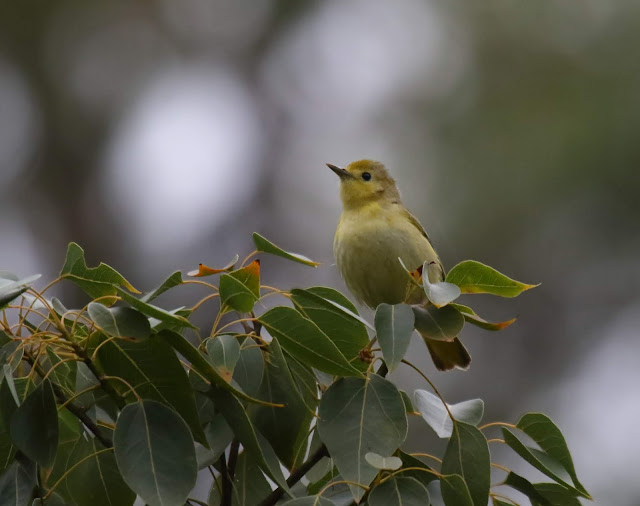
When the Yellow Warbler flies, or fans its tail as seen below, the very pale inner webs of the tail feathers give the impression of big white tail spots--a contrast lacking on the tails of Wilson's and Orange-crowned Warblers.
At first look, one could think a female Yellow Warbler is an Orange-crowned or female Wilson's Warbler. Indeed, that black eye and plain face matches female Wilson's, though female Wilson's often show a darker green crown mimicking the black cap of the male.

When the Yellow Warbler flies, or fans its tail as seen below, the very pale inner webs of the tail feathers give the impression of big white tail spots--a contrast lacking on the tails of Wilson's and Orange-crowned Warblers.
 |
| Yellow Warbler fanning tail showing the white interior webs. May 3, 2019. Escondido, California. |
Wednesday, April 10, 2019
Essay: 50 Years of Field Guide Changes--a personal perspective
I haven't quite yet been birding 50 years. But my first field guide, the one I bought in 1973, was Peterson's Field Guide to Western Birds, published in 1969 [a version of the 2nd edition of 1961]. Now that the calendar has reached 2019 I wanted to look back at some of the history. I don't want to review the field guides individually, so much as get a feel for the kinds of changes that have happened over the past 50 years. I want to review how birders responded as newer guides arrived. Or, at least, how I remember it.
First, let me describe my 1969 version of Peterson's work. It is sitting there on my shelf. I've thinned and weeded my bookshelf over the years. I now own far fewer bird books than I have in the past. So the fact it still remains says how much it is revered. The hard-cover is held on with various layers of duct tape, packing tape, and masking tape. Several pages in the introduction are loose. I had underlined field marks and voice for nearly each species. I added notations that were liberally crammed in the narrow margins. Name changes I dutifully updated through the 1980s. There may even be a spotted owl feather as a bookmark. The main point is this. This book was studied. This book was loved. It is the most prized book on my shelf. Why? It was my first.
The layout of that guide was this: 60 plates and 24 pages of line illustrations, scattered throughout the 366 pages. All the finches, sparrows, buntings, and grosbeaks took only 4 plates. All the herons, ibises, storks, and cranes were on a single plate. Oh, and it was black-and-white (well, really, gray-scale), as were about half the plates. Illustrations were schematic, patternistic rather than showing feather details that mark the style of today's bird books. There were no maps; the ranges were written out. Each account listed similar species, nests, and eggs--in a nod to a form of the hobby no longer deemed appropriate. The voice descriptions used English sound-alike words. That's still how I hear birds today--with Peterson's descriptions. 687 species were covered for this western version, plus 60 species in Hawaii.
How far have we come? There were only two Empidonax illustrations. One illustration showed a "Western Flycatcher." Another was for all the rest, labeled "Trail's Flycatcher," that supposedly illustrated the field marks of Willow, Dusky, Hammond's, and Gray Flycatchers. The text for Hammond's Flycatcher says, "It is a standing joke among western ornithologists that no one seems to have an infallible way of telling Hammond's and Dusky Flycatchers apart in the field (italics in original)."
There was one illustration for "Dowitcher." No illustrations for breeding, non-breeding, and juvenile. No illustrations for Long-billed versus Short-billed, or the several distinctive subspecies of the latter.
No wonder so many birds went by unidentified, or worse: misidentified. But this allowed me to do my own observations and research and put those field marks in the margins.
Actually, there was another field guide. It was first published in 1966: Birds of North America, the so called, "Golden Guide," after the publisher, Golden Press. Looking at the book now, it seems this work by Robbins, Brunn, Zim, and Singer, was really a landmark. It had color illustrations of every species in lifelike poses, male and female where they differed, summer and winter, and immatures. The illustrations also included just a hint of habitat. It had maps and text on the left hand page; on the right hand page were the bird illustrations--all together. And it showed all North American birds (north of Mexico), 700 species with more than 5 records since 1900. Oh, and sonograms, as well as word descriptions of the voice!
You would think, then, that birders of the time would have jumped at this new and more complete guide. And maybe they did. For some reason, though, the young birders of the 1970s that I knew disdained the Golden Guide in favor of the tradition of Peterson. At least, that's the way I remember it.
The Third Edition (1990) of Peterson's Western field guide had text and facing plates. Many of the illustrations were still from the 1961 edition, but at least they were shown larger. Maps were still at the end of the book. But it didn't matter. A new field guide had claimed the first spot in popularity. The Peterson field guides, once the bird field guide, became an also-ran.
The National Geographic Field Guide to the Birds of North America arrived in 1983. It updated regularly as names and checklist order changed and new species were added. This book always kept up with any new North American records, thus always had more species than any other. I've bought a new edition about every other printed edition to the now 7th Edition (2017) . The illustrations were especially uneven at first, the result of many different artists and styles. Later editions (starting with the 5th) benefited from the "feather detail" artistry and editing of Jonathan Alderfer (see American Woodcock illustration and compare with Sibley's). Paul Lehman's work on the maps in this guide have always been top-notch.
Bird field guides proliferated in the 1980s, continuing to today. But none could touch the "NatGeo" guide. That is, until the year 2000 when the Sibley Guide to Birds was published.
Sibley's illustrations, all done by him in the same style, are unifying. Even Peterson's artwork seems uneven by comparison. Sibley is excellent at getting the posture and the proportions correct. The Second Edition (2014) provides much more textual ID than the first. It's maps now match the quality, accuracy, and information content of those in the National Geographic guide. Sibley's Introduction is superior.
From the year 2000 until today, the "best" field guide is whichever of the National Geographic or Sibley guides is the most recent edition. What active birder wouldn't own them both?
But you know what? My Second Edition Sibley and my Seventh Edition National Geographic guides are pristine. Unmarked. They never leave my library--they come off the shelf to check a detail, then go right back. They are excellent field guides, far superior to my worn out, black-and-white, 1969 Peterson guide. They are my go-to references whenever I have an identification question. But unlike my Peterson's guide,... they are unloved.
First, let me describe my 1969 version of Peterson's work. It is sitting there on my shelf. I've thinned and weeded my bookshelf over the years. I now own far fewer bird books than I have in the past. So the fact it still remains says how much it is revered. The hard-cover is held on with various layers of duct tape, packing tape, and masking tape. Several pages in the introduction are loose. I had underlined field marks and voice for nearly each species. I added notations that were liberally crammed in the narrow margins. Name changes I dutifully updated through the 1980s. There may even be a spotted owl feather as a bookmark. The main point is this. This book was studied. This book was loved. It is the most prized book on my shelf. Why? It was my first.
 |
| One of these books is not like the others. |
How far have we come? There were only two Empidonax illustrations. One illustration showed a "Western Flycatcher." Another was for all the rest, labeled "Trail's Flycatcher," that supposedly illustrated the field marks of Willow, Dusky, Hammond's, and Gray Flycatchers. The text for Hammond's Flycatcher says, "It is a standing joke among western ornithologists that no one seems to have an infallible way of telling Hammond's and Dusky Flycatchers apart in the field (italics in original)."
There was one illustration for "Dowitcher." No illustrations for breeding, non-breeding, and juvenile. No illustrations for Long-billed versus Short-billed, or the several distinctive subspecies of the latter.
No wonder so many birds went by unidentified, or worse: misidentified. But this allowed me to do my own observations and research and put those field marks in the margins.
Actually, there was another field guide. It was first published in 1966: Birds of North America, the so called, "Golden Guide," after the publisher, Golden Press. Looking at the book now, it seems this work by Robbins, Brunn, Zim, and Singer, was really a landmark. It had color illustrations of every species in lifelike poses, male and female where they differed, summer and winter, and immatures. The illustrations also included just a hint of habitat. It had maps and text on the left hand page; on the right hand page were the bird illustrations--all together. And it showed all North American birds (north of Mexico), 700 species with more than 5 records since 1900. Oh, and sonograms, as well as word descriptions of the voice!
You would think, then, that birders of the time would have jumped at this new and more complete guide. And maybe they did. For some reason, though, the young birders of the 1970s that I knew disdained the Golden Guide in favor of the tradition of Peterson. At least, that's the way I remember it.
The Third Edition (1990) of Peterson's Western field guide had text and facing plates. Many of the illustrations were still from the 1961 edition, but at least they were shown larger. Maps were still at the end of the book. But it didn't matter. A new field guide had claimed the first spot in popularity. The Peterson field guides, once the bird field guide, became an also-ran.
The National Geographic Field Guide to the Birds of North America arrived in 1983. It updated regularly as names and checklist order changed and new species were added. This book always kept up with any new North American records, thus always had more species than any other. I've bought a new edition about every other printed edition to the now 7th Edition (2017) . The illustrations were especially uneven at first, the result of many different artists and styles. Later editions (starting with the 5th) benefited from the "feather detail" artistry and editing of Jonathan Alderfer (see American Woodcock illustration and compare with Sibley's). Paul Lehman's work on the maps in this guide have always been top-notch.
Bird field guides proliferated in the 1980s, continuing to today. But none could touch the "NatGeo" guide. That is, until the year 2000 when the Sibley Guide to Birds was published.
Sibley's illustrations, all done by him in the same style, are unifying. Even Peterson's artwork seems uneven by comparison. Sibley is excellent at getting the posture and the proportions correct. The Second Edition (2014) provides much more textual ID than the first. It's maps now match the quality, accuracy, and information content of those in the National Geographic guide. Sibley's Introduction is superior.
From the year 2000 until today, the "best" field guide is whichever of the National Geographic or Sibley guides is the most recent edition. What active birder wouldn't own them both?
But you know what? My Second Edition Sibley and my Seventh Edition National Geographic guides are pristine. Unmarked. They never leave my library--they come off the shelf to check a detail, then go right back. They are excellent field guides, far superior to my worn out, black-and-white, 1969 Peterson guide. They are my go-to references whenever I have an identification question. But unlike my Peterson's guide,... they are unloved.
Tuesday, April 9, 2019
Ruby-crowned Kinglet at Stonewall Mine
Kinglets are twitchy little birds. The first image caught the wing-flick that is a behavioral mark of this species. Beginners might mistake this species for Hammond's Flycatcher or Hutton's Vireo. The male Ruby-crowned Kinglet, though, sports that namesake crown streak when it is excited and raises its crown feathers. The tiny little toothpick legs with yellow feet are another supporting field mark, if you don't also notice the black bar under the white wing bars.
Ruby-crowned Kinglets breed in forests far to the north. They sing in migration, though. That's how I found this one. The loud song last 4 seconds, a high pitched whistled: tee-tee-tee, teer-teer-teer, continuing with an almost chickadee-like: tid-i-lee, tid-i-lee, and breaking up with some closing notes.

Ruby-crowned Kinglets breed in forests far to the north. They sing in migration, though. That's how I found this one. The loud song last 4 seconds, a high pitched whistled: tee-tee-tee, teer-teer-teer, continuing with an almost chickadee-like: tid-i-lee, tid-i-lee, and breaking up with some closing notes.

 |
| Ruby-crowned Kinglet. March 18, 2019. Stonewall Mine, California. |
Wednesday, March 27, 2019
Eurasian Wigeon in Borrego Springs
Eurasian Wigeon is a rare winter visitor with about 5-10 sightings per winter in the San Diego region.
A pair (presumably the same pair?) has wintered the past 3 years at the Roadrunner Golf & Country Club ponds in Borrego Springs. The male is easier to pick out. Females can appear similar to the female American Wigeon with their contrasting gray heads, or have brown heads matching the flanks. I have photos below.
Be aware that American and Eurasian Wigeon have frequent hybrids that show a combination of characters on the sides and flanks and head (though a small green eye patch doesn't necessarily indicate a hybrid on an otherwise solid Eurasian Wigeon).
More photos of Eurasian Wigeon in San Diego from eBird. Click on the photos to rate (1 awful, 2 poor but identifiable, 3 average or small, 4 very good, 5 magazine cover worthy). (Rating eBird photos: How and why.)
A pair (presumably the same pair?) has wintered the past 3 years at the Roadrunner Golf & Country Club ponds in Borrego Springs. The male is easier to pick out. Females can appear similar to the female American Wigeon with their contrasting gray heads, or have brown heads matching the flanks. I have photos below.
Be aware that American and Eurasian Wigeon have frequent hybrids that show a combination of characters on the sides and flanks and head (though a small green eye patch doesn't necessarily indicate a hybrid on an otherwise solid Eurasian Wigeon).
 |
| Male Eurasian Wigeon. Borrego Springs, California. February 18, 2019. |
 |
| Three males and a female American Wigeon. |
 |
| A female and male Eurasian Wigeon. |
 |
| Male Eurasian Wigeon |
 |
| Female Eurasian Wigeon with brown head matching sides. |
 |
| Female American Wigeon showing gray head and brown sides. |
 |
| Male Eurasian Wigeon |
Monday, March 25, 2019
Sage Sparrows in Borrego Springs
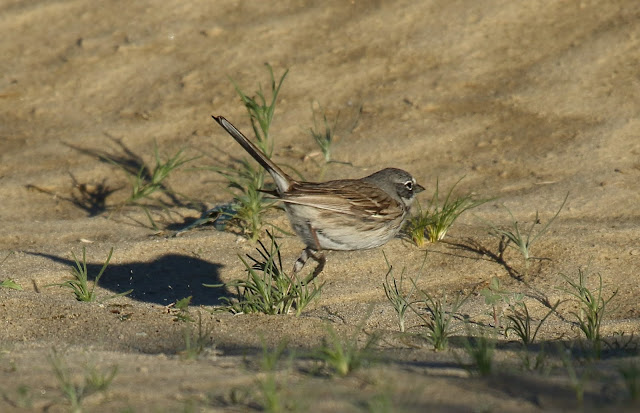
It has been several years since the Sage Sparrow was split into the Sagebrush Sparrow (Artemiseospiza nevadensis) and the Bell's Sparrow (Artemiseospiza belli). Yet experts still do not agree on how to tell apart the canescens race of Bell's Sparrow from the nominate Sagebrush Sparrow in the field where they winter together in southern California.
I detect differences in back streaking, darkness of the gray head, and width and blackness of the malar streak, as well as habitat preferences. Nevertheless, these differences could be due to sex, age, feather wear, or normal variation.
These birds I found in the saltbush and sand dunes in Borrego Springs. The streaked back, pale gray head, weak malar, all indicate to me that these are Sagebrush Sparrows. But they are not accepted as such in eBird. So, into the Sagebrush/Bell's "Sage" Sparrow bucket they go. Perhaps someday the identification criteria will be more exactly known. Until then, I'll keep on taking photos.



More photos of Sagebrush/Bell's Sparrows in San Diego from eBird. Click on the photos to rate (1 awful, 2 poor but identifiable, 3 average or small, 4 very good, 5 magazine cover worthy). (Rating eBird photos: How and why.)
I detect differences in back streaking, darkness of the gray head, and width and blackness of the malar streak, as well as habitat preferences. Nevertheless, these differences could be due to sex, age, feather wear, or normal variation.
These birds I found in the saltbush and sand dunes in Borrego Springs. The streaked back, pale gray head, weak malar, all indicate to me that these are Sagebrush Sparrows. But they are not accepted as such in eBird. So, into the Sagebrush/Bell's "Sage" Sparrow bucket they go. Perhaps someday the identification criteria will be more exactly known. Until then, I'll keep on taking photos.


 |
| Sage Sparrow. Borrego Springs, California. February 18, 2019. |
 |
| An early blooming Sand Verbena. Borrego Springs, California. February 18, 2019. |
Saturday, February 16, 2019
Rare Lesser Black-backed Gull at Coronado
The beach at the historic Hotel del Coronado was the picturesque site of a rare bird this winter. Ron and Shawn Miller of Wisconsin discovered a Lesser Black-backed Gull there on November 23, 2018.

The identification of this gull is straight-forward, but it will be unfamiliar to most West Coast birders. Large with a dark mantle it has a white eye and yellow legs. Western Gulls have pink legs and often pale grayish or brown eyes. California Gulls are slightly smaller but always have dark brown eyes.

The Miller's didn't identify it immediately; it was "discovered" a few days later, apparently after they posted photos of it on iNaturalist. Fortunately for local birders, the bird was settled in for the winter and will probably remain until early April.
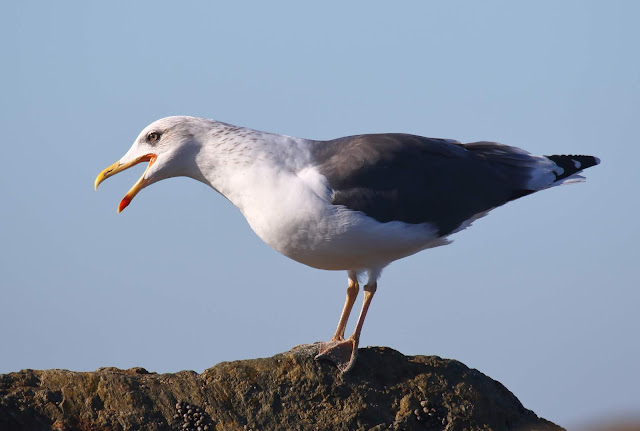
This species breeds on the Atlantic coasts of Europe. It winters south to West Africa. In the last third of the 20th century it underwent a range expansion. It now shows up regularly in eastern North America (southern Atlantic Canada and Great Lakes southward through the Mississippi River Valley), but especially right on the Atlantic coast.
It is more or less annual in San Diego county, now. It wasn't reported in 2010 or 2013, but has averaged about 3 birds per winter since then.
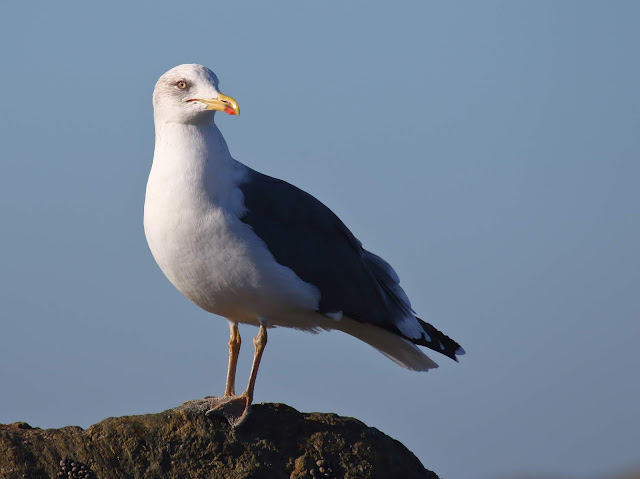
Being the big chaser of rarities that I am (NOT), I didn't make plans to go see it until it had been present over a month. But as you can see, my sloth mattered not. I'm an unenthusiastic chaser, even though I love to find rare birds on my own. Yes, even this life bird.
Photos of this and other Lesser Black-backed Gulls in San Diego on eBird. Click on the photos to rate (1 awful, 2 poor but identifiable, 3 average or small, 4 very good, 5 magazine cover worthy).
 |
| Lesser Black-backed Gull. Coronado, California. December 30, 2018. Greg Gillson. |

The identification of this gull is straight-forward, but it will be unfamiliar to most West Coast birders. Large with a dark mantle it has a white eye and yellow legs. Western Gulls have pink legs and often pale grayish or brown eyes. California Gulls are slightly smaller but always have dark brown eyes.

The Miller's didn't identify it immediately; it was "discovered" a few days later, apparently after they posted photos of it on iNaturalist. Fortunately for local birders, the bird was settled in for the winter and will probably remain until early April.

This species breeds on the Atlantic coasts of Europe. It winters south to West Africa. In the last third of the 20th century it underwent a range expansion. It now shows up regularly in eastern North America (southern Atlantic Canada and Great Lakes southward through the Mississippi River Valley), but especially right on the Atlantic coast.
It is more or less annual in San Diego county, now. It wasn't reported in 2010 or 2013, but has averaged about 3 birds per winter since then.

Being the big chaser of rarities that I am (NOT), I didn't make plans to go see it until it had been present over a month. But as you can see, my sloth mattered not. I'm an unenthusiastic chaser, even though I love to find rare birds on my own. Yes, even this life bird.
 |
View of Point Loma and the mouth of San Diego Bay from Coronado.
The Lesser Black-backed Gull is on the rocks dead center of the photo,
while a Heermann's Gull and Brown Pelican fly past.
|
Thursday, November 22, 2018
American Robins in Julian
Without looking, describe the field marks of the head of an American Robin. This species is a common backyard bird throughout most of North America. But how well do you really know it?
What if a Rufous-backed Robin or Clay-colored Thrush showed up from Mexico? Would you immediately recognize an Asian stray such as Eyebrowed Thrush or Dusky Thrush? Would you pass off a European Redwing as just a juvenile American Robin?
Do you remember the shape of the eye ring? Bill color? Throat? Back color? Under tail coverts?
This is a reminder to really study the plumage, calls, and behaviors of common backyard birds. Then, when something rare shows up, you'll be prepared to recognize it and describe it so others can understand what you've seen.
What did you see?
An American Robin.
No, that's what you concluded. What did you see?


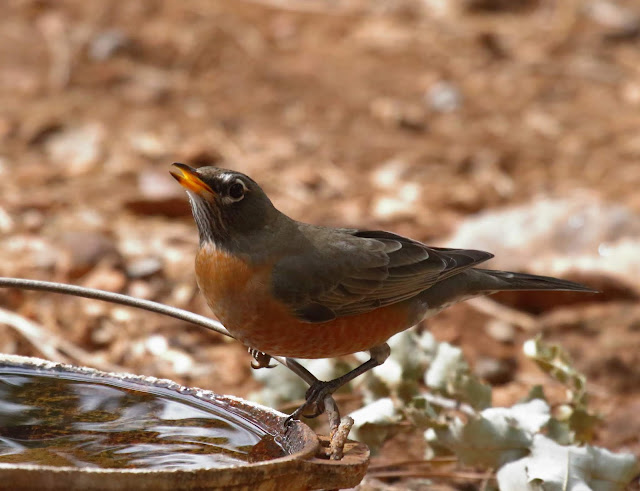

In San Diego County American Robins are patchily distributed. According to the San Diego Bird Atlas this bird started breeding regularly only in the 1940s. They breed in three habitats: mountains, orchards (avocado and citrus), and urban parks with shade trees and lawns (college campuses, etc.). They winter more widely, but are scarce some winters, abundant others.
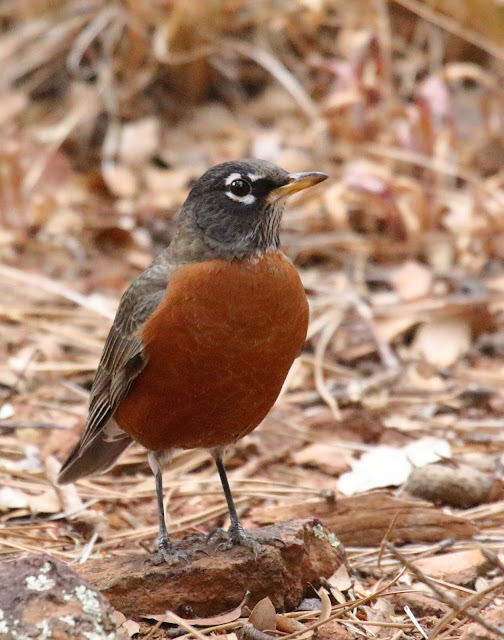


What if a Rufous-backed Robin or Clay-colored Thrush showed up from Mexico? Would you immediately recognize an Asian stray such as Eyebrowed Thrush or Dusky Thrush? Would you pass off a European Redwing as just a juvenile American Robin?
Do you remember the shape of the eye ring? Bill color? Throat? Back color? Under tail coverts?
This is a reminder to really study the plumage, calls, and behaviors of common backyard birds. Then, when something rare shows up, you'll be prepared to recognize it and describe it so others can understand what you've seen.
What did you see?
An American Robin.
No, that's what you concluded. What did you see?


In San Diego County American Robins are patchily distributed. According to the San Diego Bird Atlas this bird started breeding regularly only in the 1940s. They breed in three habitats: mountains, orchards (avocado and citrus), and urban parks with shade trees and lawns (college campuses, etc.). They winter more widely, but are scarce some winters, abundant others.


Sunday, November 18, 2018
ID: Oregon and Slate-colored forms of Dark-eyed Juncos at Lake Cuyamaca
I spotted an obvious male Slate-colored Junco at Lake Cuyamaca on November 5th. It was feeding on some grain thrown on the ground at the bait shop. I have never really explored that part of Lake Cuyamaca as the $10 day use fee seemed more than I wanted to pay for a visit that would only last an hour-and-a-half. But, guess what? It seems somehow I am old enough to earn something called a "senior discount." I'm only worth $5 now.
I followed around a flock of Dark-eyed Juncos down by the shoreline hoping for Gray-headed, Pink-sided, or Cassiar juncos. But I didn't find any of those forms of Dark-eyed Juncos. The Oregon form is the common one here, but so pale compared to the dark rusty-brown ones I grew up with in Oregon. The sides, especially, are so pale and restricted compared to those northern birds. Here, let me show you from previous posts to my blogs:
Gray-headed, Slate-colored, and Oregon juncos in December 2016 in San Diego here.
Cassiar juncos in March and April 2011 in Oregon here.
Oregon junco in November 2007 in Oregon here.
So here are photos from Lake Cuyamaca.
First is a series of male Oregon juncos that match the resident form, thurberi, that is paler on sides and not as dark rusty brown on back as more northern races.
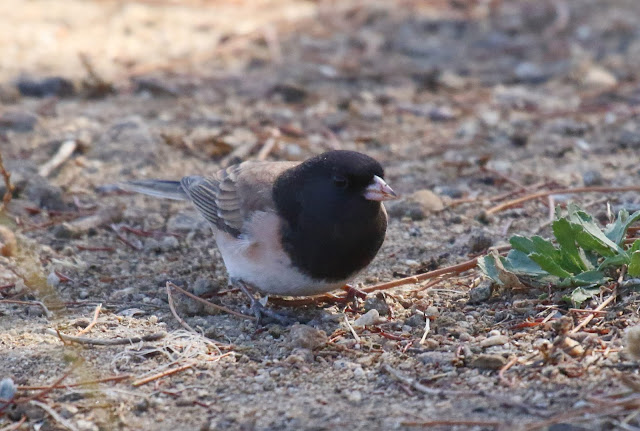


Here, then is a female Oregon Junco. It matches the male except the head is pale gray. Note the sides are pinkish-buff.

Next is the male Slate-colored Junco with dark slate sides. There is no contrast between the hood and back or sides (a mark that would indicate Cassiar Junco).


Finally is this pale female Slate-colored Junco. There is no sharp contrast between the head and back, so not Cassiar Junco. The sides are gray, so not Oregon or Pink-sided Junco. And the back is not bright rusty, so not Gray-headed Junco. Oh, and no white wing bars, so not a White-winged Junco.
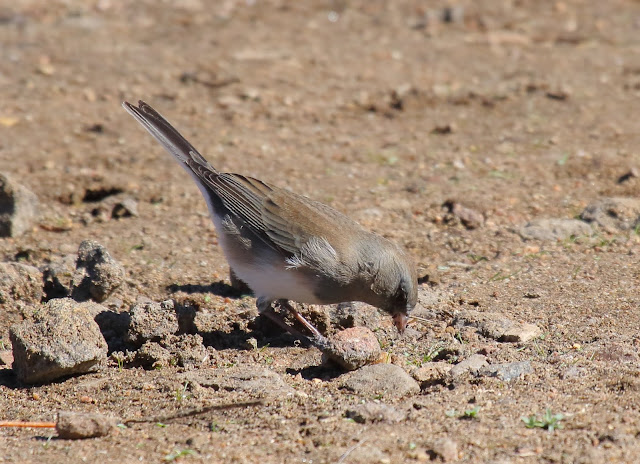

I followed around a flock of Dark-eyed Juncos down by the shoreline hoping for Gray-headed, Pink-sided, or Cassiar juncos. But I didn't find any of those forms of Dark-eyed Juncos. The Oregon form is the common one here, but so pale compared to the dark rusty-brown ones I grew up with in Oregon. The sides, especially, are so pale and restricted compared to those northern birds. Here, let me show you from previous posts to my blogs:
Gray-headed, Slate-colored, and Oregon juncos in December 2016 in San Diego here.
Cassiar juncos in March and April 2011 in Oregon here.
Oregon junco in November 2007 in Oregon here.
So here are photos from Lake Cuyamaca.
First is a series of male Oregon juncos that match the resident form, thurberi, that is paler on sides and not as dark rusty brown on back as more northern races.


Here, then is a female Oregon Junco. It matches the male except the head is pale gray. Note the sides are pinkish-buff.

Next is the male Slate-colored Junco with dark slate sides. There is no contrast between the hood and back or sides (a mark that would indicate Cassiar Junco).


Finally is this pale female Slate-colored Junco. There is no sharp contrast between the head and back, so not Cassiar Junco. The sides are gray, so not Oregon or Pink-sided Junco. And the back is not bright rusty, so not Gray-headed Junco. Oh, and no white wing bars, so not a White-winged Junco.


Subscribe to:
Posts (Atom)