Showing posts with label birds. Show all posts

Friday, July 19, 2019

A family of White-tailed Kites at San Elijo Lagoon

While visiting Stonebridge Trail upstream from San Elijo Lagoon, I came across a tree with 5 juvenile kites! I photographed two that were out in the open a bit more.

It was an overcast morning so I increased the exposure compensation 1 full step, even though I was using spot metering.

Juvenile White-tailed Kite
Juvenile White-tailed Kite. San Elijo Lagoon, California. June 14, 2019. Greg Gillson.

Tuesday, July 16, 2019

California Quail at San Elijo Lagoon

Here's a recent photo. Well, it's a month old now, I guess. What can I say, I've been busy.

California Quail
California Quail
California Quail. San Elijo Lagoon, California. June 14, 2009. Greg Gillson.

Saturday, July 6, 2019

Black-footed Albatross off San Diego

After 9 hours our pelagic trip was nearly over, and we were heading back toward port. We were still about 15 miles offshore, though, when the call of "Albatross!" went up. And there it was: far behind the boat but closing on our stern.

We were still trailing some popcorn and had a flock of gulls behind the boat. The albatross must have thought we had something good to eat. Well, albatrosses like popcorn just fine, though they'd probably rather have their favorite food--squid!

Albatrosses are fairly rare off San Diego. Trips in April, May, and June frequently will record one. They are sometimes found in August, but generally not later.

Black-footed Albatross
Black-footed Albatross. Off San Diego. June 9, 2019.


Thursday, July 4, 2019

Scripps's Murrelets off San Diego

Birds on the water!

Two dark dots, sitting on the water ahead: murrelets!

Murrelets are "always" in pairs. They swim together, dive together, fly together. A singleton is rare. Three together is also quite unusual.

Now will they stay there long enough for the boat to approach more closely? If not, then they may get away unidentified further.

We are 15 miles offshore from San Diego, following the Mexican border westward. The water has been getting gradually deeper as we progress, but then became quite shallow again as we crossed over the south end of the Nine Mile Bank. Birds increased as the underwater hill forced bottom currents to the surface, carrying nutrients toward the surface that fish feed upon. Birds followed.

Thursday, June 20, 2019

Black Skimmer at the San Diego River mouth

Black Skimmer
Black Skimmer. Mission Beach, California. June 1, 2019.
A flock of about a dozen Black Skimmers were feeding in the San Diego River mouth on June 1st, where I was able to get these flight shots.

To fly low and plow the shallow, calm waters with their knife-like bills, skimmers flap from horizontal to highly vertical, not below the horizontal in this feeding flight. The flock feeding flight appears choreographed and synchronized at times (upper photo). At other times flocks appear uncoordinated and chaotic (photos below).

Black Skimmer

Black Skimmer

Black Skimmer

Monday, June 17, 2019

Feral Pigeon

While searching for the rare Hudsonian Godwit at the San Diego River mouth, I photographed this common bird.

In January 2014 eBird changed the way these pigeons are reported. All populations in North and South America and Australia derived from feral stock. Thus, in eBird these are entered on your checklist as "Rock Pigeon (Feral Pigeon)."

These doves in their native lands--and if showing the wild phenotype will be entered into eBird as Rock Dove (Wild Type). The native range is North Africa, the Middle East, southern Europe, and parts of southern Asia. The full announcement form 2014 is here.

Rock Pigeon
Rock (Feral) Pigeon. Ocean Beach, California. June 1, 2019.

Wednesday, June 12, 2019

Wilson's Warbler in Borrego Springs

Here's a pretty little Wilson's Warbler recently photographed in a mesquite tree.

Wilson's Warbler
Wilson's Warbler. Borrego Springs, California. May 27, 2019.

Sunday, June 9, 2019

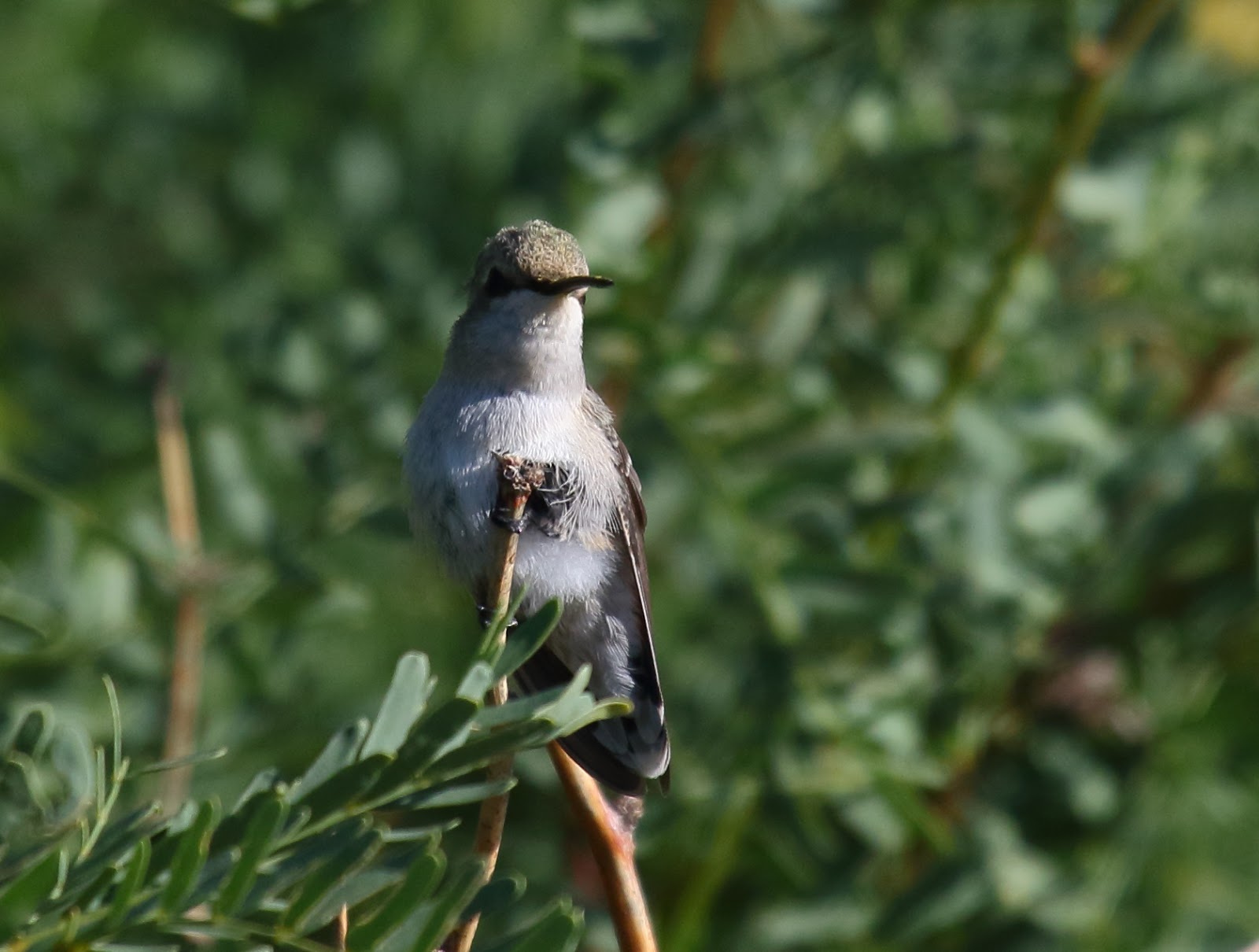
Costa's Hummingbirds in Borrego Springs

Here are some Costa's Hummingbirds I photographed in Borrego Springs, May 25-27, 2019. Most seem to be young birds. Where are the adults?

Costa's Hummingbird
Costa's Hummingbird
Costa's Hummingbird
Costa's Hummingbird
Costa's Hummingbird
Costa's Hummingbird. Borrego Springs, California. May 27, 2019.

Saturday, June 8, 2019

Female Hooded Oriole in Borrego Springs

Female orioles aren't nearly as easy to identify as males.

One of these days I'm going to find a rare Orchard Oriole. The females and immatures look very like the common Hooded Orioles. But this is spring, not fall and winter. So an olive above, yellow below, female oriole is most-likely a Hooded Oriole. Unless it's a Scott's Oriole, which is more lemony yellow throughout.

In the mean time, I'll try grabbing a shot of any oriole I see. Even of the one I happen to photograph isn't rare, orioles are wonderfully colorful!

Female Hooded Oriole
Hooded Oriole. Borrego Springs, California. May 26, 2019.
Female Hooded Oriole

Friday, June 7, 2019

Pacific-slope Flycatchers in Borrego Springs

Pacific-slope Flycatchers are perhaps the "easiest" of the Empidonax to identify in western North America. Or, at least they were,... back when they were named Western Flycatchers. Then they got split into Pacific-slope and Cordilleran Flycatchers, which are identical in plumage, but the male's position note is supposedly different.

Let's try again...

Pacific-slope Flycatchers are perhaps the "easiest" of the Empidonax to identify in most of California and western Oregon, western Washington, and SW British Columbia. If you live from Arizona to Idaho, then forget it.

This is not how I wanted this post to go. One more time...

Western Flycatchers are perhaps the "easiest" of the Empidonax to identify in western North America. Better? No?

Oh, forget this....

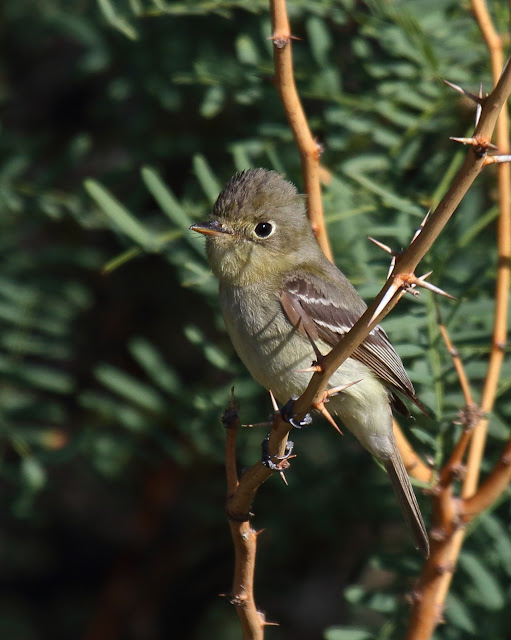
Pacific-slope Flycatchers are hard to identify--as are all Empidonax flycatchers. They are small, greenish, and with generally white eye rings and wing bars. Identification in the field depends upon excellent looks at subtle field marks. Museum specimens are easier if you accurately measure wing, tail, and bill. On the breeding grounds the songs are distinctive.

The yellow throat and the large teardrop-shaped eye ring separates "Western Flycatchers" (Pacific-slope and Cordilleran) from other Empids in the West (Hammond's, Dusky, Willow, Gray, Least). In the East, you have  the similar Yellow-bellied and others to confuse you. There are about 15 species of Empids from Canada all the way to Costa Rica for your viewing pleasure (or frustration).

I came across a bunch of these in migration last month in Borrego Springs. The mountains, separating the coastal slope of San Diego County from the harsh desert to the east, had blocked a storm front coming in from the west. Migrants flying at night encountered strong headwinds and potential rain and dropped to the ground to find protection. They found the dry Anza-Borrego desert and oh, what's that? A bit of green mesquite surrounding the Borrego Springs waste treatment ponds.

It was very windy, so these tired travelers sought refuge on the lee side of the mesquite clumps and found some flying insects near the ground to feed upon for breakfast.

I spent quite a bit of time photographing these and Willow Flycatchers.
Pacific-slope Flycatcher

Pacific-slope Flycatcher

Pacific-slope Flycatcher

Pacific-slope Flycatcher
Pacific-slope Flycatcher. Borrego Springs, California. May 25, 2019.
Pacific-slope Flycatcher

Pacific-slope Flycatcher

Pacific-slope Flycatcher

Pacific-slope Flycatcher

Pacific-slope Flycatcher

Pacific-slope Flycatcher

Thursday, June 6, 2019

California Quail in Borrego Springs

Here are two pictures of California Quail for you today. I've discussed before that the Anza-Borrego Desert is one of only a few areas where California and Gambel's Quail overlap and hybridize. Do you remember how to separate pure birds from hybrids? (Hint: crown, forehead, chest, breast, belly)

California Quail. Borrego Springs, California. May 25, 2019.

Wednesday, June 5, 2019

Ash-throated Flycatchers in Borrego Springs

I find Ash-throated Flycatchers difficult to photograph or, at least, to get an uncluttered close-up photo. Last week I was able to get several photos, but there are the usual scraggly branches where this bird seems to love to hang out. The trees in these photos are all mesquite, typical of American SW deserts.

Ash-throated Flycatcher
Ash-throated Flycatcher. Borrego Springs, California. May 25, 2019.
Ash-throated Flycatcher

Ash-throated Flycatcher

Ash-throated Flycatcher

Tuesday, June 4, 2019

Willow Flycatchers galore!

Wind is the bane of desert birding. You arrive at dawn only to find the winds howling. It is the tail end of migration anyway, so migrants are thin to begin with. But I persevered. In each mesquite clump I found flycatchers nearly on the ground on the lee side of the trees, hungrily consuming flying insects after their all-night flight.

The most common small flycatcher present this day was Willow Flycatcher. I estimated there were 7, but there could easily have been more. I found only 2 the next day. One of the notoriously difficult to identify Empidonax flycatchers, this Empid has these ID marks: Short primary projection past the secondaries, eye ring almost lacking, all-yellow under mandible, brownish-olive plumage, white throat. A liquid "whit!" call and an occasional sneezy "fitz-bew!" song, helped confirm. Not all birds sing in migration, many wait until they are on the breeding grounds. So having an aural confirmation of identity is always nice for this look-a-like group.

Willow Flycatcher
Willow Flycatcher. Borrego Springs waste treatment ponds, California. May 26, 2019.


Sunday, June 2, 2019

Blue skies and White-winged Doves in Borrego Springs

White-winged Dove
White-winged Dove. Borrego Springs, California. May 25, 2019. Blue skies!
It's been a wet spring. It's not unusual, of course, for San Diego to start the morning out with a marine layer that burns off by mid-morning. But we've had 6 months, now, of dreary, cool, drizzly, often unforecasted rainy weather. Everyone consoles themselves by saying "we need the rain." [I know, I know. I'm complaining about winter weather that often breaks 70 degrees by noon. But I need my sun!]

Even today, June 2nd, the skies are gray. "June gloom." There's a 25 % chance of precipitation in the forecast, with a high of 73F predicted. This morning the streets are wet and water drips off the plants and eaves. There's a slight mist in the air; I'm sure it's not even "measurable precipitation." But I didn't wake to my preferred sunny skies. Yes, I'm spoiled. I prefer 80, or more.

Last weekend Marlene and I got sick of it and headed over the mountains to enjoy the desert for the third time this year (4th for me). It wasn't as warm as predicted, just the low to mid-70's, but the skies were sunny. We rented our favorite inexpensive, no-frills, motel, and spent a relaxing 3-day weekend in the sun, while it poured at home on the west side of the mountains. Now, remember, the average high temperature in Borrego Springs this time of year is in the mid to high 90s, and we normally wouldn't visit again until it cooled in the fall. But that's the weather the past 6 months.

The last week of May is the tail end of spring migration and I was able to see some late migrants and take many photos of White-winged Doves, ostensibly the real reason for this post.

Some photos at the Roadrunner Club on May 25:

White-winged Dove

White-winged Dove

White-winged Dove

I found some doves in the mesquite on May 26. They weren't wary like most of the "wild" doves out in the desert (as apposed to the residential doves, above). They lack colorful eye skin and markings and may be young birds.

White-winged Dove

White-winged Dove

White-winged Dove