I attended the May 12, 2019 12-hour pelagic trip (
web site here) of the Buena Vista Audubon Society. The trip enjoyed calm seas and had typical birds for spring (no rarities) and a couple of bonus marine mammal encounters.
Skies were cloudy, so most photographs are rather gray. Oh, wait! Most seabirds are gray or black-and-white anyway.
 |
| Calm seas and mostly overcast skies greeted us at the Point Loma Marina. |
This is perhaps the best time of year from San Diego to see rare Black-footed Albatrosses. There were none. We got skunked on jaegers of any kind. This spring trip is the best all year for Scripps's Murrelet. This trip did not disappoint.
But I'm getting ahead of myself. Here is the trip report as it happened.
Before the trip left the dock, Royal, Caspian, and Elegant Terns flew over the marina with their raspy calls. Snowy Egrets and Black-crowned Night-Herons were perched on several of the boats. Western Gulls pestered them. It was a bit dark for photos.
 |
| Double-crested Cormorant |
 |
| Caspian Tern |
 |
| Elegant Terns |
Not much of note in the bay. We made our way offshore. First we head south, straight out of San Diego Bay, until we near the border with Mexico. Then we turn westward, staying in US waters.
An hour and a half into our trip, and about 12 miles offshore on Nine Mile Bank, we found one of our target species: Scripps's Murrelet. In another month or two the Scripps's Murrelets will have moved offshore or northward, and we'd expect Craveri's Murrelets for the rest of summer and fall.
A Brown Booby winged by, our first of only two for the day--a low number now, of a species expected every trip, that would have been very rare only 10 years ago.
We had hundreds of dolphins all day. All the ones we identified were Common Dolphins, yet my first photos clearly show a pod of Bottlenose Dolphins.
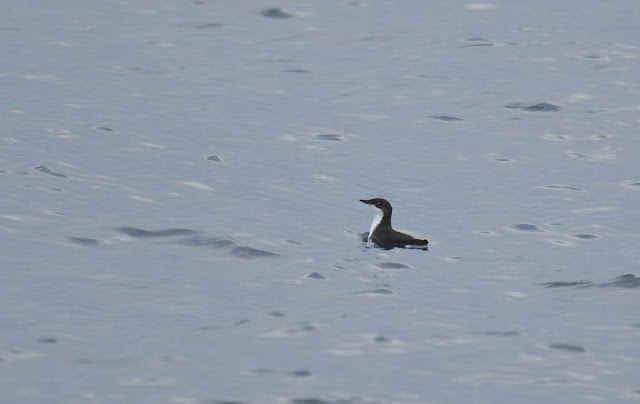 |
| Scripps's Murrelet |
 |
| Off they fly. The white underwing linings mark these as Scripps's Murrelets. |
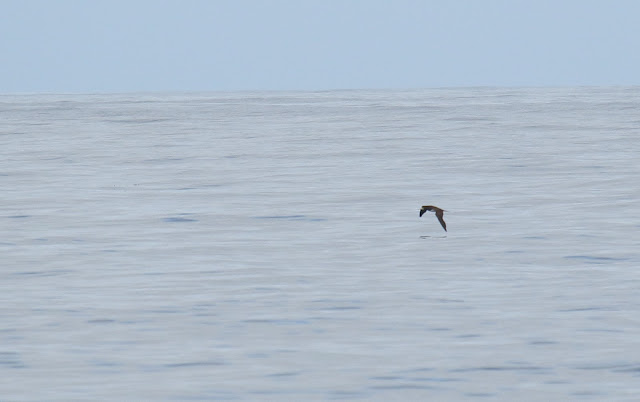 |
The Brown Booby didn't approach closely.
The smooth seas made spotting distant birds easy; identifying them was another challenge. |
 |
| Bottlenose Dolphins |
Crossing over the south end of the Nine Mile Bank we motored westward in the deeper waters over the San Diego Trough. We added more species, but bird numbers dropped once we left the Nine Mile Bank.
Phalaropes are little shorebirds that nest on the Arctic tundra. But during migration and in winter they live at sea, unlike any other sandpiper or wader. Well, Wilson's Phalaropes remain land-bound, but the Red and the Red-necked Phalaropes go to sea. The only phalaropes seen this day were Red-necked. We had a good number of Sooty Shearwaters during the trip, also Pink-footed Shearwaters. We saw only a few Black-vented Shearwaters close to shore--they are more of a fall and winter visitor.
Off at the horizon we would occasionally see flocks or small groups of Cassin's Auklets. Neckless slow-flying dark flying potatoes with popsicle-stick whirring propellers of wings, they stayed maddeningly distant. Only previous experience aided identification; no additional field marks were visible with binoculars or camera, except maybe an indication of pale belly.
 |
| A spot of color! Female Red-necked Phalaropes are more brightly-colored than the males. |
 |
Sooty Shearwaters breed December to March in the southern hemisphere.
Thus they molt their flight feathers now, in their non-breeding season.
You can see the chunk of missing inner primaries.
|
 |
| Only previous experience identify these distant birds as Cassin's Auklets. |
The prized bird of the day for me was a Pigeon Guillemot. This bird breeds out on the islands, and all the way to Alaska, but is locally rare. This was my first for San Diego County. This bird flew right in front of the bow when I already had my camera up photographing shearwaters, so I was able to take a usable photo!
 |
| Pigeon Guillemot flying across the bow. Red feet! |
It was now about 10:30 am, and we were coming up on the south end of the Thirty Mile Bank escarpment. There are two underwater features here. One is the 182 Spot. From 500 fathoms (3000 feet of water) a needle-like spire rises to 182 fathoms (1092 feet deep). A mile away is a flat-topped peak rising to 183 fathoms, but this one is right on the edge of the 1100 fathom depth (6600 feet deep) of the San Diego Trough. This one must look like Devil's Tower rising up, but one side is 1100 fathoms and the other is 500 fathoms, right on the edge of the escarpment! Can you imagine a half mile tall cliff wall extending 30 miles, with this giant tower almost rising another quarter mile above it? That would be quite the sight!
These rugged underwater features disrupt underwater currents, bringing the nutrients from the bottom up to the surface. The 182 spot is
known in fishing circles for marlin, yellowtail, yellowfin tuna, and dorado, especially from July to September. It is also the location of many rare bird sightings--and just a general increase in numbers of the usual birds, too. So we circled around over the top of these sunken mountains for some time. But no rare birds showed up.
But it was at this point that we started seeing swallow-like seabirds called storm-petrels in every direction. Most were the common Black Storm-Petrels, but we also picked out Ashy Storm-Petrels and a few of the Chapman's form of Leach's Storm-Petrels. Most populations of Leach's Storm-Petrels in the North Pacific have white rumps. But Chapman's has the white very restricted, or even missing.
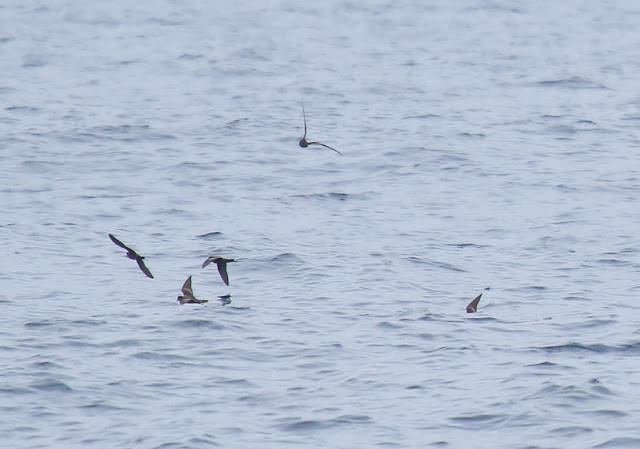 |
Ashy Storm-Petrels. Can you see the paler underwing and longer tail compared to other storm-petrels not in this photo?
No? Storm-petrels are hard.
|
Storm-Petrels are small. Storm-Petrels are mostly dark with subtle field marks, wing shape, and flight style differences. Storm-Petrels fly erratically. Storm-Petrels are afraid of gulls. Storm-Petrels are afraid of the boat. Storm-Petrels are frustratingly hard to get near and to get good looks at. Remember the Cassin's Auklets? Yeah. Take lots of photos and maybe one or two will show something diagnostic.
During the day we picked up a couple wayward Wilson's Warblers. They migrate at night and found themselves out over the sea at dawn. These tired waifs flew to the boat seeking rest. The birds rested up for a bit in the wheelhouse. Then they flew out toward shore. But not far. I photographed this one catching a mothlike flying creature. It was its last meal. The warbler was immediately swallowed by a gull. Sad.
 |
| A Wilson's Warbler catches its last meal. |
We followed the edge of the Thirty Mile Bank northward until it was time to turn around. Then we cut eastward across the north end of the San Diego Trough for an hour until we reached the north end of the Nine Mile Bank. Then we followed it back southward. Birds picked up once we got back on top of the shallower Nine Mile Bank. And it almost got sunny! (I've got the peeling face to prove it!)
 |
| Common Loon |
 |
| Scripps's Murrelets |
 |
| Western Gull |
 |
| Pink-footed Shearwater |
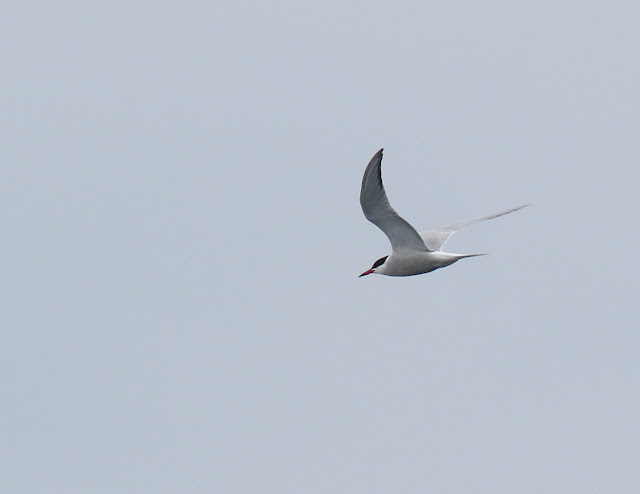 |
| Common Tern |
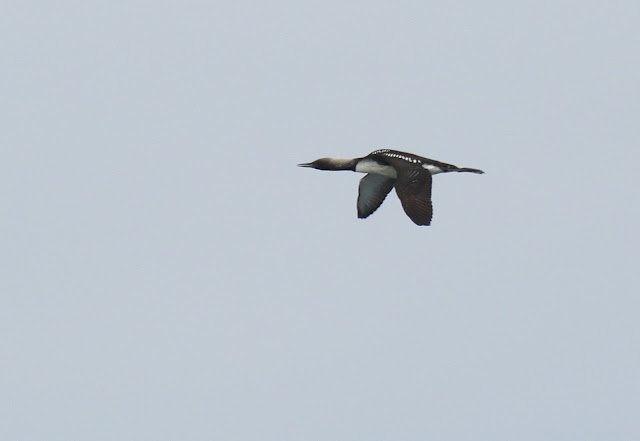 |
| Pacific Loon |
It was 3:30 pm. We had reached the south end of the Nine Mile Bank, where we had been about 7 hours earlier. A couple of blows led us to two Fin Whales! Later we spotted two Blue Whales. I'll have some more photos in a separate post.
 |
| Fin Whale |
 |
| Elegant Tern |
 |
| Brown Booby |
We now headed the remaining 12 miles back to San Diego Bay. The sun was low. Heavy cloud cover had returned. It was starting to cool off. We finally spotted a few Black-vented Shearwaters. They are abundant near shore in fall and winter, but most of the population is now at the breeding colony on Natividad Island, Baja California Sur, about 350 miles to the south in Mexico.
A Townsend's Warbler flew up to the boat but did not land. It took off for shore. I don't know if it made it or not. It really wasn't that far away, but there were a lot of gulls between him and the nearest shrubbery.
 |
| Red-necked Phalaropes |
 |
| Which is bigger, a Brown Pelican or a Red-necked Phalarope? Photo comparison. |
 |
| Black-vented Shearwater |
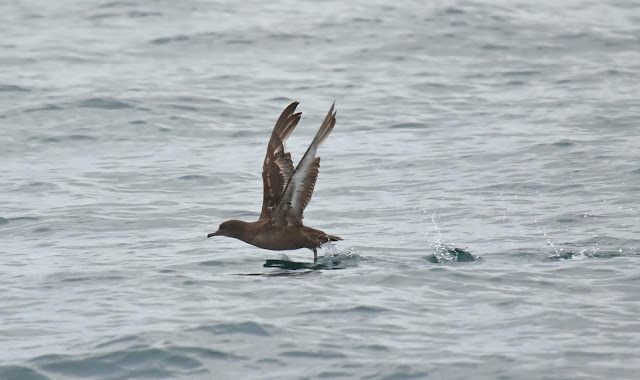 |
| Sooty Shearwater |
 |
| Finally! A close bird: Brown Pelican |
 |
| San Diego skyline from San Diego Bay |
 |
| Sea lion yoga. |
And we're back to the dock and unloading and driving home. A long day.


