Showing posts with label photography. Show all posts

Sunday, February 17, 2019

Fieldcraft: How to use and improve eBird Media Search bird photos

You may have noticed when I present some of my recent bird photos that I provide a link to eBird photos. You may just enjoy looking at bird photos, but these photos can help you improve as a birder. I also encourage rating those photos. Here is the why and how.

Why use eBird Media Search Tool?

eBird Media Search is an indispensable tool to help learn what local birds look like. What do I mean--what's wrong with a field guide?

The immediate example that comes to mind is a rare seabird to the West Coast of North America--Short-tailed Albatross. If you look at Sibley or the National Geographic guide, what do you see? In the recent versions (Editions 2 and 7, respectively), 5 or more illustrations of a giant white-and-black bird with golden head and big white wing patches (in older field guide versions only 1-2 illustrations of the adult, or just the head). However, the only place in North America you are likely to see this bird with any white on it at all is the Aleutians on special birding cruises. Only juvenile and birds less than 2 years old are found south of Alaska--all dark chocolatey brown. Take a look at the eBird photos from Oregon: here.

For a more recent example, there was a Chestnut-sided Warbler reported wintering not far from my home. What does it look like? Well, it happens to be a first-year female. It doesn't even have chestnut sides! But it does have a nice lime green crown and white eye ring. I knew exactly what to look for (now and in the future). See photos here.

Choose your location (or intended location, if planning a trip) and choose the month you will be there. See what the birds looks like at that time of year! If it is far away, you may not even recognize the common local Song Sparrows from that region!

How do you view the Media Search Tool?

Start at the eBird home page (www.ebird.org). Choose the Explore tab. Scroll down to the Search Photos and Sound link. This brings you to the eBird Media catalog of Macaulay Library. Ooh, 10 million bird photos... and growing!

We need to filter this.

1) First limit the location, say, to a county, perhaps San Diego, California (United States). You can limit it to as small as an eBird Hotspot or as large as the world.
2) Change the View Results icons from Gallery (default) to Grid. Now you can see the 5-star rating of each photo and other details.
3) Reorder the photos. There is a filter for Recently Uploaded (default), Best Quality, Least Rated, oldest, and newest. These reorder the photos in useful ways that I'll explain in a moment.

The world's highest rated photos in eBird.
The world's highest rated photos in eBird. They're nice, but are they really the best? Over 200 ratings!

What do the Photo Ratings mean?

There is a 5-star rating system for the photos. eBird has a help file, but I tend to remember it this way:
1) Awful. There's a bird in that photo?
2) Poor photo (tiny, out-of-focus, more than half hidden)
3) Average point-and-shoot type photo, small in frame, slightly out-of-focus or partially hidden in foliage.
4) Very good, but not perfect. Often the bird is large and sharp, perhaps blocked by a small stick or cast with a harsh shadow, or the background is distracting.
5) Magazine cover quality. Sharply focused. Eye level. Frame-filling. Looking at the camera. No distracting shadows. Pleasantly blurred or non-distracting background.

Most of the photos in eBird are 3s and 4s. The only time anyone should put in a 1 is for documentation of a rare species. Okay, eBird tracks your photo list as it does your sightings list. Some people may enter a 2 for their first photo of a species, but shouldn't put in bunches of 1s and 2s. But that's my opinion, not an eBird rule. Photographers always try for a 5, but that quality rarely happens without planning your photoshoot in advance.

How are the Photo Ratings used?

eBird uses the better-rated photos in illustrated checklists at a local, county, country, or world level. And you can sort the photos by "best rated" first for your general viewing pleasure.

Sample eBird Illustrated Checklist at Buddy Todd Park, Oceanside, California.
Sample eBird Illustrated Checklist at Buddy Todd Park, Oceanside, California. More photos needed!

What happens in practice?

1) No rating.
2) "Improper" rating.

Some photographers do not rate (any or some of) their personal photos. Or they may not rate their poorer photos. Others might tend to rate poorer photos as better than they are, especially if the bird is rare or charismatic and colorful.

So, then, one of two things happens. A great photo is not shown because no one rated it. A poorer photo is shown as "Best" when it clearly is not, and then is served up by eBird in illustrated checklists instead of an actually better photo. These are not important in the big scheme of things, I know. But I really like eBird and want it to be the best it can be.

How can you improve the eBird Photo Rating?

The more people that rate a photo, the better the result. Here's what I do when looking at eBird photos in media search.
1) I reorder the photos to "Best Quality." Then I rate the first dozen or so that may already be marked as 5 stars, asking: "Is this magazine cover quality?" If not, I give a lower rating, as appropriate, so the best rise to the top.
2) I reorder the photos to "Least Rated." Many of these aren't rated at all. I may "pick and choose" looking for treasures--a top photo with no ratings yet. That starts them up the listing to where they deserve. But it is important that all photos in eBird are rated because they are really in the Macaulay Library--like a museum collection of photographs. Who knows where they may be displayed someday.

Note: You may also come across a misidentified photo. You can report those in the Media Search tool. I just found a good photo of Townsend's Solitaire accidentally added as a Townsend's Warbler--an easy mistake to make! So that's another way you can improve the data... catch mistakes.

Sunday, February 3, 2019

On the web: Tim Boyer Photography: Basic Video for Bird Photography

Tim at Tim Boyer Photography has just completed a 3-part tutorial on his YouTube channel: Basic Video for Bird Photography.

I want to start shooting video with my camera. On my camera about 6 seconds of video is the same size as a single large RAW image, so there should be room on my memory card for over 2-1/2 hours of video, if my battery holds up.

Check out his 3 videos outlined as follows.

Part 1: The 3 Deadly  Sins (6:34) January 9, 2019
  • Bad audio
  • Shaky footage
  • Out-of-focus

Part 2: 7 Key Techniques to Master (7:45) January 16, 2019
  • Manual mode (24fps, shutter speed 1/50 sec)
  • Aperture (f8 for better depth of field, wide open for blurred background)
  • Constant white balance
  • ISO to adjust exposure
  • Lock-down shot
  • Short clips edited to 4-6 seconds each
  • Establishing shot, plan your story

Part 3: 7 More Things to Master (4:16) January 23, 2019
  • Tell a story (wide, medium, tight shots)
  • Shoot plenty of B Roll
  • Slow pan
  • Don't zoom in and out while shooting
  • Pull focus technique
  • Audio (dead cat, wireless mic)
  • Editing transitions

Tim has enabled sharing for Blogger, so I assume he wants me to share it with you. Here's the first part embedded.


Tim has also written a book on bird photography and leads photography workshop tours. Check it out on his webpage: Tim Boyer Photography.

Tuesday, January 1, 2019

My 10 best bird photos of 2018

Welcome to my second annual list of best bird photos from the past year.

My best photos from 2017 here.

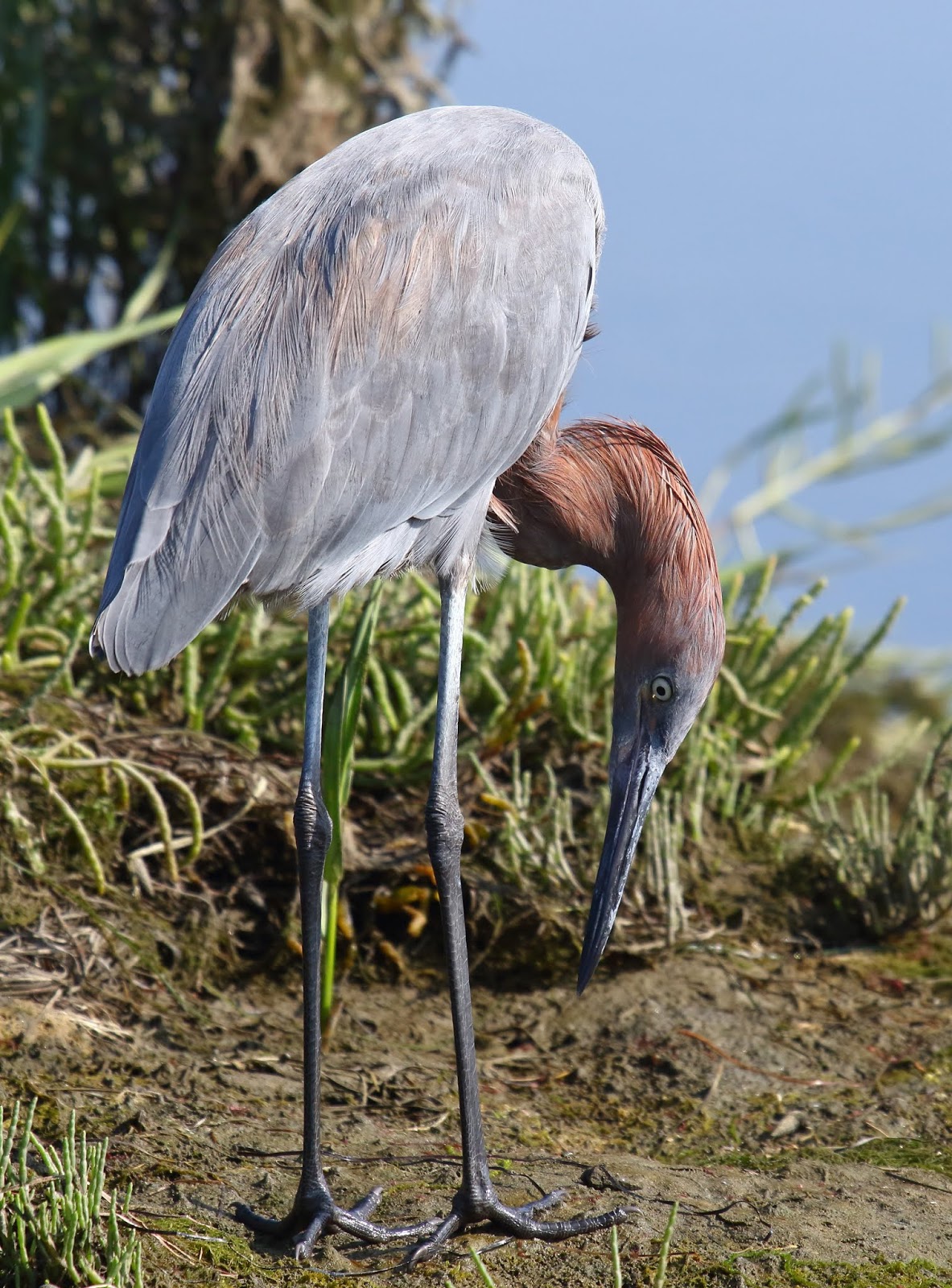
Reddish Egret
Reddish Egret. San Diego River mouth, San Diego, California. August 12, 2018.
This high key photo of Reddish Egret is the one I'm most proud of for the year. It captures this rather rare bird in a typical, but exciting, pose. More photos of this bird are here.

Brown Pelican
Brown Pelican. San Diego Bay, California. August 19, 2018.
This immature Brown Pelican was photographed from the boat as we were coming back from a pelagic trip. The bird is photographed at eye level with warm afternoon light. It generally meets all the qualifications of an "artistic" bird photo. More.

Common Ground-Dove
Common Ground-Dove. Borrego Springs, California. March 18, 2018.
It's not perfect. The shadows of the noon sunlight are a bit harsh. There's no obvious catchlight in the eye. But I like it, perhaps because the species is uncommon. I especially like the pattern of the feathers across the breast and neck. More.

Scaly-breasted Munia. Escondido, California. August 10, 2018.
I chose this slightly smaller-in-the frame composition over a very similar one cropped a bit closer where the bird appears larger. The background grasses fade pleasingly away and the reddish-brown plumage of the bird stands out against the overcast sky reflected in the waters of the pond. More.

White-winged Dove
White-winged Dove. Anza-Borrego Desert State Park, California. April 15, 2018.
The dove is in more shadow than I would like, so I opened up the crop so the bird is small-in-frame in order to show more of the blooms on the ocotillo bush--a habitat shot. The mottled background of the out-of-focus desert hillside provides a nice texture contrast to the thorny bush. More.

Anna's Hummingbird
Anna's Hummingbird. Lake Hodges, California. January 21, 2018.
I have so many photos of hummingbirds, especially this common Anna's. Nevertheless, this is probably my best Anna's on a natural perch, even if it is a stereotypical bird-on-a-stick (BOAS). The focus, the light, the pose, and the background are all good. More.

Mountain Quail
Mountain Quail. Palomar Mountain, California. June 17, 2018.
Okay, maybe it's the backstory and not the photograph itself. The bird is in harsh sun and shade, aided by some reduction of contrast in post-production. But to encounter such a shy and reclusive bird right out in the open was a special treat. The backstory.

Great Egret high key
Great Egret. Lake Hodges, California. July 4, 2018.
My first high key photograph. Not bad for standing on the footbridge taking shots of herons and egrets as they flew up river against dark overcast skies. Practicing camera settings with my new camera. More about this photo and the High Key style.

Bell's Sparrow
Bell's Sparrow. Borrego Springs, California. January 7, 2018.
The small-in-frame and backlit sparrow is perched on a twisted creosote bush. The three main branches all lead the eye back to the bird in the center. This bird-in-habitat shot is more about the composition than the bird itself. The bird alone would be a poor shot. More.

Verdin
Verdin. Borrego Springs, California. March 18, 2018.
The head angle looking back at me is good and there is a wonderfully pleasing out-of-focus pastel-colored gradient background that complements the soft gray plumage of the bird. More.


Honorable mentions:

Gull-billed Tern
Gull-billed Tern. Imperial Beach, California. July 29, 2018.
The photo of this tern is not exceptional, with somewhat harsh overhead light. The head is in sunlight and the bird is in focus, but there is no catchlight in the eye. The background is solid blue sky which some find boring. But Gull-billed Tern is rather uncommon in US waters. And this photo captures it well. More.

Acorn Woodpecker
Acorn Woodpecker. Mount Laguna, California. October 7, 2018.
A pleasant but not exceptional photo of Acorn Woodpecker in the shade of the mountain forest. The diagonal perch adds some visual interest. It might have done better in warm early morning sunlight. More.

Marbled Godwit
Marbled Godwit. Imperial Beach, California. September 30, 2018.
This is an easy bird to photograph on southern California beaches. And photogenic, too, with those long legs and impossibly long upturned bill. There's nothing wrong with this photo, it's just such a common subject in a common pose. More.

Phainopepla
Phainopepla. Borrego Springs, California. March 18, 2018.
One of my favorite birds. If only its head had been turned more toward the camera!

Saturday, September 29, 2018

Bird photography at very high ISO

Camera settings for a bird in the bush

My new camera (Canon EOS 7D Mark II) has much better autofocus and ISO range than my previous Canon Digital Rebel XTi (bought in 2006). I've mentioned before that the XTi never had enough light with my 100-400mm zoom lens to use ISO 100, and that ISO 1600 was so grainy (digital noise--especially in shadows) I never used it. So I customarily set the ISO at 400 and aperture at f/7.1 and left it there, letting the camera choose the shutter speed.

On the other hand, the 7D Mark II has infinite ISO. Okay, so it's not infinite, but rather than 1600 it goes to 16000! And it even goes beyond that with special settings that I don't know why you'd use unless taking really grainy photos in near blackness.

I have learned to shoot Manual mode recently and often shoot Manual with Auto-ISO, at 1/1250 sec, f/7.1 @ 400mm as a default "birding" setting, as long as light is sufficient. For more active or flying birds a shutter from 1/2000 to 1/4000 sec stops motion as light permits.

However, when shooting "birds in the bush," hopping from sun to shade or backlit by bright skies, I use different settings.

Autofocus

There are a huge number of Autofocus settings on my camera. But for getting pinpoint focus through the branches on the face or even the eye, I use the Spot AF setting. It is smaller than the default single Autofocus point. I use this setting nearly always. Some of the other AF point selection modes are theoretically "better" for focusing, but I haven't found it to be so, at least on my present lens, which is the old Canon 100-400mm f/4.5-5.6 L IS. This lens is a bit soft in focus. The new lens in this series is supposedly much sharper. But as long as my present lens works I cannot afford to upgrade. Now that I can take 10 frames per second I am able to get some sharper, some fuzzier, in a burst.

Metering

For general bird photography the Evaluative Metering mode is ideal. The Evaluative mode takes into account the entire frame but is weighted more to the center. In RAW you can adjust the color temperature and restore the warm sunny tones you observed. So you don't mess with white balance in the field when shooting RAW.

In recent weeks, however, I've been shooting warblers in the trees against the backlit skies or in dense bushes under a cloudy marine layer and in shade. Jumping from over-bright to over-dark is very difficult--especially if you're chasing warblers through the foliage. If your subject bird takes up at least 15% of the frame width then you can use Spot Metering. In this case your bird is exposed properly even if the background sky is blown out, or the background shadows go to black. It's tricky though, especially for black-and-white birds, or if the bird isn't quite large enough so that you hit part of the bird and part of the background. So frame-to-frame shots may all be exposed slightly differently, depending upon how steadily you hold the focus on the exact spot on the bird. I would not use this Spot Metering mode on a pelagic trip, for instance, where the bird is too small in frame and there the bouncing of the boat, waves, and flying of the bird means that I can't hold steady.

So, I am still shooting Manual with the shutter speeds and aperture that allows me to get good photos with Auto-ISO. Shoot green grass in the open to give you an idea of proper Manual mode shutter, aperture, and ISO settings. Then set shutter and aperture as the green grass would indicate. Set Auto-ISO. Set Spot AF and Spot Metering.

This won't make artistic photographs. But it will give you properly exposed birds for documentation photos, even if the noise is severe. Noise can be smoothed when rendering your RAW files.

The photos below discuss shots of birds on September 16 and 21 of 2018 at Buddy Todd Park in Oceanside, California.

Hutton's Vireo
Hutton's Vireo in deep shade. 1/1250 sec, f/7.1 @400mm, ISO 10000.
It's grainy, but still usable.
Red-eyed Vireo
Red-eyed Vireo against bright sky. 1/1250 sec, f/7.1 @400mm, ISO 2500. 
Evaluative metering would have turned the sky gray and the bird very dark.
Black Phoebe
Black Phoebe and background in nice even light. 1/800 sec, f/7.1 @400mm, ISO 500.
Evaluative metering would have worked "better" but this came out perfect with Spot metering.
Townsend's Warbler
Townsend's Warbler in deep shade. 1/400 sec, f/5.6 @400mm, ISO 16000.
This is as shady a condition as one could obtain a sharply focused bird with my image stabilized lens.
Nuttall's Woodpecker
Nuttall's Woodpecker strongly backlit. 1/640 sec, f/5.6 @400mm, ISO 2000.
If Evaluative metering had been used the sky would have been gray and the bird and tree trunk black.
Western Tanager
Western Tanager in front of deep shadows. 1/1250 sec, f/5.6 @400mm, ISO 4000.
If Evaluative metering had been used the yellow parts of the bird would have been blown out.
Allen's Hummingbird
Allen's Hummingbird in shade. 1/1250 sec, f/7.1 @400mm, ISO 8000.
Evaluative mode would have turned the bird dark to compensate for some foliage in the light (cropped out).
With my previous camera only the phoebe had enough light to take a shot! While many of the "high ISO" shots aren't all that great, they are still sufficiently acceptable for documentation photos.

Tuesday, September 25, 2018

Photogenic Western Bluebirds at Buddy Todd Park

Close Bluebirds in the morning sun are always a joy to photograph.

Here are two pair of photos of Western Bluebirds that are more artistic than many of my shots.

The first pair of photos show a male Western Bluebird in a tree with reddish leaves--perhaps a plum tree, but perhaps something totally different. Ornamental trees in San Diego can be native to any other part of the planet. I thought the contrasting color of the wine red leaves against the dark green background was nice, and love that the background of more distant trees was pleasingly out-of-focus. the little branch up the breast detracts a bit, but perhaps not too much.

Western Bluebird
Western Bluebird. Oceanside, California. September 16, 2018.
Western Bluebird
1/800 sec, f/5.6 @400mm, ISO 160.
The second set of bluebird photos came from a few minutes later. One is cropped more closely than the other. The background is similar to the first set of photos. So is the angle of the light. For all I know it might have been the same bird in the same tree as the first set!

Western Bluebird
1/800 sec, f/7.1 @400mm, ISO 200
Western Bluebird

Friday, September 7, 2018

Sora in low light

This past weekend I wanted to get in a full morning of birding and photography. So I timed my arrival at the Dairy Mart Ponds for sunrise: 6:15am. I was kind of hoping for the first lovely golden rays of dawn's light.

 As often happens in San Diego, though, a marine layer forms at night and overcast skies are frequent into late morning. So "sunrise" in the Tijuana River Valley this morning was a very gloomy dark gray.

Well, okay, I've also been watching YouTube videos extolling the virtues of the even light produced by overcast skies or fog. At least there shouldn't be any harsh shadows. And newer cameras can shoot at high ISO without too much graininess. If I take lots of shots , a couple of them might have acceptable sharpness, even at slower shutter speeds--especially with my image stabilized lens.

There was a cooperative Sora out in the open on a pond. Unfortunately, the little trail gave me only one view through the foliage. The bird was 20 feet away and below me about 10 feet. I had to stand up and shoot down at the bird below me. So these aren't artistic shots. They only show the exposure possible with my bird photography gear: Canon EOS 7D Mark II camera with Canon EF 100-400mm f/4.5-5.6L IS USM lens.

I attempted several photos early, 6:38 am. Only the one below turned out acceptably. I've been doing a lot of Manual Mode photography. But in this low light I didn't want try to guess the difficult exposure in Manual mode with the Evaluative exposure metering mode and dialing in a couple of stops of Exposure Compensation. Instead I chose Aperture Priority and Spot Metering and let the camera do all the hard exposure work as the bird moved from dark background to backlit.

Sora
6:38am, heavy overcast: 1/60 sec, f/5.6, 400mm, ISO 4000
I set ISO to 4000. The camera can go higher. But anything more than 2000 produces notable grain--especially in darker areas. The sweet spot on my zoom lens at 400mm is f/7.1. But I set it down 2/3 of a stop to f/5.6, which is wide open at 400mm. That does three things. It lets in more light (good), gives a very shallow depth of field (bad for focusing on a bird more than an inch or two in depth-front to back of focal plane [tail is too far away and out of focus]), and isn't the sharpest lens setting (bad). With me choosing ISO and aperture, I let the camera choose the shutter speed, to make the exposure correct.

At only 1/60 of a second, the above photo suffers a bit of blurriness from camera shake and bird movement. It's not very sharp, but it's the best that could be done with the available light. Handheld at 400mm I should be shooting at least 1/800 of a second or faster, but the image stabilization on the lens helps greatly. Still, I shouldn't shoot that long lens handheld at less than 1/250. I don't use a tripod so it is unlikely I can take those "blue light" bird photos before sunrise or after sunset unless I really change my birding/photography technique and habit.

It was an hour later when I went back and got additional photos with the bird still out in the open!

Sora
Heavy overcast, 7:42am: 1/320 sec, f/5.6, 400mm, ISO 2000.
So, the light came up enough I could set the ISO to 2000. I left the aperture at f/5.6. The shutter speed came up to 1/320 of a second. That is sufficient for stationary birds only.

Sora
Sora
Sora
Sora. Tijuana River Valley, San Ysidro, California. September 2, 2018.
Later in the morning I was able to photograph some other birds under bright overcast skies. I'll share those in future posts.

Thursday, September 6, 2018

Coot photography challenge

If you live in North America like I do you probably see American Coots every time you visit a pond or other wetland. If you photograph birds you probably have a bunch of photos just like this one:

American Coot
Typical coot photo.
There's nothing wrong with the photo above. It's just common. It looks like any other photo of American Coot on a sunny day.

Only a couple of minutes after I took the above photo, I took the photo below. What changed?

American Coot
American Coot. Dixon Lake, Escondido, California. August 31, 2108.
First of all I got down a lower so I wasn't shooting down at the bird, but joined it on its level. I wasn't able to get down completely to water level, such as laying on my belly on the shore. I sat on a low rock. But since the bird was a bit farther away the angle was more horizontal than the first photo where I was standing up on a bank.

Second, I chose a more muted background. In this case the bird was in a little inlet. The brown water color is the reflection of the nearby curving shore.

Because I wasn't photographing the bright reflected sky, I was able to adjust the exposure properly. This third change is that the white bill isn't over-exposed and blown-out as on the first photo.

The next time you are looking at a coot, grebe, or duck in your viewfinder I want you to remember this. If you find it looks like the first photo, then stop. Change your shooting angle. Change your composition and background. Change your exposure. I challenge you to take a more interesting shot!

Monday, September 3, 2018

Brown Pelicans photographed in golden light

Returning from the August 19 pelagic trip I noted that we had excellent warm "golden hour" light. As our boat entered the bay I obtained several photos of Brown Pelicans specifically to practice creating artistic photos in this soft light. I present them here with some commentary on the artistic aspects of each photo. [Read "7 elements of an artistic bird photo"]

Brown Pelican

#1. The photo above has soft light, is in focus, and has a good pose. The wind-rippled water background is perhaps just a bit too strongly patterned and distracting. This is alleviated in the following photos by getting closer to the bird and having more distance between the bird and the background elements.

Brown Pelican

#2. I really like the pose in the above photo. The background is clear blue sky. But the shadow on the underwing might be a touch too distracting for some. I'm shooting up at the bird just slightly, which isn't ideal.

Brown Pelican

#3. This photo above doesn't have quite as an interesting wing pose as the previous photo. But it is better in two other regards. It doesn't have a distracting shadow across the breast and the perspective is perfect at eye level. This might be the most technically "correct" of the photos here, though it is not my personal favorite.

Brown Pelican

The photo above really has nice warm golden light without any harsh shadows. The background has a couple of slightly distracting "blobs" on the water, and the brighter shoreline is a bit distracting too.

Brown Pelican
Brown Pelican. San Diego, California. 19 August 2018.
This final photo is one I really like. It really catches the golden glow of the late afternoon sun on it's brown feathers. The pose is really interesting. The wing is extended down and forward for added lift, the hand twisted slightly to reduce air drag as it is just beginning the upstroke. The wing is pleasingly patterned with all the parallel lines of the perfect juvenile flight feathers. The almost scale-like body feather texture is replicated on the wing coverts. You can really see this well if you click on the photo and bring up a size about 3 times larger than what appears on the screen. The shoreline is so subtle at the top that I don't think it detracts. The original had more shoreline, but I cropped as much out as I could. I could wish the faint darker wake shadow didn't go all the way across the frame and through the head. That's my only "complaint."

Monday, August 27, 2018

Reddish Egret at San Diego River mouth. Part 2: Sunny

The post for yesterday was of a Reddish Egret under overcast conditions. Today's post is the set of photos after the sun came out. Whether coincidence or not, the bird soon stopped hunting in the shallows and rested on the bank. There were still many interesting poses, but the background was more distracting, and the light harsh. So these photos aren't as artistically pleasing as the first batch.

Reddish Egret
A heron running frantically around on the mudflats with its wings open--Reddish Egret.
Reddish Egret
A typical pose
Reddish Egret
Reddish Egret
Reddish Egret
Reddish Egret
Reddish Egret
Reddish Egret. San Diego, California. August 12, 2018.
Reddish Egret
Reddish Egret
Reddish Egret
Reddish Egret