Showing posts with label San Diego living. Show all posts

Monday, March 25, 2019

Anza-Borrego Desert Wildflower Super Bloom 2019

It has only been 2 years since the last "super bloom" in 2017.

It's been a cool, rainy winter in San Diego County, even in the Anza-Borrego Desert on the "dry" side of the mountains. As a result, many were predicting another "super bloom"--a spring wildflower show brought on by more than average winter rains.

Marlene and I visited in February and made arrangements to come back at the same time we were here in 2017. We spent the long weekend of March 16-18, 2019 in the Anza-Borrego Desert. The first morning we visited birding locations in the south end of the desert. We arrived in Borrego Springs in the north on Saturday afternoon and stayed until noon Monday.
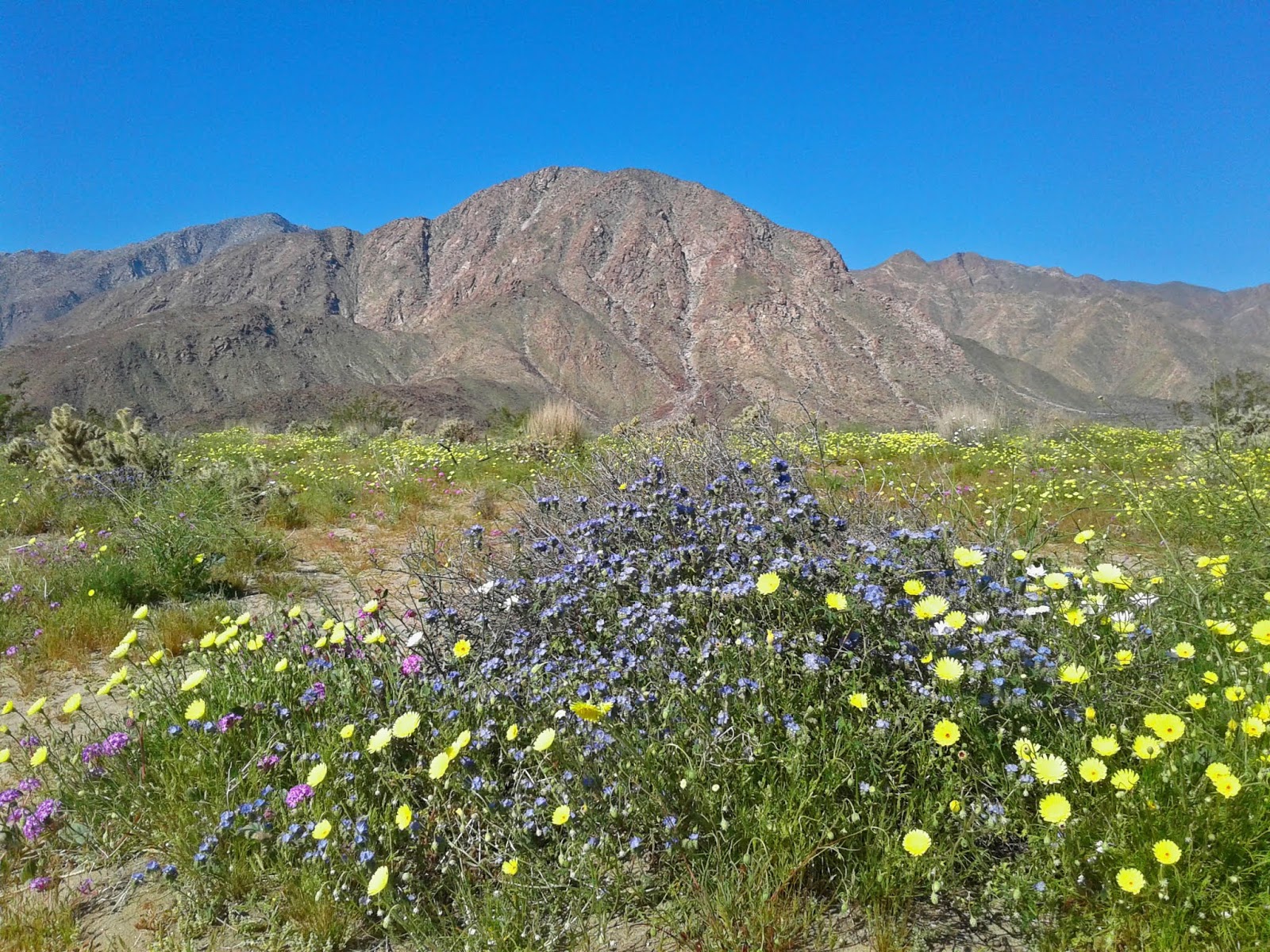
Wildflowers and mountains of Borrego Springs
Borrego Springs wildflowers, Borrego Springs Road near Henderson Canyon Road. March 18, 2019.
Compared with 2017, the wildflowers are less intense, but more widespread, this year. In 2017 all the wildflowers were blooming during that one week of 90+F degree weather. This year wildflowers started in some protected south facing canyons in February. They were going strong during our mid-March visit, yet some flowers--like the Desert Lily--were mostly just buds. Out warmest day--and one of the warmest this year, thus far, was only 83F.

The long period of rainy weather has been especially conducive to growing grass--yes, the desert floor (between all the cactus and creosote) is a carpet of foot-high grass!

Brittlebush flowers
Rain or no, Brittlebush flowers tower over the blue-green leaves of this shrub every spring. 
It is found in higher, rockier areas of the desert. This one was at Vallecito County Park.
My flower identification skills are barely at the dandelion, daffodil, rose, tulip stage. So I use the wonderfully handy foldable poster "Spring Wildflowers of Anza-Borrego Desert State Park." This 2005 publication lists over 50 species of wildflowers that pretty much include any species you are likely to see. It was still in print 2 years ago when I got mine. I noticed other people with this publication on the side of the road (reminding me of bygone ages where people navigated using impossible-to-refold paper maps).

Brown-eyed Primrose
About 6-8 inches tall are these Brown-eyed Primrose.
Wild Heliotrope
This was a new flower for me, and widespread, the Wild Heliotrope, if I'm not mistaken.
It seems this year there are more clumps of purple flowers than in 2017. I think they are Wild Heliotrope. I also saw a similar flower in the same genus (Phacelia)--Scorpionweed. I could easily have them reversed. There is a third Phacelia I did not identify: Wild Canterbury Bells.

Pretty white flower with red oval leaves
This pretty flower is about 6 inches tall. I have no idea what it is, though. 
It was near the Borrego Springs waste treatment ponds.
It is surrounded by the tiny Popcorn Flower.
Desert Dandelion
Desert Dandelion was a widespread flower.
Little Gold Poppy
Little Gold Poppy, I think.
Desert Chicory.
Desert Lily. One of my favorites.
The lovely Desert Lilies were not blooming yet. I saw only 3 that had open flowers. I did see hundreds of these sand-loving flowers with buds. They needed another week of warmer weather, I guess.

Popcorn Flower
Barely 3 inches tall, the Popcorn Flower carpets the desert, often under the taller flowers.
Sand Verbena
Though smaller, the Sand Verbena is one of the major flowers of Anza-Borrego.
Wildflower super bloom
Wildflowers: yellow Desert Dandelions and purple Wild Heliotropes with a few white Desert Chicory.
Desert Dandelion
Desert Dandelion
Sand Verbena
Sand Verbena
There is another species of verbena that grows on the sand dunes of the ocean beaches.

Sand Verbena and Desert Dandelion
Sand Verbena and Desert Dandelion tower over the Popcorn Flower. 
All grow out of the thick spring grass in the Anza-Borrego Desert.
Arizona Lupine
Tall Arizona Lupines were only seen on the side of the road near Truckhaven.
Barrel Cactus flowers
A Barrel Cactus flowers near Vallecito County Park.
Sunset in Borrego Springs
The sun sets behind the western mountains as Marlene and I take a late afternoon walk in Borrego Springs, California.
Brown-eyed Primrose
A carpet of Brown-eyed Primrose on sandy soil catches the sunrise at the Borrego Springs waste treatment plant.
Dune Evening Primrose
The large Dune Evening Primrose favors sandy soil.
Some Little Gold Poppies peek out.
Caterpillar of sphynx moth eating Dune Evening Primrose
The 3-inch long caterpillar of the Sphynx Moth gorges on the Dune Evening Primrose.
I spent Sunday evening with a group counting migrant Swainson's Hawks going to roost. Unfortunately, it was a disappointing show. About 70 hawks were circling around very high to the north over Henderson Canyon Road about 5:30 PM. They disappeared for over an hour, then came back, but never approached near the Date Farm evening count site. I couldn't even get a distant photo.

Hal Cohen was leading the volunteer group. The flowers bring the Sphynx Moths, which lay eggs and soon the finger-sized caterpillars are munching on the flowers. Those juicy morsels in turn are eaten by the Swainson's Hawks which may only stay a day or two before continuing north to their breeding grounds in the interior Mountain West. The hawks winter in Argentina and migrate in large flocks of hundreds. During most of the year they eat large grasshoppers, but during a few weeks in spring these Sphynx Moth caterpillars are favored.

Visit the Borrego Valley Hawkwatch blog.

Sand Verbena near the Badlands.
Sand Verbena near Truckhaven.
Fremont's Pincushion
This must be the Fremont's Pincushion.
Scorpionweed or Notch-leaved Phacelia
If I've got this right, this is a Scorpionweed, also known as Notch-leaved Phacelia, near Truckhaven.
Wild Heliotrope
If I've got this right, this is Wild Heliotrope.
Wildflowers at Anza-Borrego Desert.
Sand Verbena and Desert Sunflower
Sand Verbena and Desert Sunflower on Henderson Canyon Road.
Flowers and plants pictured in this article:

Arizona Lupine  Lupinus arizonicus
Barrel Cactus  Ferocactus cylindraceus
Brittlebush  Encelia farinosa
Brown-eyed Primrose  Camissonia claviformis
Desert Chicory  Rafinesquia neomexicana
Desert Dandelion  Malocothrix glabrata
Desert Lily  Hesperocallis undulata
Desert Sunflower  Geraea canescens
Dune Evening Primrose  Oenothera deltoides
Fremont's Pincushion  Chaenactis fremontii
Little Gold Poppy  Eschscholzia minutiflora
Notch-leaved Phacelia (Scorpionweed)  Phacelia crenulata
Popcorn Flower  Cryptantha angustifolia
Sand Verbena  Abronia villosa
Wild Heliotrope  Phacelia distans

Saturday, March 2, 2019

Fieldcraft: What is a King Tide? What good is it for birding?

In January there was a King Tide in San Diego, appearing on the news.

What, exactly, is a King Tide?

Well, according to NOAA (here), a King Tide is the unofficial name for an unusually high tide. It may also be known as a Spring Tide that "springs forth" with no relation to a particular season that comes to mind with that particular word.

There are always higher tides twice a month as the sun and moon line up (New moon and Full moon). When accompanied by storms or high waves or wind, these tides can be especially high, flooding coastal areas that are usually above the high water line. Thus, during the December to February "winter" in southern California, any new or full moon accompanied by high waves will create conditions of a King Tide.

Since the beaches are submerged and the tidal marsh is flooded, why should birders care? I'll tell you. But first, some photos...

King Tide flooding at Imperial Beach
Seacoast Drive in Imperial Beach closes during King Tides.
King Tide flooding at Imperial Beach
Ocean waves splash over the breakwater and run down the street.
King Tide flooding at Imperial Beach
Residents take in the view from their back deck.
King Tide flooding at Imperial Beach
King Tide running down the street.
King Tide flooding in Tijuana River Estuary
Famous Lemonade Berry bush on edge of Tijuana Slough along Seacoast Drive.
Why is the lemonade berry (Rhus integrifolia Wikipedia page here) above famous? Well, last year during very high tides, a couple Nelson's Sparrows were flooded out of the marsh. That bush was the only place to hide! And hide they do. One could be in that bush right now for all I know. But it's not budging, nor giving itself away.

The nearest nesting Nelson's Sparrows breed from extreme north central US into the Canadian Prairie region. They winter in the coastal marshes of the Gulf Coast (other populations in Hudson Bay and SE Canada and NE US winter along the Atlantic coast). A very few end up every year wintering in California's few remaining salt marshes. Some of those winter in San Diego.

I stumbled upon one in San Elijo Lagoon a couple of years ago. I hadn't paid any attention to the tides when I made my birding plans. So, luck one, intention zero. That's the way birding is sometimes.

Nelson's Sparrow. San Elijo Lagoon, California. January 1, 2014. Greg Gillson.
A Nelson's Sparrow briefly comes out of hiding. San Elijo Lagoon, California. January 1, 2014. Greg Gillson.
I should mention that other birders were watching a Nelson's Sparrow about 15 miles away at Mission Bay. But views were distant and it had already been seen, and I'm picky proud lazy (pick your own adjective)--I generally prefer to find my own rarities!

What I did find on my recent King Tide Adventure were lots of other sparrows, especially Savannah Sparrows, including this dark resident form, Belding's Savannah Sparrow.

Belding's Savannah Sparrow. Imperial Beach, California. January 20, 2019.
I was hoping for Large-billed Savannah Sparrows. They are at the extreme northern edge of their range in San Diego County, I find them occasionally in winter on beach-cast seaweed piles, apparently feeding on flies (kelp flies?). I figured with the beaches under water and the marsh grasses providing no cover that these birds might be right out on the edge of the marsh. But what do I know? I didn't find any. [Previous post on Large-billed Savannah Sparrows is here.]

And King Tides are well known for pushing rails into view. The local Ridgway's Rails were visible in the tops of the grass.

Ridgway's Rails flooded out by King Tide in Tijuana River Estuary
Zoomed in... they were way out there!
Ridgway's Rails flooded out by King Tide in Tijuana River Estuary
Cropped too far, but you can make their shape out a bit.
Such high tides may also reveal Virginia Rails and Soras, as well as push all the herons and egrets up to the edge. And this day a Merlin was hunting the marsh edge for sparrows. You never know what you might find.

Next winter you may want to mark the new and full moon on your calendar in advance. If the seas are stormy, you may want to visit your nearest tidal wetland during a King Tide.

Saturday, February 2, 2019

Sailboats in San Diego Bay

For something different, I present some sailboats I spied on January 1, 2019. Marlene will like these, I know.

Sailboats against the sun. San Diego. Greg Gillson.
Sailboat in San Diego Bay. Greg Gillson.

Thursday, November 15, 2018

Julian getaway: turkeys and deer photo collection

It was Marlene's and my 40th wedding anniversary. We only had 3 days. Getting "away" sounded better than going to a place with lots of other people. So instead of an expensive stay on a crowded beach, we rented a little cabin in the woods at Julian.

We arrived Saturday afternoon and stayed until noon on Monday. No other people for nearly 48 hours. Pine trees, turkeys, deer, sunsets, oak trees. Silence. Rest. Away.

Here is a collection of photos from our trip. The first 3 were taken on my camera phone, the remainder with my large lens and camera.

As perhaps you can tell from the photos below, there was no time during the weekend when there weren't deer and turkeys in view. In fact, when I walked around the property I invariably had  several deer following me around, and the turkeys weren't spooked until I was within 30 feet.

Cabin
Turkeys
Sunset
Turkey
Deer
Turkey
Turkey
Fawn and turkey share a drink
Buck
Cuyamaca Peak
Manzanita
Coulter Pine Cone
Nursing Deer
Sunset
turkey head
turkey head
Turkey
Turkey
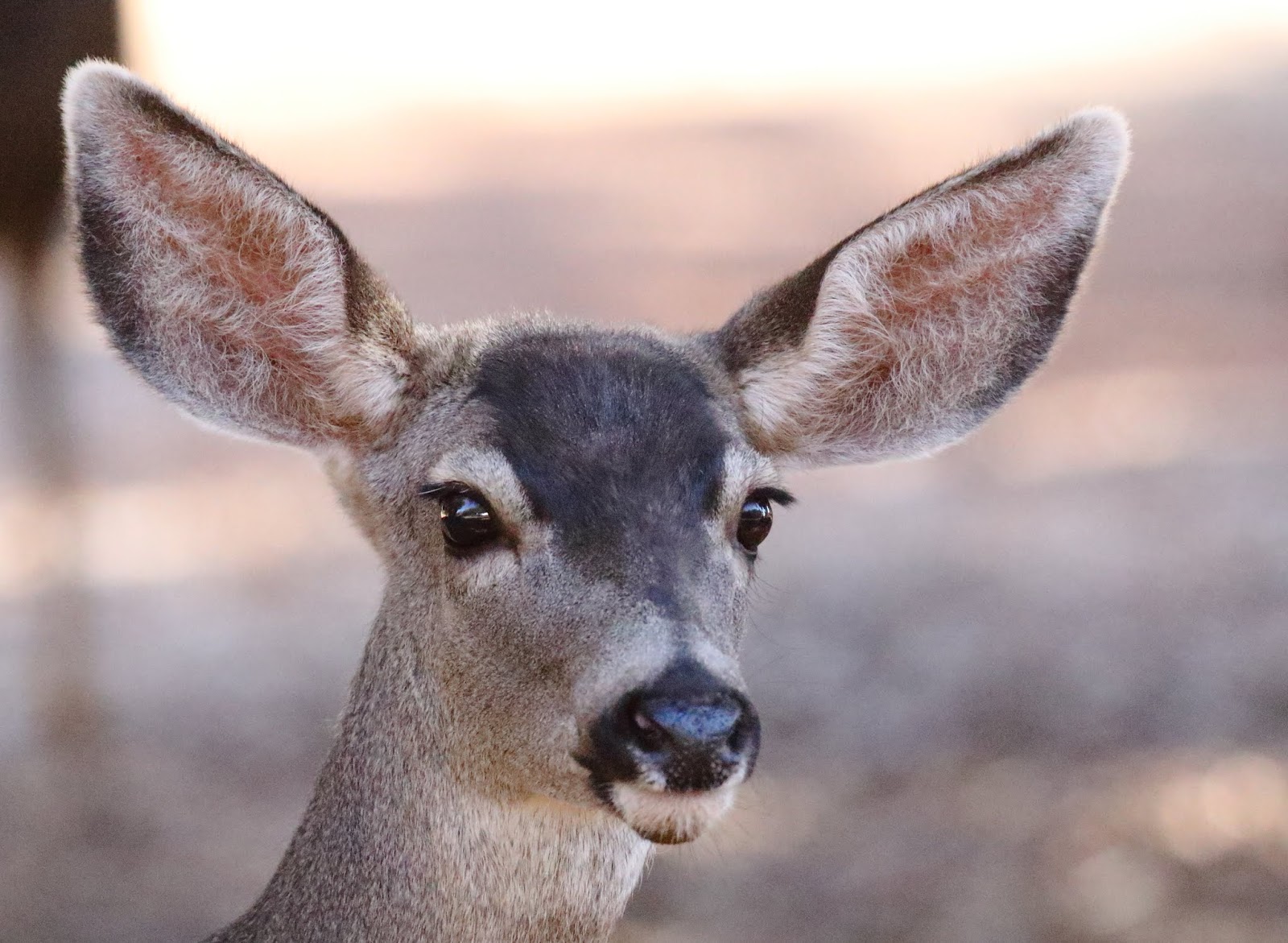
Deer head
Deer head

Just what we needed!