Saturday, September 1, 2018

New birding trails on Bayshore Bikeway, Imperial Beach

This post updates my February 2015 birding site guide to the Bayshore Bikeway, in Imperial Beach.

That site guide covered birding opportunities between 7th and 13th Streets, plus down the Bikeway a half mile or so beyond 13th Street to the Saltworks. Please see that original site guide for general birding and expected species.

This information adds 3 new (since June 2016) access points (paths) that should increase the value of this birding location.

Bikeway map
eBird map: Bayshore Bikeway map 7th to 13th Street. Click for full-sized image.
Key for map above:

Green P: Parking at 7th Street, 10th Street (lot next to Public Works), 13th Street

Yellow path: Bayshore Bikeway existing path.

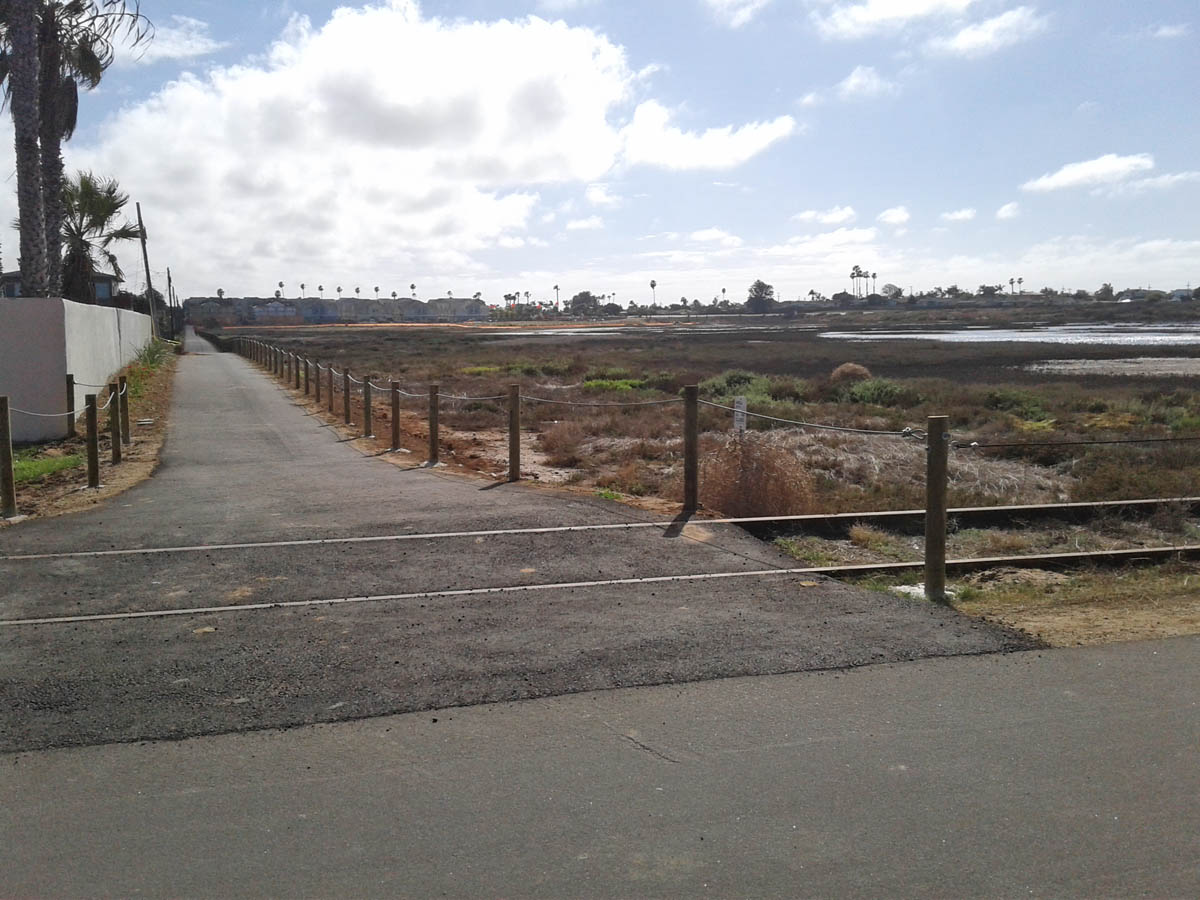
Red Path 1: Designated birding trail. In June 2016 a walking path of 0.4 miles was completed between 7th Street and 10th Street, in Imperial Beach. This footpath follows the edge of the marsh at the south end of San Diego Bay. It parallels the Bikeway and makes it safer to watch birds and set up your spotting scope without impeding bike traffic.

Red Path 2: Some improvements have been done at the end of 13th Street (13th and Cypress), including some new retail shops (Bikeway Village). There are fewer parking spaces, but they are now paved. Street parking is also available on 12th Street, and also on Florence Street--which is between 12th and 13th Streets. A new city park botanical garden has been installed that looks over San Diego Bay between 12th and 13th Streets. It's a good place to scan the bay. Look for nesting Elegant Terns by the multi-thousands, Black-necked Stilts, Willets, and Black Skimmers.

Red Path 3: There is a new paved accessway behind the homes on the west side of 7th Street. It may come from the new condominium development called Bayshore Landing. To access this path, drive to the north end of 7th Street and park on the street. Walk to the edge of the marsh. Walk the Bayshore Bikeway west about 150 feet. The new paved path leads south and has good light for morning shorebirding.

Yellow A: eBird Hotspot: "Bayshore Bikeway--7th St."

Yellow B: eBird Hotspot: "Bayshore Bikeway--13th St."

Yellow C: eBird Hotspot: "Pond 23 island & Otay River channel"

Yellow D: eBird Hotspot: "San Diego NWR--Pond 10A"

Yellow E: eBird Hotspot: "Saltworks--pond 20"

Bayshore Bikeway walking path at 7th Street
The new walking path/birding trail parallels the Bayshore Bikeway between 7th (here) and 10th Streets.
Bayshore Bikeway
West from 7th Street you still have the irregular shoulder of the Bikeway as a walking option. Pond 10A to left.
Bayshore Bikeway
West of 7th Street is a new paved pathway bordering the marsh (Pond 10A).
Flamingo Trail. Bayshore Bikeway Pond 10A
Oh look! Same view in August 2018. Famous local escaped bird gets its own trail!
Flamingo Trail mural. Bayshore Bikeway Pond 10A
Beautiful mural. How long before it gets tagged with graffiti? August 26, 2018.
Bayshore Bikeway walking path
Path near the end of 8th Street.
Bayshore Bikeway walking path
Path near end of 8th Street looking west toward end of 7th Street.

Friday, August 31, 2018

Laysan Albatross off San Diego

Thirty-one days, thirty-one blog posts for August. I have now caught up with my better photos, showing what I shot in the last week or two. In July I was showing photos from March, so that's where I started. From April 2017 to April 2018 I posted much less frequently. Then I decided to post better bird photos, even if I didn't have much to say about them. When I started this blog I didn't want it to be just about birds, but it is. Mostly. I don't get many comments on my posts, even if over 100 people a day visit my pages. So I'm not sure if people want more or less of certain topics. If you read this and have an opinion, please let me know! Thanks.

These bird photos show a rare Laysan Albatross only 12 miles off San Diego on the August 19th pelagic trip. There are only 3 to 5 accepted records of this species in San Diego county waters. My first in San Diego waters was May 2015 (details here). The first photos show the bird back in our wake eating popcorn in the setting sun. But it soon caught up to the boat and made for some fantastic shots!

There is no apparent wear or wing molt anywhere on this bird. Thus, though there are no plumage differences between adults and juveniles, this bird appears to be only about 6 months old. It possibly is from one of the new breeding colonies off Baja Mexico, rather than the outer Hawaiian Islands where there are 20 million or so. But seabirds can travel surprisingly far in a short amount of time.

Laysan Albatross
Laysan Albatross
Laysan Albatross
Laysan Albatross
Laysan Albatross
Banded albatross. "3R4" white lettering on red band on left leg.
Laysan Albatross
Laysan Albatross. 12 miles off San Diego, California. August 19, 2018.

Thursday, August 30, 2018

Masked Booby off San Diego

On pelagic trips birds can approach fast and be gone in a short period of time. It is easy to miss seeing smaller birds. Sometimes larger birds can approach unseen and only be glimpsed as they streak past the boat.

Fortunately, this Masked Booby was spotted and called out to passengers with enough time for all to attain decent looks. Nevertheless, all my photos occurred during the same one-minute period according to the clock in my camera. Here it comes... there it goes!

This near-adult seems to have greenish-yellow bill of the Masked Booby, not the pinkish-yellow of Nazca Booby. Nevertheless, the identification is not always so straight-forward--especially on the more-frequently encountered younger birds, both of which species have more of a pale gray bill.

Masked Booby
Masked Booby
Masked Booby
Masked Booby
Masked Booby. Off San Diego, California. August 19, 2018.

Wednesday, August 29, 2018

Black-footed Albatross

Black-footed Albatrosses are not frequently found in warm southern California waters. They are rare, but most expected in late spring (April-June). So this August bird was a welcome surprise.

The wings are just barely longer than a Brown Pelican, making this one of the smaller albatrosses. Brown Pelicans have longer necks and a very long bill, thus are much longer. The pelican also has very wide rounded wings, and is a much heavier bird. It's no contest with a White Pelican (which is rarely found along the beach and never(?) offshore. The White Pelican is huge, even compared to the Brown Pelican.

There is considerable wear on the wing coverts and some signs of flight feather molt. So the bird is not a juvenile. On the other hand, there is no hint of white on the rump or under tail coverts, so the bird is no more than 2 years old. So an age of 1-1/2 years old (hatched January or February) seems correct. Birds get more white on the rump and under tail coverts as the bird ages.

Black-footed Albatross
Black-footed Albatross. Off San Diego, California. August 19, 2018.

Tuesday, August 28, 2018

Red-footed Booby at sea

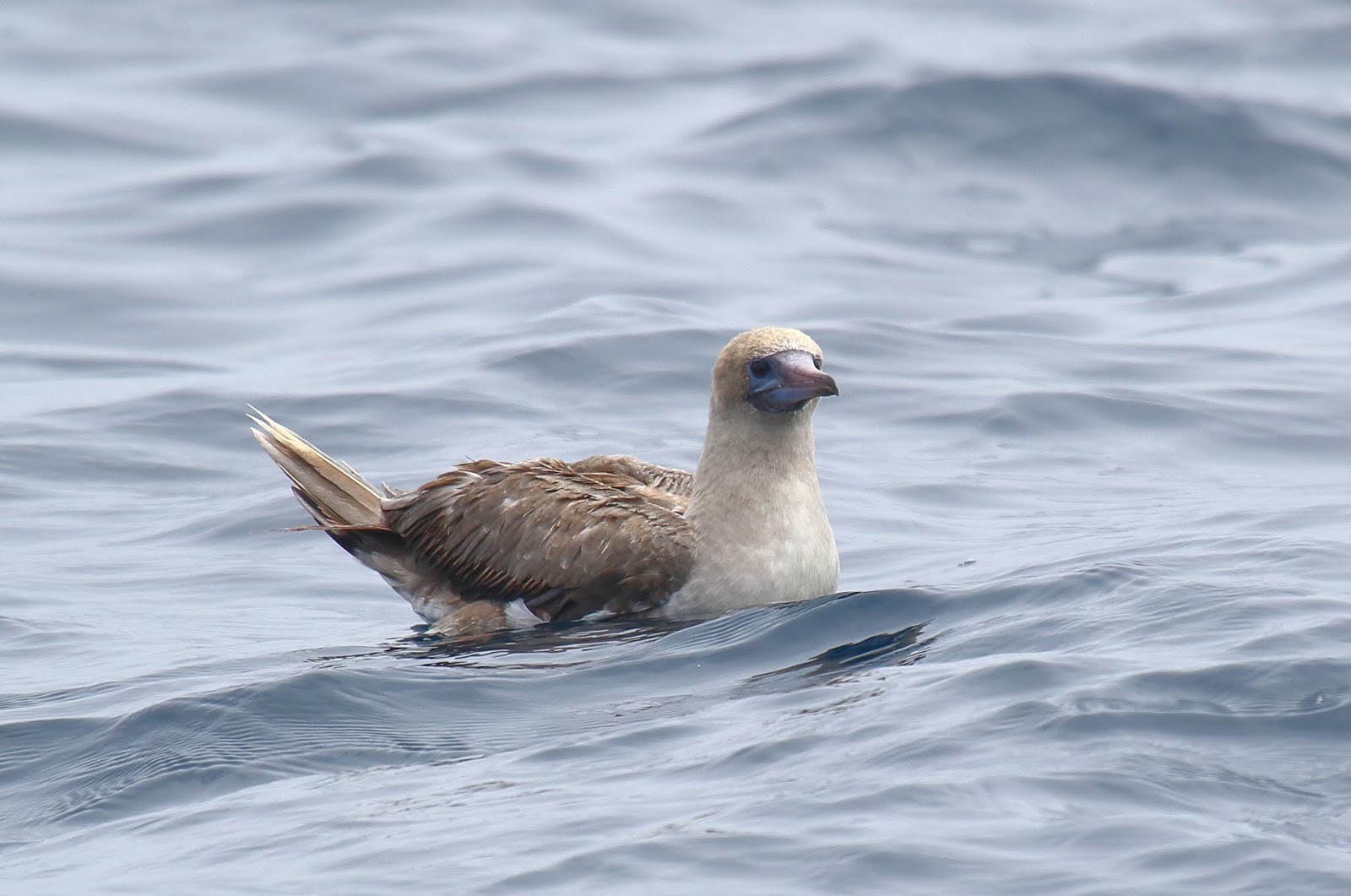
With over 200 West Coast pelagic trips on my birding resume, it is rare these days that I get any life birds at sea. I attend pelagic trips because I enjoy them thoroughly, not to get life birds (although I will gladly accept them if they come my way). Nevertheless, on August 19th we came upon a Red-footed Booby off San Diego. It is a bird I had never seen before. I added Masked and Nazca Booby to my California list earlier this year. Now the only booby I haven't seen in California is the Blue-footed, which really is probably the second most likely after Brown Booby.

As you can see from the photos, Red-footed Booby is a bit larger than Western Gull. All the boobies are close to the same size. The body size is similar to a large gull, but the pointed tail and conical bill and pointed wings are longer. So they are larger than gulls but smaller than pelicans. And, remember, pelicans have broad rounded wings and a short tail.


The distal parts of the mandible are pink with a dark tip. The basal mandible and face is kind of a lilac-blue. The body is dark cream, tail pale brown, wings darker. This is a common coloration for this species, though white-bodied morphs occur. The bright bill and fully red feet indicate this is an adult. The wing plumage is pretty tattered and worn. This could indicate that this bird spent time recently nesting on land?

Red-footed Booby
Red-footed Booby
Red-footed Booby
Red-footed Booby
Red-footed Booby
Red-footed Booby
Red-footed Booby
Red-footed Booby
Red-footed Booby. Off San Diego, California. August 19, 2018.