 |
| Common Raven. Borrego Springs, California. December 26, 2014. Greg Gillson. |

Saturday, January 3, 2015
Common Raven at Borrego Springs

Thursday, January 1, 2015
Phainopepla
 |
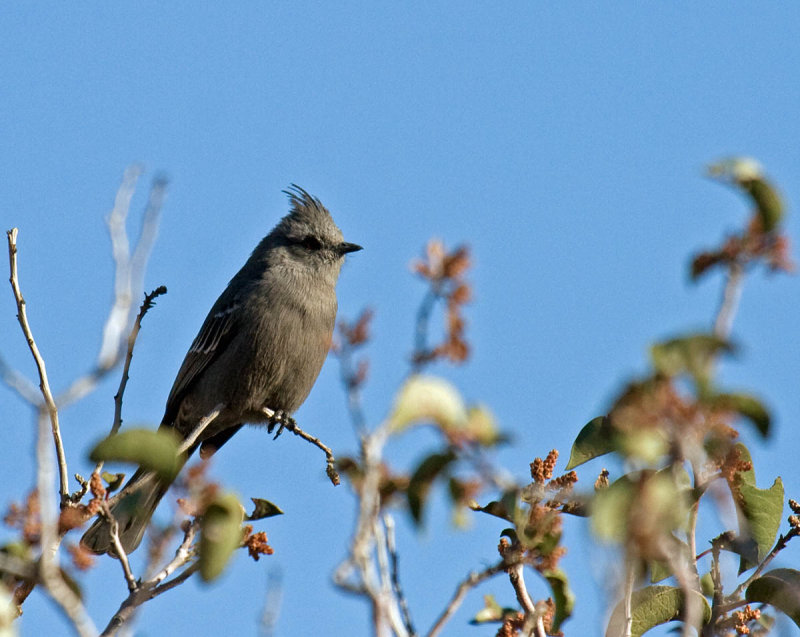
| Female Phainopepla. Culp Valley, California. December 25, 2014. Greg Gillson. |
I was able to get several photos this past week in the Anza-Borrego Desert, in the eastern portion of San Diego County.
Females are grayish, as above. The males are a silky black with big white wing patches at the base of the primaries, visible in flight.
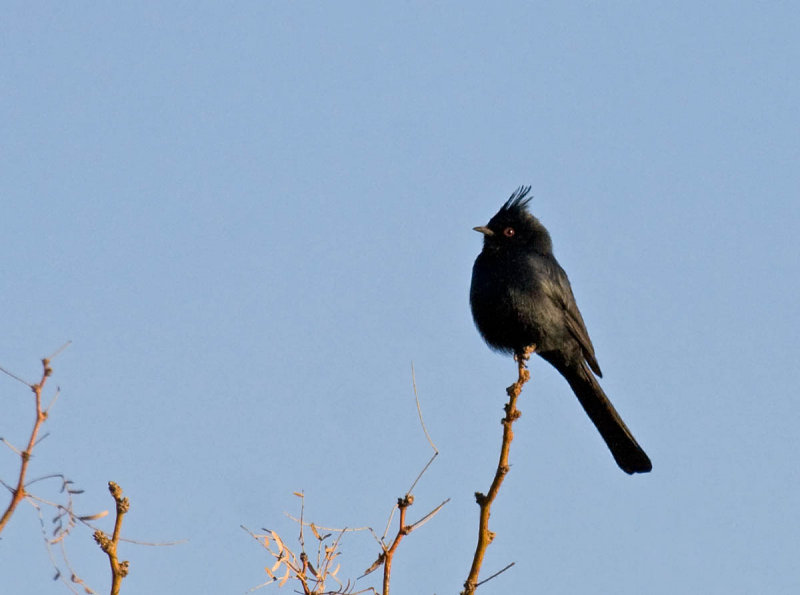 |
| Male Phainopepla. Borrego Springs, California. December 26, 2014. Greg Gillson. |

I'm always happy to see these birds and hear their imitable mellow, whistled, "whit!" call.
Wednesday, December 31, 2014
Peek-a-boo with a Yellow-bellied Sapsucker in Ramona
 |
| Yellow-bellied Sapsucker. Ramona, California. December 25, 2014. Greg Gillson. |
I was seeking a reported vagrant woodpecker--the Yellow-bellied Sapsucker, the form of sapsucker found primarily from the Rocky Mountains eastward. I did not find it, primarily because there was some kind of memorial or public speaking going on right in the middle of the park by what appeared to be 60-year-old hippies. (I'm much better at identifying birds than people--I wonder who they really were!).
The disappointment of not finding the sapsucker was more than made up in my mind by having a Zone-tailed Hawk dive into a Eucalyptus after House Sparrows and then be escorted out of town by a group of crows. Zone-tailed Hawks look--and fly--uncannily like Turkey Vultures, and even fly with them! It happened so fast I didn't get a photo (again!). It was my second sighting of a Zone-tailed Hawk--a rare annual winter visitor here.
So I made another stop this week and "found" the sapsucker. It was very wary, and did not want to be spied upon. The photo above is all I got as it peeked around the trunk of a California Pepper Tree (native to the Peruvian Andes, so how did it get this name?) and kept hiding from me. Still, it is identifiable from this photo. The most similar species is Red-naped Sapsucker. It is told from that species by lack a red nape, which would be at the back of the head where it is white in this bird. Also, this bird has a red throat (not visible) completely surrounded by the black border (which is visible). If this was Red-naped Sapsucker, the red of the throat would bleed through the black border onto the white cheek.
This is my third sighting of Yellow-bellied Sapsucker. The first was another vagrant in Bay City, Oregon on January 12, 2002. The second was at an expected location, Walker Valley, New York on October 14, 2004.
Tuesday, December 30, 2014
Red-shouldered Hawk in Ramona
 |
| Red-shouldered Hawk. Ramona, California. December 25, 2014. Greg Gillson. |
I found this handsome adult in Collier County Park in Ramona. The breast and belly is finely barred with rusty orange; the back and wing coverts are strikingly barred black and white.

Monday, December 29, 2014
Winter Sage Sparrow identification dilemma: Sagebrush or Bell's Sparrow?
 |
| Presumed Bell's Sparrow (canescens). Borrego Springs, California. December 26, 2014. Greg Gillson. Note the sharply-defined black malar and unstreaked back. |
The Bell's Sparrow includes the dark nominate form (A. b. belli), a resident of coastal California, and the migratory "Mojave" form (A. b. canescens) of eastern California and western Nevada--a "tweener" population, genetically more similar to Bell's than Sagebrush. But ID can be tricky, especially in winter when both forms (nevadensis and canescens) mix together on the wintering grounds in the American SW deserts (from central Arizona west to SE California, and NW Mexico).
This past week I had the opportunity to observe over 50 birds in 3 locations around Borrego Springs in eastern San Diego County. Well, I saw that many birds, but certainly not very well--they prefer low scattered creosote and other desert bushes in the sand. I tried photographing as many as I could during my (unsuccessful) search for LeConte's and Crissal Thrashers. The desert at dawn was just below freezing, but warmed quickly to about 60 degrees by late morning.
When submitting my reports to eBird of Bell's and Sagebrush Sparrows from this field trip, I received this reply:
Despite recent papers describing A. b. canescens (Bell's Sparrow) and nevadensis (Sagebrush Sparrow) in museum trays, many Southern California experts feel strongly that such winter birds cannot be diagnosed to species in the field without a strongly supportive series of photos. Phil Unitt wrote in the San Diego Bird Atlas: "Patten & Unitt found too much overlap between nevadensis and canescens for the latter to be distinguished.”This is certainly commendable restraint to the data integrity of eBird. However, I've never been one to shy away from bird identification when it was difficult. In fact, just the opposite.
While there is much overlap, some expert feel that with excellent photos of the front, back and sides that it *might* be possible to assign a species to limited birds. Therefore, each observation of wintering Bell's (A. b. canescens) or Sagebrush (A. nevadensis) must to be carefully supported with a good series of photos per individual before record confirmation is considered in eBird.
One of the "recent papers" in the eBird reply is probably Peter Pyle's preliminary ID discussion based on museum specimens. (pdf here)
My summary of his findings...
"It appears a combination of bolder back streaking and reduced malar can be used to separate most or all nevadensis from most or all canescens....I did not find any intermediates in fresh plumage [September-December] that could not be placed to species."On the other hand, Patten and Unitt's paper (pdf here), not only argued that nevadensis and canescens weren't good subspecies (before the split), they argued that the definition of subspecies was too broad. They argued against mean differences as the determining factor for subspecies recognition and for diagnosability exclusively.
Patten and Unitt looked primarily at mantle shade, wing cord, and back streaking. However, their definition of back streaking was in an all-or-nothing manner, not degree. Thus, they said belli has a streaked back, when other authors use the unstreaked (or faintly streaked) back as an identification mark for belli to separate it from the significantly streaked back of nevadensis. They used wing cord for size determination and found more overlap than previous authors between nevadensis and canescens, and showed a cline for this measurement.
So, with eBirds warnings and Pyle's encouraging words, I dove right in. The top photo I believe is Bell's (canescens) and the photo immediately following I believe to be Sagebrush (nevadensis).
 |
| Presumed Sagebrush Sparrow. Borrego Springs, California. December 26, 2014. Greg Gillson. Note the striped back and paler more diffuse malar. |
 |
| Confirmed Sagebrush Sparrow. Malheur NWR, Oregon. May 26, 2007. Greg Gillson. This individual has a stronger darker malar than most. |
 |
| Confirmed Sagebrush Sparrow. Malheur NWR, Oregon. May 27, 2009. Greg Gillson. Note the densely streaked back and weak malar, typical of this species. |
I photographed 9 different birds. Of these I believe 3 show characters of Bell's (canescens) and 3 show characteristics of Sagebrush. Three others don't show the right angle or are out-of-focus enough that I can't tell, though 2 of them I lean towards Bell's. All non-photographed birds, as well as ambiguous ones go down on my eBird list as Sagebrush/Bell's Sparrow (Sage Sparrow).
I have selected the 2 best series of photos of both presumed Bell's and presumed Sagebrush sparrows.
Bird A, presumed Bell's (canescens): Photos 9784, 9786, 9787, 9788
Old Springs Road Open Space Preserve, Borrego Springs, San Diego County, California
December 26, 2014.
[Click photos for full-sized view.]


Bird B, presumed Sagebrush: Photos 9790, 9791, 9792, 9794
Old Springs Road Open Space Preserve, Borrego Springs, San Diego County, California
December 26, 2014.
[Click photos for full-sized view.]


Update: During the winter of 2017-2018 I was sent a quiz of sorts. It was a photo of 10-12 winter "sage sparrow" museum specimens of both Bell's (canescens) and Sagebrush Sparrows. There was wide variation between darkness of head and malar thickness. I identified at least half the birds with confidence--the others I would not have attempted to identify in the field. How did I do? Was I fooling myself? No. All the birds I felt confident about I identified correctly! Of the others? Back streaking (not scapular streaking) was the clinching ID mark. If one gets a clear view of the center of the upper back, identification can be made with certainty.
Subscribe to:
Posts (Atom)