Tuesday, June 4, 2019

Willow Flycatchers galore!

Wind is the bane of desert birding. You arrive at dawn only to find the winds howling. It is the tail end of migration anyway, so migrants are thin to begin with. But I persevered. In each mesquite clump I found flycatchers nearly on the ground on the lee side of the trees, hungrily consuming flying insects after their all-night flight.

The most common small flycatcher present this day was Willow Flycatcher. I estimated there were 7, but there could easily have been more. I found only 2 the next day. One of the notoriously difficult to identify Empidonax flycatchers, this Empid has these ID marks: Short primary projection past the secondaries, eye ring almost lacking, all-yellow under mandible, brownish-olive plumage, white throat. A liquid "whit!" call and an occasional sneezy "fitz-bew!" song, helped confirm. Not all birds sing in migration, many wait until they are on the breeding grounds. So having an aural confirmation of identity is always nice for this look-a-like group.

Willow Flycatcher
Willow Flycatcher. Borrego Springs waste treatment ponds, California. May 26, 2019.


Monday, June 3, 2019

Fieldcraft: Choosing your birding direction. Literally.

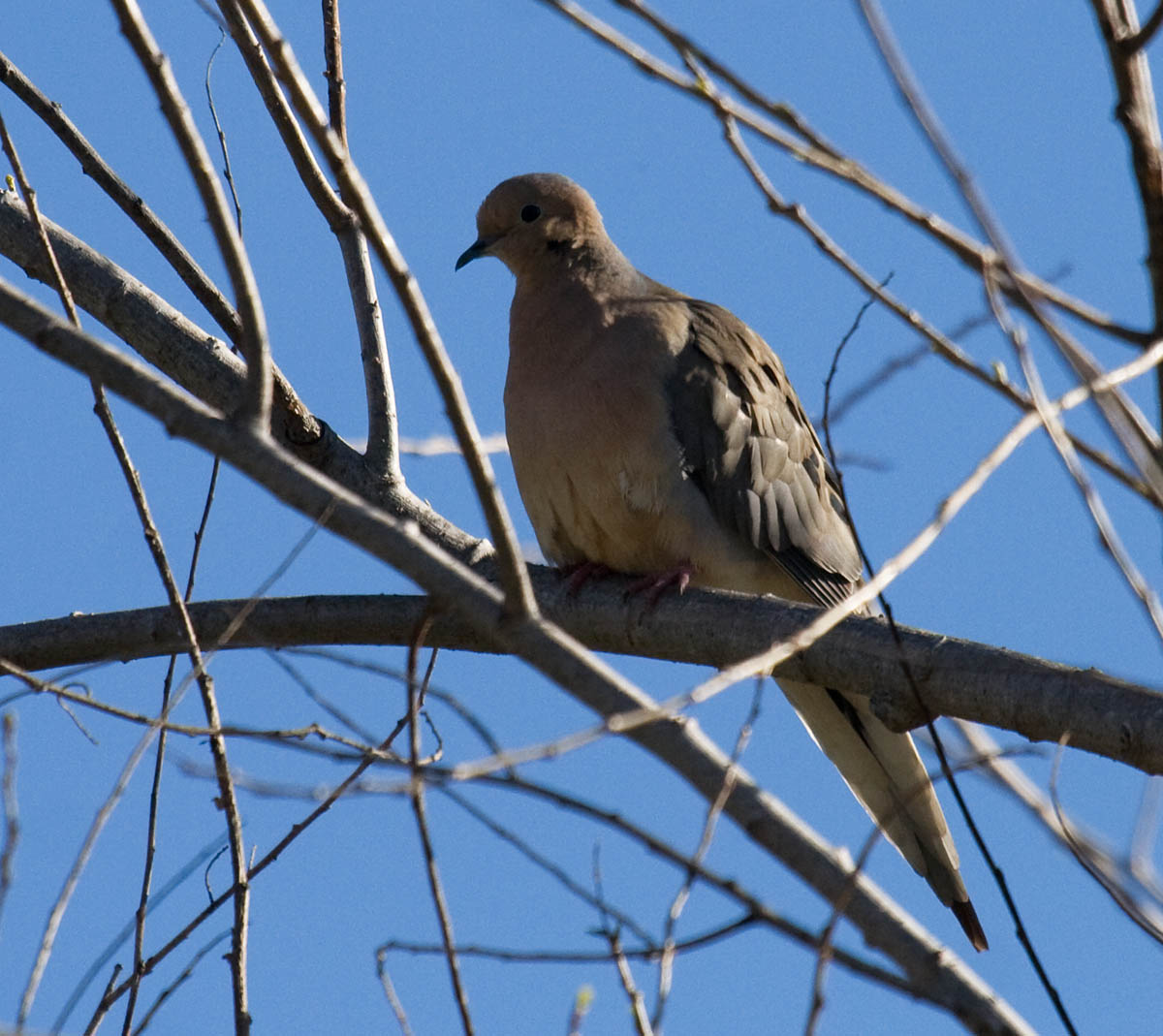
Mourning Dove in good light
Mourning Dove. Lake Hodges, California. December 1, 2013.
I can't be the only one. When I go bird watching I prefer loops to out-and-back spur trails. Don't you?

My thinking is: "I've already seen most of the birds on the trail I was just on. My chance for additional species seems higher to me on a different trail than to repeat the one I was just on."

So, when you start your birding walk and come to that fork in the loop path, which path will you take? If you say: "It's a loop; it doesn't matter," you would be wrong from a birding fieldcraft perspective.

The question is this: Do you want to glory in the beautifully colored birds lit warmly by the morning light? Or do you want to be squinting and see mostly silhouettes? I want you to think like a photographer now: point your shadow at the bird!

The sun rises in the east, more or less. In the northern hemisphere it rises in the northeast in spring and the southeast in winter. At dawn (and winter) the sun is low. If you start your birding by traveling east you'll be looking directly into the sun. However, if you start your loop by heading in a westerly direction first, looping to the right to the north, you'll start and stay in good light. Later, when you have to loop around toward the east and south, the sun will be higher, and less in your eyes.

So that's my advice to you. When you start your birding loop in the morning, choose to head off in a westerly direction first, then clockwise.

The difference can be night and day,... compare the first photo with this one:

Mounring Dove backlit
Mourning Dove backlit. San Elijo Lagoon, California. March 1, 2017.

Sunday, June 2, 2019

Blue skies and White-winged Doves in Borrego Springs

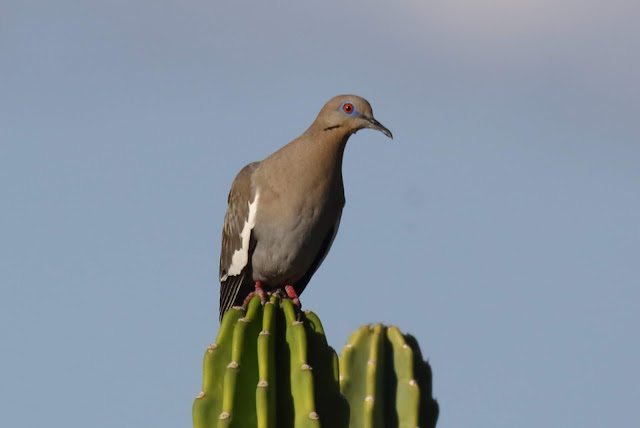
White-winged Dove
White-winged Dove. Borrego Springs, California. May 25, 2019. Blue skies!
It's been a wet spring. It's not unusual, of course, for San Diego to start the morning out with a marine layer that burns off by mid-morning. But we've had 6 months, now, of dreary, cool, drizzly, often unforecasted rainy weather. Everyone consoles themselves by saying "we need the rain." [I know, I know. I'm complaining about winter weather that often breaks 70 degrees by noon. But I need my sun!]

Even today, June 2nd, the skies are gray. "June gloom." There's a 25 % chance of precipitation in the forecast, with a high of 73F predicted. This morning the streets are wet and water drips off the plants and eaves. There's a slight mist in the air; I'm sure it's not even "measurable precipitation." But I didn't wake to my preferred sunny skies. Yes, I'm spoiled. I prefer 80, or more.

Last weekend Marlene and I got sick of it and headed over the mountains to enjoy the desert for the third time this year (4th for me). It wasn't as warm as predicted, just the low to mid-70's, but the skies were sunny. We rented our favorite inexpensive, no-frills, motel, and spent a relaxing 3-day weekend in the sun, while it poured at home on the west side of the mountains. Now, remember, the average high temperature in Borrego Springs this time of year is in the mid to high 90s, and we normally wouldn't visit again until it cooled in the fall. But that's the weather the past 6 months.

The last week of May is the tail end of spring migration and I was able to see some late migrants and take many photos of White-winged Doves, ostensibly the real reason for this post.

Some photos at the Roadrunner Club on May 25:

White-winged Dove

White-winged Dove

White-winged Dove

I found some doves in the mesquite on May 26. They weren't wary like most of the "wild" doves out in the desert (as apposed to the residential doves, above). They lack colorful eye skin and markings and may be young birds.

White-winged Dove

White-winged Dove

White-winged Dove

Friday, May 31, 2019

Great Horned Owl chick at Borrego Springs

Great Horned Owl
Peek-a-boo! Great Horned Owl chick. Borrego Springs, California. May 25 2019.
I heard an adult male Great Horned Owl hooting from trees in a golf course. "That's odd." I searched around and spied this large chick checking me out! I never did see any adults, or other chicks.

It looks to be in the "branching" stage of development. This is a period of a week or so when the large owl chicks leave the nest, climbing and hopping among the branches. Just yesterday I saw a comical photo of an owl chick, hanging upside-down by one foot from a branch, where it had fallen down a few branches. It eventually fell the rest of the way to the ground and then crawled its way back up the tree. They soon learn to fly, leaving this cute, but awkward, stage behind.

Sunday, May 26, 2019

Scripps's Murrelets

Scripps's Murrelets nest on islands in the Pacific Ocean in northern Baja California and southern California. They are frequently noted on pelagic trips off southern California in May and June. They then move northward following warm water into late summer and early fall, rarely as far as British Columbia, far (60+ miles) offshore.

Almost always noted in pairs, this is the frequent view:

Scripps's Murrelet

However, this view above is not really sufficient to separate these birds from Craveri's Murrelets. If you are really lucky, when they fly away you may be able to see the underwings--white on Scripps's; black on Craveri's. A camera helps:

Scripps's Murrelet
Barely visible, but diagnostic: white under wing linings. Usually they fly straight away, 
so all you get is the tail, and no view of the under wing.
There is also the newly-created Guadalupe Murrelet, with its eye in the middle of the more extensive white face.

Sadly, many times, you will first spot these birds flying away from you, unidentified.

Occasionally, you'll find a chick/adult pair. The chick may be reluctant to fly, and instead dives, and both birds may allow closer approach. Tiny fuzzy chicks leave the nest burrow at 2 days of age and remain with a parent.

Scripps's Murrelet
Scripps's Murrelet
Possibly older chick. It can fly, but is hesitant.
Scripps's Murrelet
Wow! Flying toward me!
Scripps's Murrelet
Scripps's Murrelet
Scripps's Murrelet, adult (right) and older chick (left).
The chick has a shorter bill, more curved upper culmen, and smoother black-and-white facial transition.
Scripps's Murrelet