Showing posts with label hybrids. Show all posts

Monday, January 22, 2018

ID: Hybrid California x Gambel's Quail

If you report sightings of Gambel's Quail to eBird on your visit to the mesquite Bosque in the Anza-Borrego Desert, you'll be prompted for details or photos. Why?

In most of their ranges California Quail and Gambel's Quail are strongly separated by habitat and don't overlap. There are a couple of places in the eastern parts of southern California where the ranges of these two quail do meet. The Anza-Borrego Desert is one such area, with the town of Borrego Springs right on the edge of this tiny area of overlap between the California Quail descending from the oak hills above to the west and the Gambel's Quail from the mesquite and cactus desert to the east.

When birding in this area one should record most quail detected as "California/Gambel's Quail" unless you get a very good look. Evidently, based on the reference below, there is no impediment to breeding between the two species. They interbreed freely. Gambel's Quail have a wider variety of songs and calls than California Quail, so in the area of overlap voice is an unreliable identification feature. Evidently the birds themselves don't care what calls and songs are given when choosing potential mates. Fortunately, the area of overlap is small and the hybrid region restricted to this small area of overlap.
"Quails are sedentary, and typically move less than 5 miles during the course of their lives." --Jennifer M. Gee. 2003. Causes and Consequences of Hybridization Between California and Gambel's Quail (Callipepla californica and C. gambelii). Princeton University Press.
Birders do not take DNA sequencers into the field. Even direct hybrids don't always show it--they can look like "pure" members of either parent species, or a mixture. So even though birds of many species probably have some hybrid ancestors somewhere in their past; go with what you see.

I searched The Birds of North America species account for Gambel's Quail and its references, Western Birds, and the Searchable Ornithological Research Archive (SORA), as well as Google generally, and was unable to find descriptions or identification articles specifically separating California and Gambel's Quail from hybrids. There seems to be more identification material on gamebird breeding websites than on birding websites. Certainly someone must have covered this identification before? Let me know in the comments below. Thank you.

So, without an identification article immediately available, we'll go with the field guide descriptions and my recent photos to create a 5-criteria preliminary hybrid quail identification guideline:

1) Crown color on males (brown or rusty)
2) Forehead coloration on males (pale or black)
3) Upper breast/back color (dark gray or pale blue-gray)
4) Lower breast scaling (strong or nearly absent)
5) Belly patch on males (formed by dense brown scaling or more solid blackish)

Let's examine some photos I took recently at the Borrego Springs Resort on January 7, 2018. There were over 35 birds visiting a residential feeder that appeared to be both pure California Quail and Gambel's Quail, as well as apparent hybrids. About 15 of these birds I didn't get good looks at. All in all, though, under field birding conditions, plumage-wise this group of quail looked to be mostly Gambel's Quail and hybrids.

The lighting was overcast, creating slightly darker and duller colors without strong contrasting shadows. Some of the birds were under trees, others were out in the open.

Photo 1. Typical-looking male California Quail. 1) Brown crown. 2) Pale forehead. 3) Dark gray upper parts. 4) Scaled lower breast. 5) Brown scaling on pale belly converge to form rusty patch.
Photo 2. Typical-looking male Gambel's Quail. 1) Rusty crown. 2) Black forehead. 3) Pale blue-gray upper parts. 4) Rather clear cream-colored lower breast. 5) Dark belly patch with faint scaling.
The scaled hind-neck is supposed to be more defined on California Quail. Additionally, the flanks are supposed to be brown on California and rusty on Gambel's. Frankly, the viewing angle makes quite a bit of difference on birds in the field, so they are not as reliable or observable as the other marks. After looking at many photos online, I really can't see a difference.

Let's take a look at more of my photos from January.

Photo 3. Gambel's Quail. Though a bit distant as it ran across the road, this male has all the proper marks for Gambel's Quail, notably the rusty crown, black forehead, pale blue-gray upper breast, unmarked cream-colored lower breast and black belly patch.
Photo 4. A pair of Gambel's Quail. Both birds show the pale blue-gray upper breast and the unmarked cream-colored lower breast. There are only these two criteria on females. The male shows a blackish belly patch, but crown and forehead criteria are not visible in this view.
Photo 5. Gambel's Quail. Again, all 5 criteria point to Gambel's.
Photo 6. Apparent hybrid California x Gambel's Quail. At first glance this bird appears most-similar to Gambel's Quail. But all 5 criteria aren't unambiguous. 1) Crown is darker brown favoring California. 2) Forehead is paler than black face favoring California. 3) Upper breast half way between the dark gray of California the light blue-gray of Gambel's. 4) The pale cream lower breast has hint of scaling, but favors Gambel's. 5) The belly patch is not as solid dark as it could be but still favors Gambel's.
Photo 7. Apparent hybrid California x Gambel's Quail. At first glance this bird appears most-similar to California Quail. Again, the 5 criteria mix to favor different species. 1) Crown fairly rusty favors Gambel's. 2) Forehead is pale as California. 3) Upper breast rather pale blue-gray favoring Gambel's. 4) Lower breast heavily scaled as California. 5) Dark belly patch as Gambel's.
I'm glad I ran into this large flock of easily-photographed birds in a residential area. Most of my quail records here are of birds flushing away in a burst, or of single warning calls in the brush and maybe a glimpse running away. Based on current eBird filters, California Quail and hybrids are accepted without comment in this area but Gambel's require descriptions. So finding a preponderance of Gambel's was a bit unexpected. Then again, because it is so hard to get decent views of these sneaky birds, and the identification criteria is not easy to find, I wonder how many birders bother to separate them. Perhaps this post will help. I know researching this has helped me.

Sunday, February 15, 2015

Intergrade American x Eurasian Green-winged Teal

intergrade or hybrid American and Eurasian Green-winged Teal
Intergrade drake American x Eurasian Green-winged Teal. Tijuana River Valley, California. January 18, 2015. Greg Gillson.
The American Ornithologists' Union currently differs from the British Ornithologists' Union in their treatment of two forms of Green-winged Teal. The AOU says that the American and Eurasian forms are just subspecies of the same species (Anas crecca carolinensis for American Green-winged Teal and Anas crecca crecca for the Eurasian Green-winged Teal (also called Common Teal or just Teal)); the BOU classifies them as separate species (Anas carolinensis and Anas crecca).

The Eurasian form of Green-winged Teal "Common Teal" breeds as far east as the Aleutian Islands of Alaska. While most of this population winters southward in Asia, some individuals are regular vagrants that are found annually in winter south to California amid flocks of American Green-winged Teal. Additionally, intergrades (if one considers them subspecies, or "hybrids" if one considers them the same species) are equally frequent--rare, but if you look, you can often find some annually.

Drakes of the American form have a vertical white bar on the side of the breast. The Eurasian form lacks this vertical bar and instead has a white horizontal bar at the edge of the wing. Additionally, the green eye/ear patch on the Eurasian form is surrounded by bolder white lines.

I photographed an intergrade at the Dairy Mart Road "Stick Pond" at the Tijuana River Valley recently. The out-of-focus documentation photo is above. It shows both the vertical and horizontal white bars, and the face markings are midway between the American and Eurasian populations.

Field guide author and artist David Sibley wrote an identification piece and drew artwork on his blog in 2011 about the two forms and intergrades between the two. If you look at his references, he used my earlier photos and discussion from my web site in 2004. Pretty neat!

Sunday, April 27, 2014

Hybrid Audubon's x Myrtle Yellow-rumped Warbler

Hybrid Audubon's x Myrtle Yellow-rumped Warbler. March 30, 2014. San Elijo Lagoon, California. Greg Gillson.
Click for larger view.
Hybrid versus intergrade--what's the difference? Well, a hybrid is a cross breeding between birds of two different species, while an intergrade is breeding between two well-marked subspecies of the same species. So, technically, this post should be discussing intergrades between Myrtle and Audubon's Warblers. But why be pedantic? These were considered two different species until 1973 and may be again some day. Where the ranges meet in NE British Columbia they breed together producing offspring with mixed characters.

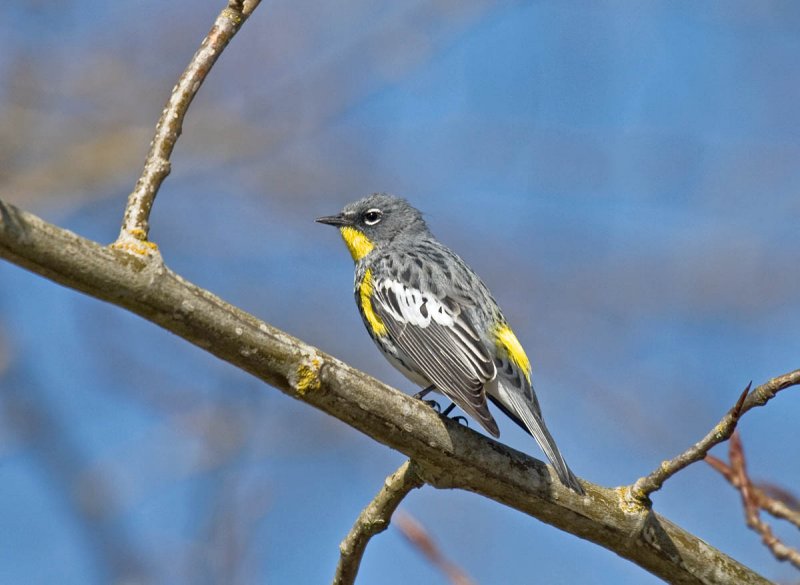
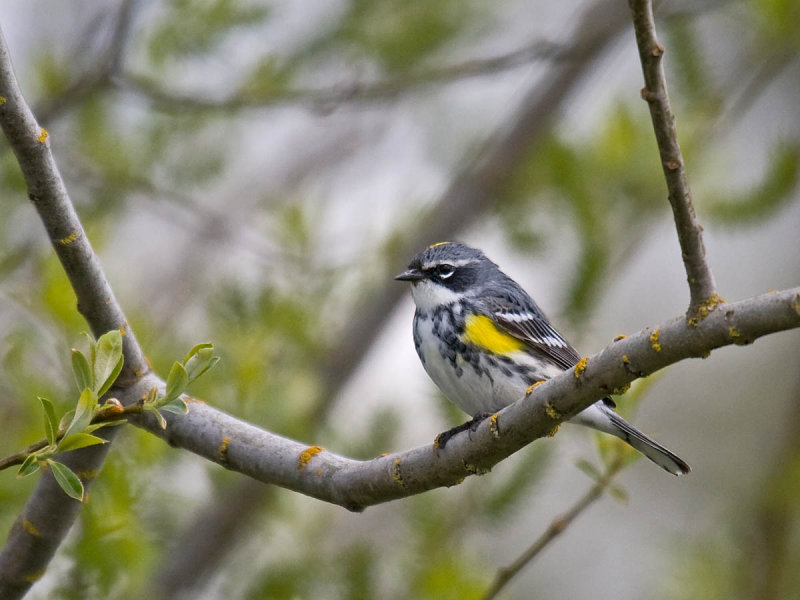
You may know that the western Audubon's form of Yellow-rumped Warbler has a yellow throat and the eastern Myrtle form has a white throat. But, of course, that is not the only field mark.

Myrtle Warblers have thin white eyebrows while Audubon's do not. Myrtle has two white wingbars while Audubon's has a big white wing patch. The under tail on Audubon's has black feathers all the way across the tip while on Myrtle the white reaches the end of the tail. The Myrtle has a hard "check" call note while Audubon's is a higher "tchip."

Intergrade Yellow-rumped Warblers are more often noticed in photos than in the field. In the photographed bird above, there is a bit of white around the edges of the yellow throat. And there is a short white eyebrow behind the eye (it was slightly longer and more obvious on the other side of the head). The wingbars form a messy patch. The under tail feathers are white to the tip in the center. Really, in most aspects, this bird is midway in field marks between Audubon's and Myrtle, except for the more Audubon's-like throat.

Here are two photos of more typical representatives of each form for comparison.

Audubon's Warbler
Audubon's Warbler. Forest Grove, Oregon. March 23, 2012. Greg Gillson.
See? Throat, eyebrows, wingbars, undertail.

Myrtle Warbler
Myrtle Warbler. Forest Grove, Oregon. April 29, 2011. Greg Gillson.