Here is my trip report for the May 21, 2016 pelagic trip from San Diego. This was a 12 hour trip. Usually this trip is aboard
Grande, but it is in dry dock for annual maintenance. So about 35 of us birders were aboard
Ocean Odyssey. Due to the change and having to move the boat, we got a late start.
 |
| Ocean Odyssey backing into the dock to pick us up. |
Before even boarding we were being watched by this Black-crowned Night-Heron in another boat's rigging.
 |
| Black-crowned Night-Heron. |
Overhead flew Caspian and Elegant Terns.
 |
| Caspian Tern |
Another common bird in the marina, and throughout the rest of the day--even far offshore, was Brown Pelican.
 |
| Brown Pelican |
As we made our way down the bay toward the ocean, we were accompanied by Western Gulls, and one Heermann's Gull.
 |
| Heermann's Gull |
Soon we reached the mouth of San Diego Bay and passed by Point Loma and entered the ocean.
 |
| New Point Loma Lighthouse |
We check all the buoys for roosting Brown Boobies. Instead, we found a couple of California Sea Lions. We found boobies later.
 |
| California Sea Lion |
The San Diego Bay faces south. We continue about 5 more miles in that direction, heading to the Mexican border. We trailed gulls, terns, and pelicans.
 |
| Brown Pelican, adult (left) and immature (right) |
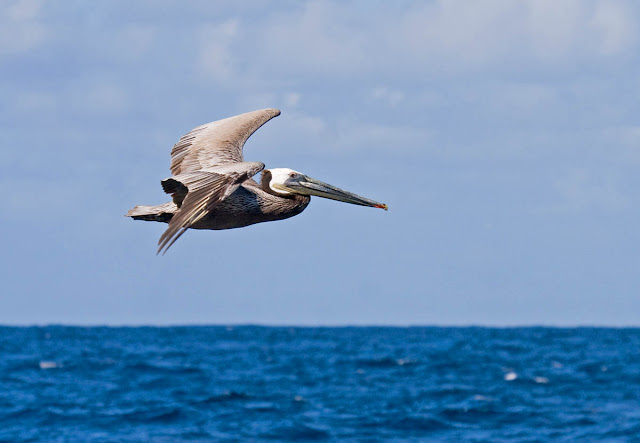 |
| Brown Pelican |
Soon we reached the border with Mexico and turned westward. From here the Coronado Islands, I mean, Islas Coronados, offshore 9 miles from Tijuana, were also only about 9 miles away to our south.
 |
| Islas Coronados |
We picked up our first Northern Fulmar in this section. They were in heavy molt and can be flightless this time of year. Remembering that fulmars are more aggressively attracted to human food than gulls (if you can believe that) it occurred to me that I had been up since 4 am and hadn't had anything to eat. So I ordered a huge breakfast burrito from the galley. Pelagic birding trips from San Diego are the only ones I know of that regularly bring a cook!
 |
| Northern Fulmar |
We also picked up our first Scripps's Murrelets. Spring is the best time for this species in San Diego County. Soon we reached the south end of the Nine Mile Bank and turned northward to follow it.
 |
| Scripps's Murrelet |
There were many small flocks of Sooty Shearwaters throughout the day.
 |
| Sooty Shearwater |
As we left the north end of Nine Mile Bank and headed northwest across the San Diego Trough, we spied a mixed flock of birds that included a Brown Booby.
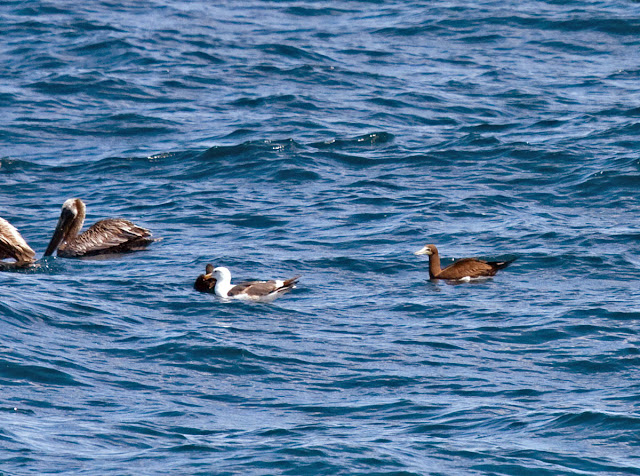 |
| Brown Pelican (left), Western Gull (center), Brown Booby (right) |
Both Sooty Shearwaters and Pink-footed Shearwaters were in heavy molt. The lack of normal wing surface made them flap more than typically, with less gliding. It also gave them odd wing and tail shapes and odd exposed wing patches normally covered by feathers.
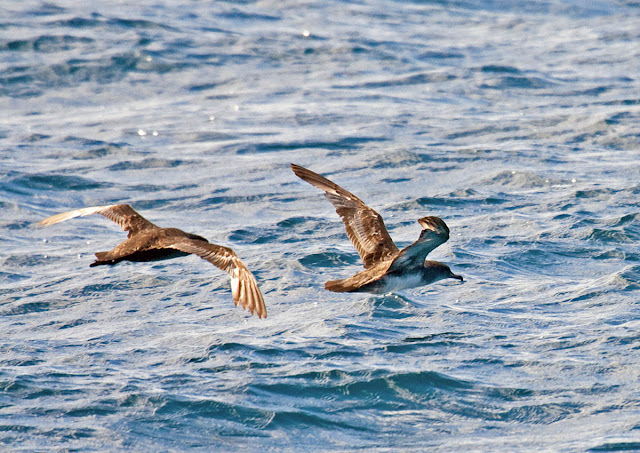 |
| Sooty Shearwater (left) and Pink-footed Shearwater (right) |
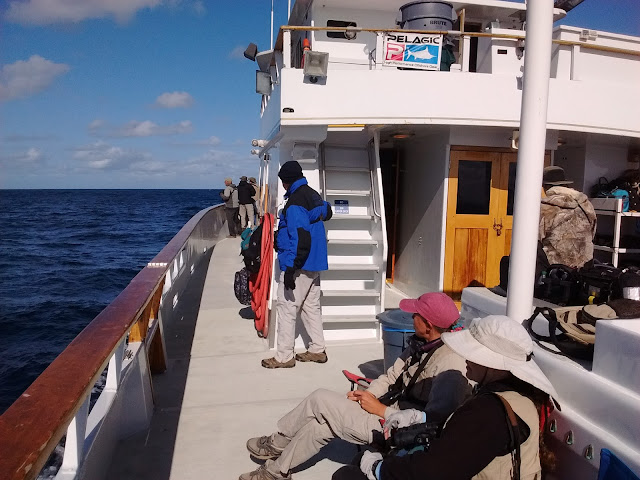 |
| A relaxed moment |
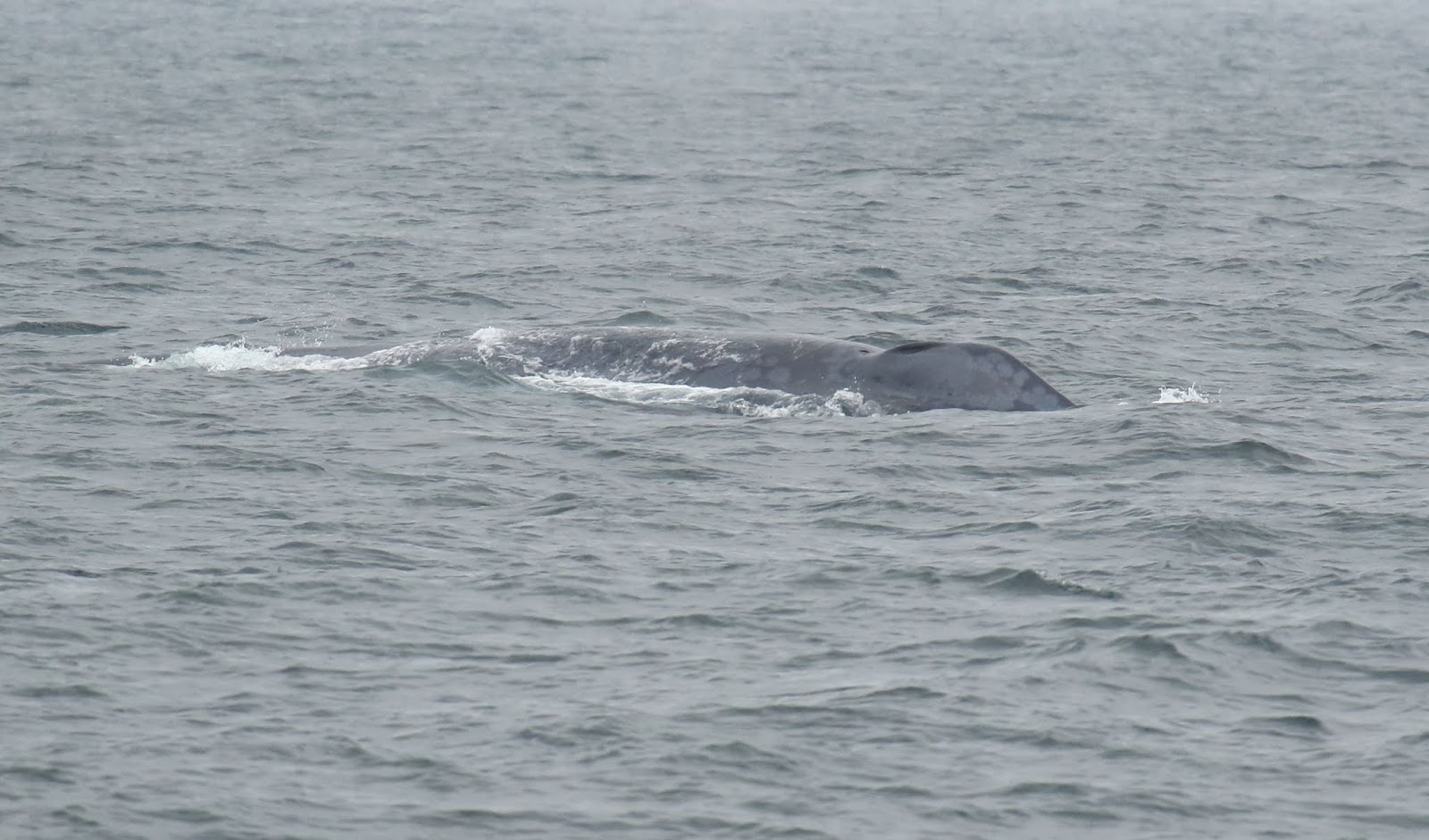
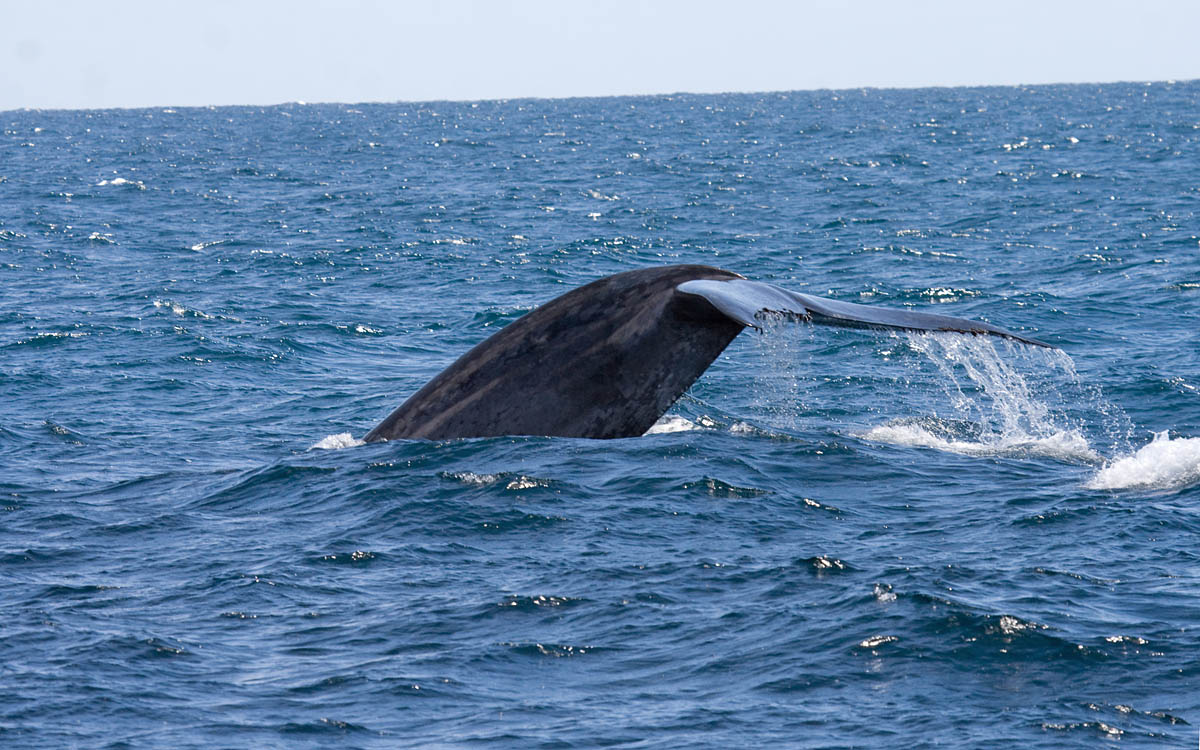
Ahead we spotted the tall blow of one of the great whales. We headed toward the animal on the surface. As we neared it dove. We decided to wait around 10 minutes or so for it to resurface. When it did, we got great views (as previously posted
here).
 |
| Blue Whale |
 |
| Blue Whale |
As we waited for the whale to resurface and get those photos above, a Black-footed Albatross came in, curious to see what we were doing. I organized and attended over 175 pelagic trips from Oregon from 1994 to 2014. Albatrosses were always the draw and crowd-pleaser. Somehow, a pelagic trip just isn't the same without the friendly albatrosses. They are much rarer in San Diego County waters, but spring--especially May--is the time to see them.
 |
| Black-footed Albatross. No white on rump or vent, and no flight feather molt, so probably only 1 year old. |
The albatross circled once and landed in the stern for the popcorn chum we were throwing out continuously on this trip. I had one person in the past express disappointment that albatrosses came in to popcorn and cheese puffs like a city park goose. Somehow it spoiled the regal majesty of the bird in his eyes. I guess he had never read
Loye Miller's 1940 description of the Black-footed Albatross as a "feathered pig" when it came time to choose food to eat, but a 'gentleman in table manners.'
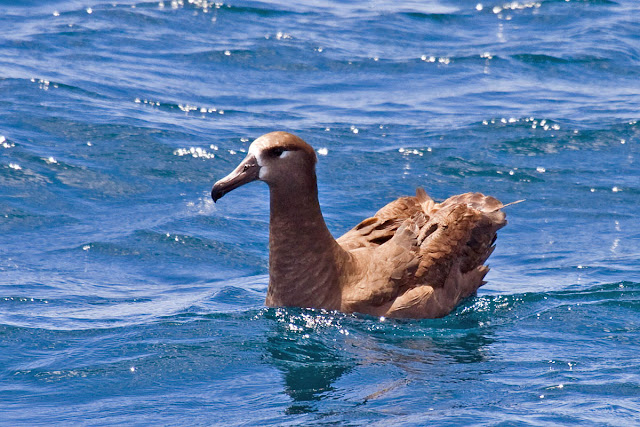 |
| Black-footed Albatrosses |
As we reached waters at the edge of the Thirty Mile Bank we had more flocks of Black Storm-Petrels. Waters were a little roughed up, but we glimpsed a few smaller storm-petrels, of which we were able to identify a couple as Ashy Storm-Petrels and a couple as Leach's Storm-Petrels (a county-first for me!). My attempts at photographing the storm-petrels were unsuccessful. Most were out-of-focus. Over the years I have taken thousands of photos of beautiful waves with out-of-focus birds flying in front. Therefor, I find it most successful to take a picture of the water under where I think the bird is flying, as odd as it sounds. The camera wants to focus as far back as it can on all those ripples, not the little bird in the frame. Here's my "best" storm-petrel shot for the day...
 |
| Camera-shy Black Storm-Petrel darting behind a wave. |
After we turned around and headed back southeast to travel back across the "less birdy" (but not totally birdless) San Diego Trough, I decided to take a break, eat lunch, and re-hydrate myself. The galley was open and the cook made me a huge burger. Unlike most people, pelagic trips make me hungry!
 |
| Sooty Shearwater |
Most birds on the return trip were the same. But the lighting and the return with the wind and waves made spotting Cassin's Auklets ahead much easier and we saw scores. Most flushed several hundred feet in front of the boat, so photos were out of the question. In fact, for those who had never seen them before, they really still haven't had a good look. We did get a close look at a few Red-necked Phalaropes on a tidal rip.
 |
| Red-necked Phalarope |
We encountered more flocks of Sooty Shearwaters. We tried and tried to find some rarity hidden within, but no.
 |
| Sooty Shearwaters |
Because we didn't get
Grande this day, this was a new skipper and crew to bird watching. They did a pretty good job. But sometimes they put the birds on the wrong side of the boat so we were looking into the sun at them. And sometimes they didn't come up stealthily on an arc, but pointed the boat directly at the birds, causing this (below), instead of good photo opportunities. The rough water splashing against the side of the boat didn't help allay the birds' fears either.
 |
| Sooty Shearwaters taking flight |
Finally, at the south end of the Nine Mile Bank, we turned due east, and a cry of "Jaeger!" went up that quickly changed to "Skua!" I was a bit slow to remember that I had a 10 pound camera around my neck for the past 10 hours, so I was a bit late getting this shot off. It's sufficient for documentation purposes, I guess. Late May is about the earliest you can expect a skua off the West Coast. This is primarily a fall bird that peaks (in this case meaning more than one individual) in early October and is immediately not seen after that. It is rather rare in San Diego waters, even so. My second first-county-record of the trip.
 |
| South Polar Skua |
Finally I got a decent shot of a shearwater.
 |
| Pink-footed Shearwater |
This next photo was more an experiment to see if I could anything in focus on flying murrelets. These didn't take off until the boat was quite close, so that helped. The camera focused on the water, but the bright sun aided in keeping a high shutter speed so the wings weren't a blur. The "sweet spot" (settings where I get the most good pictures) on my camera/lens combination is f7.1 and ISO400. So I always shoot aperture priority with these settings and let the shutter speed vary with the light. The left hand bird is back a ways toward those in-focus waves behind. So the right hand bird is a bit soft in focus. If you don't blow up the photo too large it looks pretty good.
 |
| Scripps's Murrelets. White underwings and even white chins visible for ID confirmation. |
Well, we're just about back, only another hour to go. I saw 7 Brown Boobies in this trip segment. One white-headed adult male approached closely. None of the photos were really good. So I present an artistic mood photo below (that just means it isn't very close).
 |
| A Brown Booby soars off toward the Coronado Island, a few miles away in Mexico, where there is a breeding colony. |
I had basically tired out by this point. I was still looking for new birds but not counting anymore after we reached a mile offshore. We entered the bay and then slowly motored past the bait docks. They were crowded with cormorants and herons.
 |
| Bait dock buddies. Snowy Egret and California Sea Lion. |
 |
| San Diego skyline and waterline. |
Selected seabird trip totals (my sightings only, not entire boat):
Black Storm-Petrel: 316
Brown Booby: 10
Scripps's Murrelet: 19
Elegant Tern: 755
South Polar Skua: 1
Black-footed Albatross: 1
Cassin's Auklet: 35
Sooty Shearwater: 593
Pink-footed Shearwater: 31
Northern Fulmar: 4
Ashy Storm-Petrel: 1
Leach's Storm-Petrel: 2
Apparently, the only species seen by others that I missed was that 2 people saw a Fork-tailed Storm-Petrel (fairly rare here) for a second or two (literally) before it disappeared behind a wave, never to reappear. On the other hand, I was one of less than half the boat that identified the Ashy and Leach's Storm-Petrels. In this case my experience with shape and flight style helps in picking out birds from a flock that are just a bit different.