Showing posts with label animals. Show all posts

Saturday, May 11, 2019

Zebra-tailed Lizard at Agua Caliente

The sun glints harshly off the silvery white sand. Suddenly, a few steps ahead, a shadow moves quickly across the sand! A rather small skinny lizard, about 7 inches long, runs across the desert with its tail curled up in the air like a scorpion.

Zebra-tailed Lizard
Zebra-tailed Lizard
Zebra-tailed Lizard. April 28, 2019. Anza-Borrego Desert, California.

Monday, April 22, 2019

Turtles at Kit Carson Park

I don't know that much about turtles (except for an Ogden Nash limerick).

Here is a great website on California herps. From this website I found out what I suspected. These turtles are all non-native escaped pets--or at least, their recent ancestors were. The big turtle showing some red stripes on the underside ("plastron"--new vocabulary word!) is the Western Painted Turtle (Chrysemys picta bellii). Most of the others here have yellow stripes on the plastron and a red mark behind the eye--the Red-eared Slider (Trachemys scripta elgans).

Sunning Turtles
Sunning turtles. March 29, 2019. Escondido, California.

Friday, April 12, 2019

Ground Squirrel at Stonewall Mine

While quite a pest if they are digging up your yard, how could you not love this cute little guy in the mountain slopes?

Squirrel
Ground Squirrel. Stonewall Mine, California. March 18, 2019.

Monday, April 8, 2019

Jackrabbit in Borrego Springs

Lepus californicus is known as the Black-tailed Jackrabbit or American Desert Hare. Oh that little stick right through the face! This could have been a much better photo, but the animal wouldn't cooperate. I'll have to try again.

Black-tailed Jackrabbit is also known as the American Desert Hare
Black-tailed Jackrabbit. March 17, 2019. Borrego Springs, California.

Friday, March 8, 2019

Is it all right that I like coyotes?

Coyotes seem to be universally despised. Despite two centuries of persecution they survive, even thrive, alongside humans. Pretty impressive that. In fact, the more you kill, the larger their litters become. At the same time, persecution breaks up their packs into small family units, helping them evade their enemies.

They are opportunistic. They primarily eat rodents, insects, rabbits, fruit, berries. But they will eat cats, small dogs, and livestock on occasion. That doesn't win them any friends. More and more they are moving into cities where no one shoots, traps, or poisons them. Here they eat rats and human garbage, which they find in plenty.

Coyote. Ramona, California. January 21, 2019.
It is extremely rare for a coyote to attack a human, though it happens more frequently as the "urban coyote" population increases. Dogs on the other hand? They bite 4.7 million people each year in the United States (Dog Bite Statistics). And dogs kill other dogs, cats, and livestock too. Yet one we love, the other we despise.

I see coyotes fairly frequently. I've seen luxuriously-furred animals hunting voles in the snow in Oregon. I've seen mangy-looking skinny animals hunting lizards in the desert. I hear them howling out the window when I wake up at night, even in residential areas. I see them sitting on the hillside like a small German Shepherd, soaking up the warming rays of morning sun.

But mostly, I see them hunting mice in fields, as this one pictured above. They keep a respectful distance, but aren't overly wary. They get no animosity from me.

Sunday, August 5, 2018

Chasing the Indigo Bunting: Bees, moths, and butterflies

The reports of a rare Indigo Bunting had been on the local bird list for a week. An atypical patch of white feathers on the belly, however, prompted a spirited discussion causing some to use the dreaded h-word. That's right--hybrid. Others disagreed. Well, for good measure, someone went out and found a no-doubt-about-it, honest-to-goodness, all-blue Indigo Bunting only a quarter of mile farther down the trail.

So, when another weekend rolled around and they were still being reported, I made my plans to visit Paso Picacho Campground in Cuyamaca Rancho State Park.

Flowers were in bloom and accompanied by pollinators. So I took several photos of these flying insects. I'm not very practiced at identification of butterflies, not to mention moths and bees. But I've done my best. Let me know if I'm off.

I start off with a rather large, shiny black bee on a flowering shrub at the parking lot.

black bee
This is one large bee! Do you see the three tiny ants on the flowers?
Down the trail a ways I encountered a couple of Park workers out with their cameras. They were photographing hummingbird moths. I don't see them. Wait! That little thing? The ones I've noted in the past were almost 3 inches long, not one inch. No one would mistake these for hummingbirds!

Hummingbird moth
These hummingbird moths were quite small at barely an inch in length. I think the bee was bigger.
Oh, by the way. The plant above with the hummingbird moth is Poodle Dog Bush. Many people have reactions to this plant similar or worse than poison oak. These dense bushes were 5 feet high and equally broad.

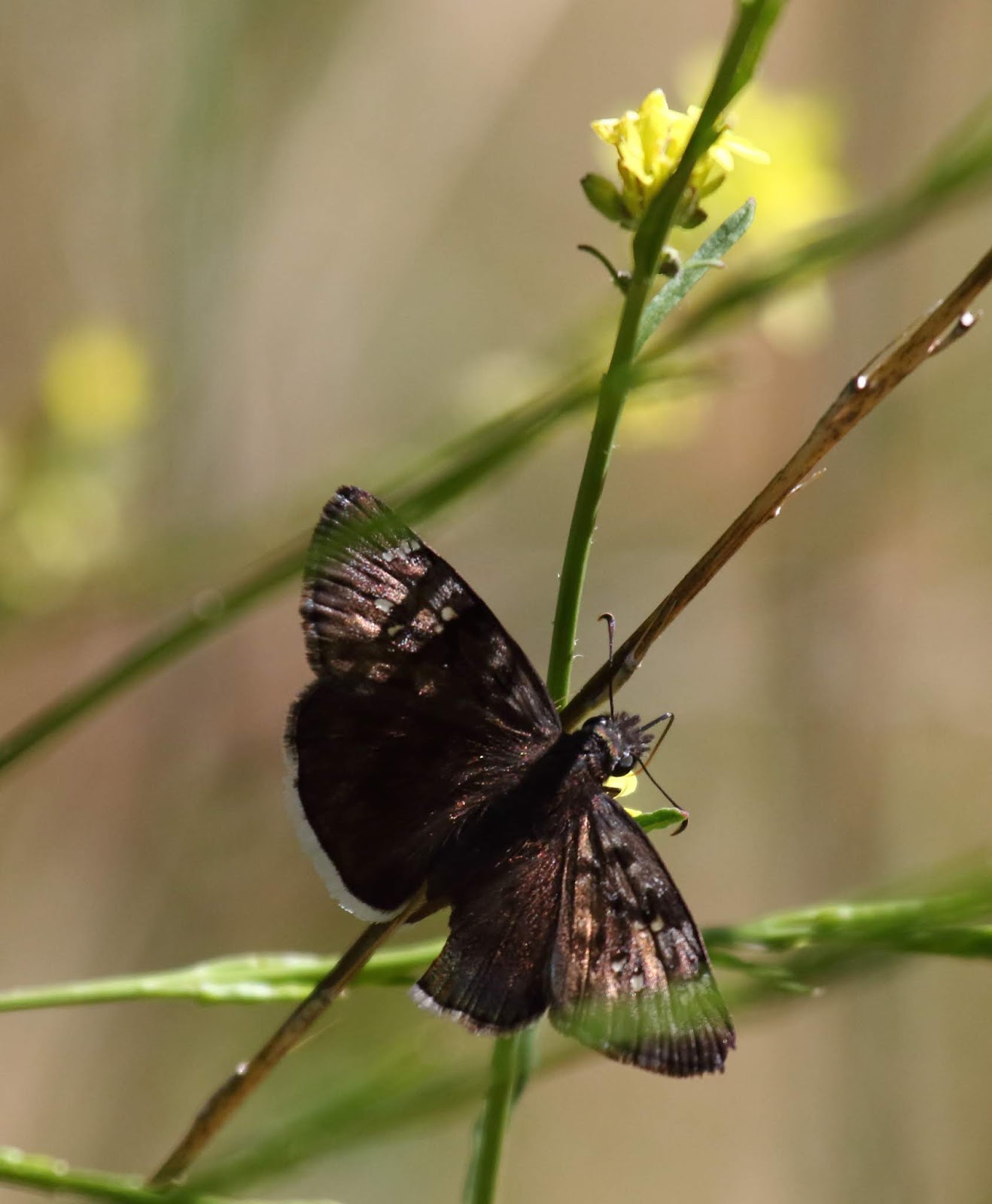
Funeral Duskywing
Funeral Duskywing
California Sister
California Sister
California Sister
Acmon Blue
Acmon Blue
I used this website to help identify the butterflies: Butterflies and Moths of North America.

Oh, I actually did find the all-blue Indigo Bunting. It was singing away in the oaks. My documentation photo is not all that good. But it is my first Indigo Bunting in California.

Indigo Bunting


Thursday, August 2, 2018

Rattlesnake!

Sometimes you are happy just to get a documentation photo, and don't care too much about the artistic merits. There was no way I was going to get eye-level with this guy! At 6 feet away I was close enough already.

Western Rattlesnake
Western Rattlesnake
Western Rattlesnake
Western Rattlesnake. Dixon Lake, Escondido, California. June 29, 2018.
As I was walking around the fishing trail at Dixon Lake I noted a man who was coming toward me, but had stopped. The snake was coiled and facing him, rattling away! This snake was at least 4 feet long, perhaps a bit more. They get to 5 feet long. I am always surprised by how stout they are throughout their length.

I don't see rattlesnakes very often. As a child, growing up in Oregon, I was always turning over rocks and logs looking for snakes and lizards and salamanders. Poisonous snakes were very unlikely in northwestern Oregon. Not so in southern California. I have outgrown the urge to seek for critters under rocks and logs now. I would like to see sidewinder in the desert though.

Wednesday, June 13, 2018

Flying dolphins!

We had a blast watching dolphins last Sunday!

The pelagic trip offshore 30 miles from San Diego on June 10 was primarily for bird watching. However, we came across numerous pods of dolphins chasing schools of fish to the surface. The Common Dolphins--both the long-beaked and short-beaked varieties--herded the fish together in a final splashing assault.

So many fish at the surface attracted Elegant Terns and Sooty and Pink-footed Shearwaters. These birds were diving into the water from flight. While the terns flew high into the air again for impressive high-dives, the shearwaters would often remain in the water. They'd stick their head under to look for fish, then run a few feet on the water with wings open and plunge into the water again.

Sooty Shearwater puts on the brakes to avoid flying into leaping Common Dolphin
Every once in a while a dolphin would decide to jump out of the water. Photographing such a random jump is pretty impossible. However, occasionally one dolphin would jump several times in a row. Thus I was able to photograph this dolphin's near mid-air-collision. I keep imagining I can see a goofy grin on the dolphin's face and hear the angry cussing of the shearwater.

Common Dolphin rockets to space
"We have liftoff." SpaceX has nothing on this little rocketman.
Common Dolphin riding the bow wave
Common Dolphin riding the bow wave.
As usual, several dolphins peeled off from the feeding group to come and play in the bow wake of our boat. It must be nice to so easily find and capture your food that you can take a play break right in the middle of dinner!

You don't realize how poorly these close-up animals photograph, though. The water distorts their appearance. When they break the surface for a quick breath, the splash nearly completely hides them. These close animals are best shown in video, where our slow eyes can combine all the frames of distorted outlines and splashes into an exciting spectacle.

Wednesday, July 26, 2017

Colored pencil: Cottontail

Colored pencil: Desert Cottontail
Desert Cottontail.
Colored pencil based on photo from Lake Hodges, California on April 26, 2017. Greg Gillson.
It has been just over 6 months, now, since I started nature journaling. Well, in actuality, I've really only done journaling in the field one weekend. My field drawings and notes are really slow and crude--I need much more practice. However, I have done nature art based on my photos. Does that count? I've tried for photo-realistic colored pencil illustrations. It fits my personality--careful, detail-oriented. Colored pencil is a very slow medium.

And my visualization is slow--I am still learning how to see color and value (light and dark). In fact, I may have studied the photo of this cottontail for two days before putting pencil to paper. You can't do that in the field!

Tuesday, May 30, 2017

Toadlets!

On April 19th I finally hiked on the trails of Daley Ranch in Escondido. I say "finally," because, I had been visiting Dixon Lake off and on for a couple of years. They both share the same parking lot! The lake seemed more green and inviting than the rather steep trail that headed into Daley Ranch through the dry chaparral.

But after this winter's rains I had heard that the ponds had refilled.

Indeed, the first half mile was upward into dry brush, but then dropped through oak woodlands into a fertile valley and the preserved ranch house.

Walking around the ponds that had probably been dry for the past 5 years, I heard the calls of coots and Gadwall ducks. And then I noticed little inch-long (if that) toadlets scrambling away from my footsteps.

California Toad

California Toad

California Toad

These are just-out-of-the-pond California Toads. They will grow much larger, up to 5 inches in length, snout to bum.

Some birds of Daley Ranch...

Red-shouldered Hawk
Red-shouldered Hawk stare-down.
Acorn Woodpecker
Acorn Woodpecker looking for that one perfect hole...
Acorn Woodpecker
Nope! This acorn must belong in a different granary!
Lazuli Bunting
Lazuli Bunting

Tuesday, May 2, 2017

Desert Bighorn Sheep at Agua Caliente County Park

Agua Caliente County Park is very isolated in The Anza-Borrego Desert. There's no direct way to it. You have to go over the mountains and then either north or south on the "Great Southern Overland Stage Route of 1849." That road name itself should evoke the Old West and the wildness of the area.

From San Diego you have to travel east 90 miles on I-15 to Ocotillo and then north for 30 miles (most miles, least time--2 hours). Or, you can travel 63 miles to the mountain tourist town of Julian and then down 12 miles to Scissors Crossing and south another 22 miles (20 miles shorter, 7 minutes longer (unless Julian is at its usually crowded and clogged weekend self--when it can take 20 minutes to get through the 1/2 mile long Main Street, which is also State Route 78 and 79)).

From Escondido, in the North County, it is 80-90 miles, and about 1 hour and 45 minutes. The shorter route goes through Julian, the less-trafficked route through Warner Springs.

Agua Caliente features a campground, hot springs and pools, and hiking trails. The birding is great in spring. That's when birds migrating out of Mexico at night find themselves at dawn over the great American Southwest deserts. Then the trees and water in this campground become a welcoming oasis in the dry surrounding lands.

As Marlene and I were about to depart from our lunch stop here, she spotted some movement on the hillside above the park entrance--our first views of Desert Bighorn Sheep (Ovis canadensis nelsonii)! Actually, the Bighorn Sheep here are quite distinctive and were formerly considered a separate subspecies called the Peninsular Bighorn Sheep (O.c. cremnobates).

Desert Bighorn Sheep at Agua Caliente County Park

Desert Bighorn Sheep at Agua Caliente County Park

Desert Bighorn Sheep at Agua Caliente County Park

Unlike other Bighorn Sheep, this variety is perfectly adapted to the desert. Apparently, their body temperature can safely fluctuate several degrees. This allows them to handle the cold nights and hot days of the desert during winter and summer. They are very adept at obtaining rainwater on rocks, and getting moisture from the plants they eat, so much so that they may not visit permanent water sources for weeks at a time.

Desert Bighorn Sheep at Agua Caliente County Park

Desert Bighorn Sheep at Agua Caliente County Park

Desert Bighorn Sheep at Agua Caliente County Park

Colored pencil drawing Bighorn Sheep by Greg Gillson

Tuesday, March 7, 2017

Coyote at Lake Hodges

Coyote
Coyote. Graphite and colored pencil. Greg Gillson.
Coyote
Coyote. Lake Hodges, California. January 29, 2017. Greg Gillson.

Saturday, June 4, 2016

Blue Whale

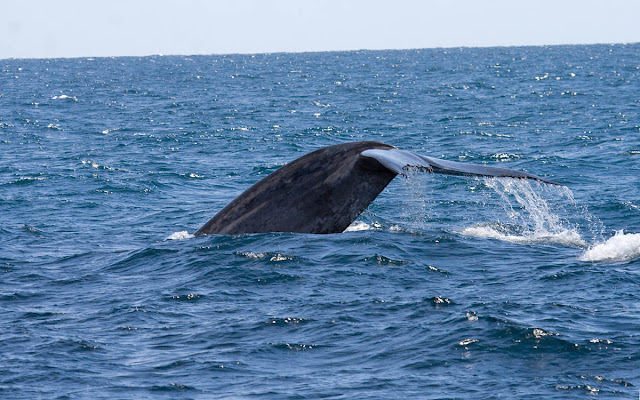
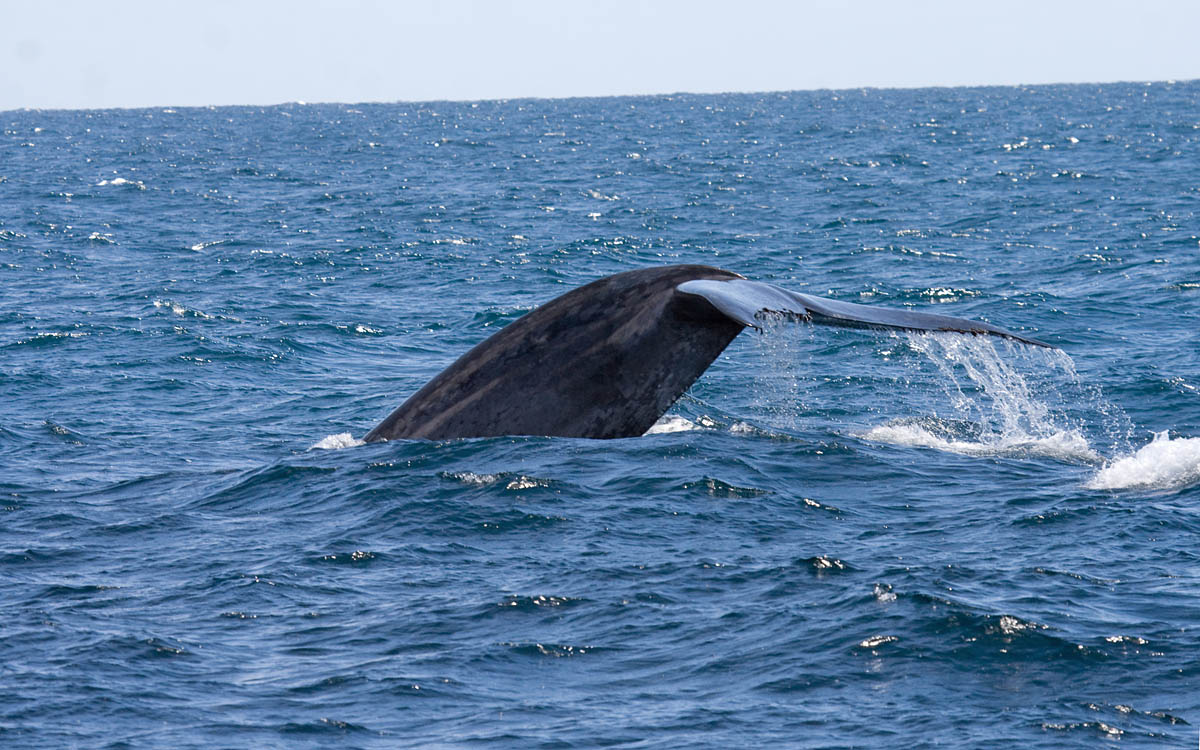
The May 21 pelagic birding trip out of San Diego was a great success. I'll be writing about it soon. One of the highlights about 30 miles offshore was a rather close Blue Whale. It dove as we first approached and we decided to wait 10-15 minutes for it to resurface. Even though this was not a bird, it was a great decision. A Black-foooted Albatross flew up to investigate what we were doing! As soon as the albatross landed to eat popcorn and pose for some photos, the whale surfaced.

It has been 10 years since I saw my first Blue Whale. It left a lasting impression on me. I wrote at the time:
"The huge geyser of a spout hung in the air. The dual blow-holes were like washtubs. The smooth, almost translucent blue back kept rolling and rolling until the small dorsal fin finally arose. And then, during the dive, the huge flukes lifted up like a rising apparition, water pouring off every surface. My knees are still weak from being so close to this huge, gentle, monster."
Blue Whale off San Diego
The spout of Blue Whale is typically 30 feet tall.
Information from Wikipedia follows.

Whaling
Blue Whales are fairly fast. Thus, it wasn't until special whale hunting steamships were invented (primarily from the 1890's) that significant numbers of Blue Whales were killed. Peak hunting was from 1930 to 1946.

Worldwide, whale hunting into the 1970's plummeted Blue Whale numbers to the point of extinction (650-2,000 animals). Though Blue Whale populations in Antarctica are recovering at about a 7% per year clip, they remain at only 1% of their original numbers there. The world wide total number of Blue Whales today (5,000-12,000 animals estimated in 2002) is less than 5% of the pre-steamship whale hunting numbers of 275,000. Blue Whale populations in the western Pacific (Japan) have not recovered.

The California population of Blue Whales was never very high. The population today has returned to pre-hunt numbers (2,200 animals).

Blue Whale off San Diego
The blow hole is on the top of the head.
The biggest animal to have ever lived on earth
Everything about the Blue Whale is B-I-G. The creature grows regularly to 80 feet in length, sometimes close to 100 feet. They weigh 80-150 tons. The tongue weighs 3 tons. The heart weighs 400 pounds. The penis is 8-10 feet long. At birth the calves weigh 6,000 pounds, drink 100 gallons of milk every day, and gain weight at the rate of about 200 pounds per day.

Blue Whale off San Diego
75% of the whale is in front of the dorsal fin, which is typically only 9-11 inches tall.
On the other hand, the food that Blue Whales eat--krill--is T-I-N-Y. Krill are shrimp-like swimming crustaceans only 1-2 centimeters (1/16th of an inch is in the middle of this range).

No dieting allowed
While an average adult human may require 2000 calories per day, an adult Blue Whale requires a daily intake of 1.5 million calories! That means straining out of the water up to 40 million krill, equal to 7,900 pounds of krill, every day.
Trivia bonus box:
Food calories are actually kilocalories, or 1000 calories. A calorie is the heat necessary to raise one gram of water 1 degree Celsius. The food calorie, or kilocalorie, is the heat required to raise a kilogram (1 liter or a bit more than a quart) of water 1 degree Celsius (1.8 degrees Fahrenheit).
Blue Whale off San Diego
The back is so long that the spout and dorsal fin are not seen above the water at the same time.
Here is the final dive sequence...

Blue Whale off San Diego
Arching the long blue-gray back in preparation for a deep dive...
Blue Whale off San Diego
The last 25% of the whale...
Blue Whale off San Diego
A waterfall pours off the flukes...
Blue Whale off San Diego
Typical Blue Whale fluke shape.
For more information on at-sea identification of the 3 largest whales: Blue, Fin, and Sei, check out the Wild Whales website sponsored by the Vancouver Aquarium.

Friday, November 6, 2015

California Flying Fish

When the ocean waters are especially warm in southern California one can view California Flying Fish. They are really more "gliding" fish than flying fish, as they don't flap their "wings" (pectoral fins). They gain speed under the water and then jump out, gliding on large pectoral fins. They frequently glide 150 feet before touching the water--and even then, their flight is not necessarily over.

Flying fish have forked tails. The lower lobe of the tail is much longer than the upper. As their glide slows and they drop closer to the water's surface an amazing thing happens. Rather than splash back into the water, they may vibrate their lower tail lobe in the water to pick up speed and extend their flight! Thus, a fish may combine several glides into a single flight reaching several hundred feet! They may stay out of the water for more than 30 seconds.

Up to 19 inches long--California Flying Fish are the world's largest.

California Flying Fish
California Flying Fish. Off San Diego, California. October 11, 2015. Greg Gillson.
California Flying Fish
Vibrating the lower tail lobe for another bout of gliding.
California Flying Fish
Off it glides again!

Saturday, May 9, 2015

San Diego Gopher Snake

Monday I was repairing an irrigation line on the hillside. As I was making my way down the steep slope my path was blocked by this large brown-patterned snake.

San Diego Gopher Snake
I have no fear of snakes. But it gave me a bit of a start anyway--shaking me from whatever my thoughts were at the moment (probably, "Don't slip and tumble down the hill").

"Ooh, cool. A snake!" Brown and black with no red or yellow--not a Garter Snake. Not rings of black and white, so not a California King Snake. Okay, skinny tail and blunt head. No worries. This is not a Rattle Snake. This must be the common and widespread Gopher Snake (various subspecies also known as Pine Snake and Bull Snake). It is, in fact, the San Diego Gopher Snake.

The San Diego Gopher Snake (Pituophis melanoleucus annectens) is 31-51 inches long as an adult, the female longer. I estimate that the snake I saw was about 48 inches, so likely a female.

It wasn't moving as fast as I like, so I reached out and picked up the tail a bit to see if it would scoot off my path. Nope; it coiled up in a defensive fashion.

San Diego Gopher Snake

I found another way down the hill.

Saturday, December 20, 2014

Red-eared Sliders

red-eared slider
Red-eared Sliders. San Marcos, California. November 27, 2014. Greg Gillson.
These turtles were sunning themselves at Woodland Park in San Marcos on a recent visit.

Native to the SE United States and northern Mexico, they are the most-common turtle pets in the US, and popular as pets in the rest of the world, as well. Unfortunately, they escape or are released into the wild and out-compete native turtles. They are listed as one of the 100 most-invasive species in the world--not a good list to be on. (Wikipedia)