Friday, January 31, 2014

San Diego County Bird #219: White-winged Dove

White-winged Dove
White-winged Dove. Borrego Springs, California. January 26, 2014. Greg Gillson.
I always think of this dove as endemic to the deserts of the Southwest. However they are more widely distributed, occurring from Texas to southern California, south to northern south America. It also is found in the Caribbean--Cuba, Bermuda, and recently to Florida. And it is expanding its breeding range. These birds frequently show up in fall well north of their normal range--I've seen singletons twice on the southern Oregon Coast.

White-winged Dove is the 219th species of bird I've seen in San Diego, County.

Additionally, as part of my goal to see 300 species of birds in San Diego, County in 2014, this is San Diego County Year Bird #152. This is my final new species of the year for January. I still have a long way to go to reach 300--I'll need to see over 80 species I've never yet seen within the county, plus almost 70 species I've seen before. Interestingly, though, according to eBird reports, over 275 species have already been seen in San Diego County in January 2014. So there are many species for me to see yet this winter.

Thursday, January 30, 2014

Anna's Hummingbird

Anna's Hummingbird
Anna's Hummingbird. Anza-Borrego Desert, California. January 26, 2014. Greg Gillson.
Some color for your enjoyment.

Monday, January 27, 2014

Anza-Borrego Desert: Cactus Loop Trail

Teddy Bear Cholla, Ocotilla, Buckhorn Cholla
The desert is full of life and full of birds. You just have to work at it a bit to find and appreciate them.

Verdin, Black-throated Sparrow, Cactus Wren, Costa's Hummingbird, Black-tailed Gnatcatcher, Phainopepla, Rock Wren, Roadrunner, White-winged Dove, Gambel's Quail, Le Conte's Thrasher, Ash-throated Flycatcher, Ladder-backed Woodpecker. These are some of the regular desert birds. Add water and migration and over 100 other species can be found at various times during the year.

Yesterday Marlene and I drove to the eastern edge of San Diego County to The Anza-Borrego Desert and the town of Borrego Springs.

There were just too many places to stop and we didn't get to half of the places I wanted to explore. That's all right. We'll do it again soon.

One place with a big list of birds is Tamarisk Grove Campground. We spent about an hour there at noon and encountered about 20 species of birds. Across the street is Cactus Loop Trail. I only went a couple hundred feet finding many of the species of birds in the first paragraph.

My grandparents were snowbirds, spending the winters in the sun. They often stayed near Quartzsite, Arizona, only a hundred miles or so to the east in the Sonoran Desert. I visited when I was in my teens and twenties. So these cacti were mostly familiar to me from 30+ years ago.

I ended up not getting photos of Barrel Cactus and Desert Agave (Century Plant), which were especially plentiful entering the Desert from the west as we descended from 4000 feet.

I also didn't photograph any of the trees--palo verde, tamarisk, and various mesquite. These trees are much more abundant in the Sonoran Desert of Arizona and NW Mexico.

Enjoy these cacti!
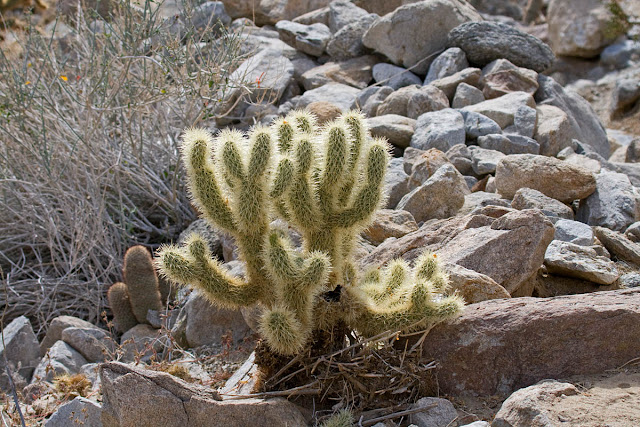
Gander's Cholla
Gander's Cholla
Hedgehog Cactus
Hedgehog Cactus
Teddy Bear Cholla and Brittlebush
Ocotillo and Creosote
Fishhook Cactus
Fishhook Cactus
Beavertail Cactus
Beavertail Cactus
Buckhorn Cholla
Buckhorn Cholla

Saturday, January 25, 2014

ID: Female Blue-winged and Cinnamon Teal

ID: female Cinnamon Teal
Cinnamon Teal female. Santee Lakes, California. October 11, 2013. Greg Gillson.
Female ducks are generally rather hard to identify. Many birders look around until they can find a drake they can recognize and just assume the hens are the same species. On my Pacific NW Birder blog several years ago I wrote a dabbling duck silhouette quiz. And provided the answers.

That quiz was based on shape. Many hen ducks can be identified by shape alone, while the brown camouflage plumage isn't all that distinctive and can be confusing. Two ducks that are very similar in shape are Blue-winged and Cinnamon Teal. Both have blue wing patches and the brown-patterned females are very similar. The subtle pattern on the face is the best way to tell them apart.

The face of the Cinnamon Teal is buffy-brown and rather plain. The crown and lower cheek is slightly darker. There is a hint of a broken eye ring, but it is not obvious.

ID: female Blue-winged Teal
Blue-winged Teal female. Santee Lakes, California. October 11, 2013. Greg Gillson.
In contrast--pun intended, the face of Blue-winged Teal is grayer with more contrast. A dark eye line goes from bill to back of head. Broken white eye rings are obvious. There is often a large pale spot at the base of the bill extending down onto the throat.

Not all individuals are as obvious as these two, And birds in their first year are much more similar. But with practice, you should be able to identify these look-a-likes more frequently with increasing confidence.

Thursday, January 23, 2014

Birding Site Guide: Crown Point Park

Low tide at Crown Point Park.
White manicured sandy beaches, calm blue waters, warm sunny skies,... and birds! Something about this peninsula on the north shore of Mission Bay attracts shorebirds, terns, and the local Black Skimmers. There they coexist with picnickers, dog walkers, bicyclers, and others enjoying Mission Bay--the largest man-made aquatic park in the nation. You'll probably spend an hour here if the birds are present and also visit the Kendall-Frost Marsh (see below).

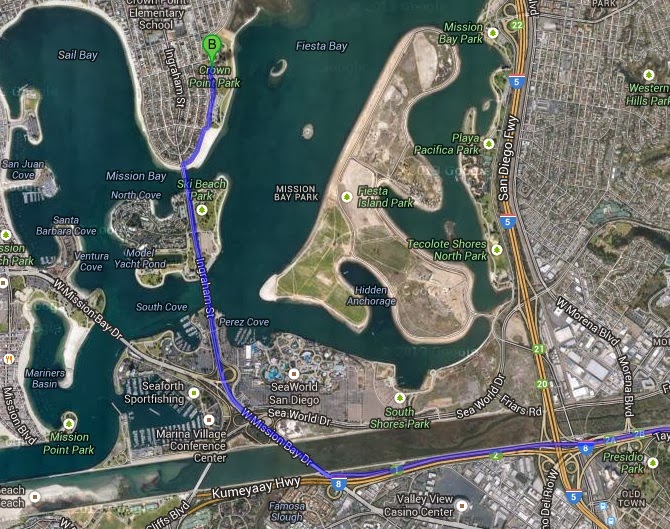
Getting there: Take I-5 to I-8 and turn west for 1 mile turning right on W Mission Bay Dr across the bridge and turn right onto Ingraham St. Cross over Vacation Isle and turn right onto Crown Point Dr. Then turn right onto Corona Oriente Rd. Parking: Free parking; the south lot is closest to the beach and birds. Hours: Dawn to 10 PM. Map navigation: Corona Oriente Rd, San Diego, CA 92109

San Diego birding site guide

Where to bird: Shorebirds are on the beach or mudflats nearest the South Parking Lot. You'll have to share the beach (see photo below), but much of the use is joggers and bicycle riders on the paved trail on the upper beach. I assume summer use is higher.

Crown Point Park at high tide
Crown Point Park at high tide. December 22, 2013.
Just past the North Parking Lot is the Kendall-Frost Mission Bay Marsh Reserve. With a scope you may be able to see interesting marsh birds here, including Little Blue Heron. At high tide rails and perhaps Nelson's Sparrow (winter) may be forced out of the marsh and up nearer the road.

eBird shows that just over 100 species have been recorded at Crown Point Park. Most birders apparently visit from late fall through early spring and avoid the summer. In the photo above note Black Skimmers, Black-bellied Plovers, Black Turnstones, Red Knots, and Royal Terns.