Showing posts with label listing. Show all posts

Friday, July 20, 2018

My 600th eBird species

On July 12th I birded at Mile Square Regional Park in Fountain Valley, California, in Orange County.

There I recorded my 600th world eBird species--Egyptian Goose. At least 65 birds roamed the lawns along with almost 200 Canada geese. Egyptian geese are not countable by ABA rules, along with probably 20 other domestic or escaped birds that I have recorded on my eBird list of 545 for "North America" north of Mexico. So my ABA area tally is somewhere near 525.

Egyptian Goose
Egyptian Goose
Egyptian Goose. Fountain Valley, California. July 12, 2018.
Egyptian Goose

Because these "ornamental" birds are generally not "countable" by birders, not much is known about them in North America. Texas and Florida have large non-native populations. In southern California they seem limited mostly to Orange County (and Los Angeles County?). I have not seen them in adjacent San Diego County. But they certainly are unique!

Wednesday, May 9, 2018

Harris's Hawk: My 350th San Diego County bird!

If one really works hard at it, one could see 350 species of birds in one year in San Diego County. eBird shows 3 persons who reached that mark last year, and not every birder uses eBird. The record of 387 species in a year was set by Barbara Carlson in 2013.

While I still try to see lots of species each year, that goal doesn't take priority over all other things in my life. I've recorded 270-290 or so species each year the past 4+ years. My total lifetime list for the county reached 350 species (eBird total, which includes a few escapees not counted by the ABA list). My 350th species was a Harris's Hawk in Ramona on January 30th, 2018.

Harris's Hawk

This bird was located by birders in late December 2017. However, local residents have been aware of this bird for some time. In fact, this is probably the same bird Nance Christensen photographed here in April 2016! It went unrecorded for 20 months--perhaps because no one expected it to remain. It was still present as recently as April 30, 2018.

Harris's Hawk

This is my third sighting of Harris's Hawk. However, the history of this bird makes it likely that this bird is possibly the only "naturally occurring" individual of those I have seen. You see, in the 1960's this species was gone from the former range along the Colorado River and southern California. The Colorado River forests were cut down and wild birds were captured for falconry. Thus, any birds seen in southern California and along the Colorado River in Arizona were judged to be escaped falconer's birds. It remained this way until 1994 when an incursion of at least 50 birds entered southern California. A few have been reported most years since, with birds reported in San Diego in each of the past 5 years.

So a bird I saw at Quartzsite, Arizona on December 28, 1974, and another at Imperial Dam (California side) near Yuma, Arizona on March 16, 1982, were possibly not of wild origin. Apparently, my Quartzsite record was expunged from eBird for this reason. But the Imperial Dam record is still intact--a pair nested there in 1984 and 1985.

While still rare, it appears that this species may be making a comeback.

Thursday, July 20, 2017

eBird: Illustrated checklists

A new functionality has been added to eBird, the illustrated checklist. A sample is shown here:

The above is a section of the eBird Hotspot checklist for the San Luis Rey River mouth in northern San Diego County, a place where I happen to have obtained many rather good photos.

From the eBird.org website, select...
Explore Data
Explore Hotspots
Then choose...
San Luis Rey River--mouth, San Diego County, California, US
View Details

There you will find a menu for three items...
Overview/Recent Visits/Illustrated Checklist

Chose Illustrated Checklist.

Along with the weekly bar chart checklist is a photo chosen from among the best-rated for that location.

Additional photos from the location are in the rightmost column, indicated with a little camera icon and the number of total photos available. Please note that many photos are not rated yet. So if you see a poorer photo displayed, and there are many more photos to choose from, please click on the photo icon to bring up all the photos. Then click on the first photo and rate it, and continue on. Next time the illustrated checklist displays a photo, it will be one of the better ones.

One other thing that was new to me is that in the hotspot Overview page, down a line or two is another menu bar: Last Seen/First Seen/Bar Charts/Printable Checklist. It is this last menu item, Printable Checklist which was new to me. Great for a field trip where participants don't all have access to eBird Mobile.

The Illustrated Checklists appear for specific Hotspot sites, counties, states, and countries.

Even if you are not a regular contributor to eBird (and if not, why?) this application is unbeatable to help you prepare for a birding trip and find your target birds.

Wednesday, July 19, 2017

San Diego Annotated Checklist: Updated

I have just completed updating my annotated bird checklist page to San Diego birds, first created a year ago. It incorporates the AOS checklist 58th supplement that came out earlier this month. It continues the major rearrangement of orders and families that began a couple years ago. For instance, hummingbirds and pigeons are near the front of the list following waterfowl and chickens. Last year's shake-up never even made it into a field guide before it changed again. I wonder if this will be a trend for the next few years?

I have also updated some rare bird sightings in the county for the past year.

An annotated checklist devotes a paragraph to each species--rather than just a list--telling where and when to find each bird, plus any other notes about status. It is especially useful for searching for specific species, whether you are a visitor or local birder.

Sunday, April 9, 2017

Field Guides: What is a "field-friendly" bird sequence?

The American Ornithologists' Union (AOU) Checklist Committee is the official body from which the North American bird checklist is derived. This checklist is the basis for both the names of birds and the order they occur in your field guide, wildlife refuge bird lists, and your eBird checklist. It is the basis for the checklist you may use in the annual Great Backyard Bird Count and Christmas Bird Counts. It is updated annually, usually July.

The annual checklist supplement reports the official "splits" and "lumps," deciding (based on published scientific literature) what species exist and what do not. It is the official name-maker/arbiter for both the common and scientific names of birds. It also adds any well-documented first records for North and Middle America. Many birders are excited to find out what "new" birds they may be able to count on their lists each year. This past year Western Scrub-Jay was split into two species: California Scrub-Jay and Woodhouse's Scrub-Jay, along with many other changes.

Proposals under consideration for 2017 include splitting Willet, Nashville Warbler, Northern Harrier, Yellow-rumped Warbler, Brown Creeper, Northern Shrike, Red Crossbill, Bell's Vireo. Proposals have also been put forth to lump Common and Hoary Redpoll, to lump Thayer's and Iceland Gull, and to lump Dark-eyed and Yellow-eyed Junco. And, yes, major changes are proposed to the sequence of families of songbirds.

In the recent past, many field guide publishers were usually in a rush to be the first to print revisions using the new names and added species. When the sequence changes however, field guide authors and publishers are a bit more hesitant.

My Sibley guide from 2000 has the loons and grebes first, followed by petrels and pelicans, as does my 1969 Peterson field guide, and so does my 1940 Birds of Oregon by Gabrielson and Jewett. That time-honored sequence was shaken up due to DNA work in recent years.

Thus, my 2014 Sibley has ducks and chickens first, then loons, grebes, petrels, and pelicans. There were some other changes as well, like falcons and parrots following the woodpeckers.

Last summer (2016) the AOU Checklist Committee again approved radically changing the sequence of birds in its official checklist. Now the order is: ducks, chickens, grebes, pigeons, cuckoos, nightjars, swifts, hummingbirds, rails. And the loons, petrels, pelicans, herons are moved after gulls. Hawks are back with owls just before woodpeckers. House Sparrow is again moved back after Starling, but finches follow that just before the warblers, and blackbirds are last. The final bird in the current North American checklist is Scott's Oriole! More changes are in store. And yet, where are the new field guides in that sequence?

Surprisingly, eBird, the tremendously popular worldwide real-time birding checklist program by Cornell University, delayed making these sequence changes to their online lists last year. They didn't say why, only that they'd make changes in 2017 (I assume August, after the next AOU list update)--perhaps they simply needed more time for programming to make the changes, or they anticipated major 2017 changes.

With so many disruptive changes to the checklist order we've been hearing more and more rumblings of field guides ordered in a "field-friendly" bird sequence, not strictly dependent upon the order in the checklist.

Sample of how birds might be arranged in a "field-friendly" approach.
What is a field-friendly bird sequence? I discussed this several years ago on another blog (here and here).

The AOU checklist is not field-friendly. It's not supposed to be. It represents supposed relationships, subject to constant re-analysis and interpretation. As an example, in the blog posts above I used the fact that Great Blue Herons and Sandhill Cranes--while visibly similar, and often confused by beginners--are not closely related, and are found far apart in the field guides. The same goes for Pied-billed Grebes and American Coots--birds that appear superficially similar but are found far apart in the checklist. In fact the Coot and the Crane are closely related and found near each other in the field guide, even though they look nothing alike. Having field guides strictly follow the checklist makes it very difficult and confusing for beginning bird watchers.

A field-friendly sequence would put the long-legged and long-necked herons and cranes near each other and near sandpipers and ibis. It would put the swimming coots and grebes near the ducks and loons and alcids. The first grouping might be called "Wading Waterbirds" (not totally correct for every species, but close enough to get the idea). The second group could be called "Swimming Waterbirds." A third group could be called "Flying Waterbirds" and include gulls, petrels, boobies, and skuas. Get the idea? Those three "Waterbird" groupings include almost a third of the birds in the world. "Raptors" would include hawks, eagles, owls, and falcons.

Even the songbirds could be divided up into only a half-dozen major groupings. Altogether, all species in North America could be placed simply and logically into one of only 13 groups--easy enough for beginners and accurate enough for advanced students! This certainly has been discussed before (see this article in Birding magazine by Howell, et al. in 2009). A couple of bird field guides have even attempted it, successfully or not (1997 All the Birds of North America by Griggs, 2000 Birds of North America by Kaufman, 2011 The Crossley ID Guide).

Field guides using the field-friendly sequence would not be re-ordered every time there was a change to the sequence in the checklist. Names could be updated, and a new species inserted, but a book wouldn't have to be re-ordered and laid out from scratch (not that books are long for this world). But however we may view future birding field guides, checklist order is not birder friendly.

Back in 2012 I proposed a field-friendly sequence as thus:
Swimming Waterbirds
Flying Waterbirds
Wading Waterbirds
Chicken-like Birds
Raptors
Miscellaneous Landbirds
Aerial Landbirds
Flycatcher-like Birds
Thrush-like Songbirds
Chickadee and Wren-like Songbirds
Warbler-like Songbirds
Sparrow and Finch-like Songbirds
Blackbird-like Songbirds

How does it work in practice? Try it for yourself. I combined about 1500 of my pBase bird photos with my annotated checklist to create a Field-Friendly Guide to San Diego Birds. Let me know what you think.

Thursday, January 5, 2017

Oh-fer: A summary of my county bird listing in 2016

It has been my goal to see over 300 species in a year in San Diego County for each of the past 3 years. I'm not trying overly hard; I'm not chasing any but the most nearby rarities. But still, others are finding over 350 species in a year. And I'm finding the regular residents and migrants and "regular rarities." I'm just not driving 45 miles to view one bird at one location when a rare bird pops up. So occasionally I make a day-long trip to see a bunch of the long-staying rarities on a circuit. Sometimes it works; other times not so much.

On November 26, 2016 I posted this message on the San Diego Region Birding list.

It sums up my rare bird chasing for 2016.

Subject: Oh-fer

Spent the whole day chasing this week's reported rarities.
Started at the Bird & Butterfly Garden where I did NOT see the Gray Flycatcher, Black-and-white Warbler, or Blackburnian Warbler.
Then over to the Sunset ball fields where I proceeded NOT to see a Lapland Longspur or Red-throated Pipit.
Down the road at Nestor Park I easily found the shady characters, but was UNABLE to find the Pine Warbler.
After a nice lunch I drove to the San Diego River mouth where there was NO sign of Burrowing Owl, Palm Warbler, Eurasian Wigeon, or Greater Scaup.
Finally, as the sun set, there was NO Franklin's Gull at Mission Bay.
My luck is 100%.
A wonderful and very typical birding day.

Greg Gillson
Escondido

Is it any wonder I don't like chasing other people's rare birds, but would rather find my own? But like my favorite sports team, I'm always enthused as the new season (or year) starts with encouragement that is somehow crushed as the year nears its end.

So I'm both excited and depressed that I started 2017 with these two birds on a brief stop after the January 1 pelagic trip...

Eurasian Wigeon
Eurasian Wigeon. STILL at San Diego River mouth, January 1, 2017. Greg Gillson.
Burrowing Owl
Mocking my 2016 listing prowess,.. and preparing me for 2017's eventual listing disappointment, this Burrowing Owl is STILL right out in the open and STILL at San Diego River mouth, January 1, 2017. Greg Gillson.
And on January 2nd, while outside at work, a rare Plumbeous Vireo inexplicably landed in a tree right beside me at eye level!

This great start to my year's bird list means only one thing about 2017... crushing disappointment lies ahead.

Wednesday, August 31, 2016

An Annotated Bird Checklist to San Diego County

I have created a stand-alone page for an Annotated Checklist to the Birds of San Diego County.

The main purpose of this checklist is to answer the question:
"When and where is the best place to find each bird species within San Diego County?"

Use the comments section of this post to offer corrections or additions to the checklist. I will use your comments to keep the checklist up-to-date and as accurate as I can.

What, exactly, is an annotated checklist? Well, a simple checklist is a list of birds that have been found in the county. Most checklists also provide seasonal abundance. An annotated checklist provides additional information in the form of textual annotations.

Why is an annotated checklist needed?

518 species of birds have been found in San Diego County (counting the newly split Townsend's Storm-Petrel in July 2016). Only five states have recorded more birds: Arizona, California, New Mexico, Oregon, Texas. Of course, being far to the south and west, San Diego has recorded many birds that aren't expected very often. Of those 500+ species, how many can you be likely to see in a single year?

The authority on the birds of the county is the 600+ page book "San Diego County Bird Atlas" by Philip Unitt, published in 2004. This volume maps and discusses birds during a 5-year county-wide survey by hundreds of volunteer birders from March 1997 to February 2002. Like me, you can buy this book for $50 on Amazon.com (but only 6 left).

The San Diego Field Ornithologists provide a County Checklist. It lists every species of bird ever found in the county along with a rarity status code.

These two references suffer from opposite problems as far as birders seeking information on bird-finding. The checklist is too brief and the book too in-depth for quickly finding information.

The book is also starting to suffer from obsolescence due to two things: 1) Bird populations are constantly changing and the book is now a dozen years old. 2) 20% of the county has burned since publication, including 98% of the mountain conifer forest in the huge Cuyamaca Rancho State Park.

A new source of bird distribution information started in 2002: eBird. This citizen science web-based bird reporting database system really took off in 2010, growing since then at a rate of 20-30% per year. In May 2016 a record 11.8 million bird records from around the world were added to the database during just that one month! California has always been at the forefront of eBird, and San Diego bird records are well-represented.

How this annotated checklist came about

As I approach 3 years living and birding in San Diego County I have now seen most of the expected annual species. But there are still several species I haven't found. And I have yet to find over 300 species in any single year. So, rather than rely on chance and my own exploration, I researched both the Atlas and eBird to try to figure out when and where each species is most likely to be found.

Knowing that others would benefit from my research, I organized and preserved my findings on the page in this link: http://sandiegogreg.blogspot.com/p/annotated-checklist-of-birds-of-san.html

I hope you find it useful.

Wednesday, July 27, 2016

Armchair ticks: Woodhouse's Scrub-Jay and Townsend's Storm-Petrel

The American Ornithologists' Union made two long-anticipated splits this year in its annual report. As a result, I added two life birds to my checklist without going anywhere!

An overview of this year's changes, including re-ordering many family groups, is on the ABA blog.

A few years ago the Scrub Jay was split into Western Scrub-Jay, Island Scrub-Jay, and Florida Scrub-Jay. It took a while, but Woodhouse's Scrub-Jay (Aphelocoma woodhouseii) finally has been split from Western Scrub-Jay. Therefore, Western Scrub-Jay received a new name: California Scrub-Jay (Aphelocoma californica).

California Scrub-Jay
California Scrub-Jay. Palomar Mountain, California. July 4, 2016. Greg Gillson.
The California Scrub-Jay is the form I'm most familiar with in Washington, Oregon, and California. Woodhouse's Scrub-Jay is an inland form. It's a bit paler with a shorter bill. I saw them on a trip to Colorado in October 1984: At Bright Angel Lodge at Grand Canyon National Park, Arizona, Dalton Springs, Utah, and between Cortez and Durango, Colorado.

In 2008 I photographed a smaller blackish storm-petrel at sea far off southern California. It had a white rump that wrapped all the way around and onto the the sides of the undertail coverts. After much research I found it was a subspecies of Leach's Storm-Petrel. Well, Leach's Storm-Petrel has now been split 3-ways, with Townsend's (Oceanodroma socorroensis) and Ainley's (Oceanodroma cheimomnestes) separated from Leach's Storm-Petrel (Oceanodroma leucorhoa). Leach's is found from Alaska to Mexico, Ainley's only in Mexico, and Townsend's primarily in Mexico and rarely to southern California. [ID article here]

Townsend's Storm-Petrel
Townsend's Storm-Petrel. Tanner Bank, Ventura Co., California. November 2, 2008. Greg Gillson.
These "new" birds, plus a significantly re-ordered checklist are supposed to be incorporated into eBird about August 1st. Ducks and chickens are still first on the North American list, but everything else between there and woodpeckers is reshuffled--it's going to take me quite a while to get used to looking for pigeons, nighthawks, and hummingbirds at the beginning of the bird book, then shorebirds and gulls, followed by albatrosses, herons, pelicans, and hawks just before the woodpeckers, falcons, parrots, and passerines.

Wednesday, June 22, 2016

Red-crowned Parrot

I finally got good close looks and photos of a large parrot in San Diego. The only parrot on the official California bird checklist is the Red-crowned Parrot (Amazona viridigenalis). It has been established for years with a good population. But that doesn't mean it's the only parrot you can see, nor does it mean that it's the most-likely. There's an Australian Cockatiel that has escaped near my home and sometimes hangs out with the tame ducks at a retention basin here. This species generally doesn't survive long in the wild. And we're near Tijuana where there's a constant supply of escaped Mexican cage birds of every variety (especially, but not exclusively, colorful singing birds), so that with any unusual bird seen here that has a native range in Mexico one always has to wonder if it is an escapee from captivity.

Most parrots are found right in downtown. There are large night-time roosts at Point Loma and El Cajon. At dusk birds return after being dispersed throughout the area all day. But I live in the North County about 35 miles north of downtown. Parrots are far less common here.

Back in February 2014 I saw my first large Amazon parrot (parrots in the genus Amazona). I got some photos and determined they were likely Lilac-crowned Parrots (Amazona finschi). I know a bit more about their identification now, and still think I identified them correctly.

Both the Red-crowned and Lilac-crowned Parrots are endangered. A primary reason for their decline is deforestation in Mexico. And, although importation of parrots from Mexico into the US is illegal, these birds are still caught for the pet trade inside Mexico. Thus, after 40 years or more of escapes and breeding in the wild, the Red-crowned Parrot is more numerous in southern California and Texas than they are in NE Mexico where they are native and endangered. See this article from the Christian Science Monitor.

Red-crowned Parrot
Red-crowned Parrot (left) and hybrid(?) (right). San Diego, California. May 21, 2016. Greg Gillson.
While meeting at the marina for a pelagic trip I heard the loud, harsh screeching of the parrots and located them in a tree over the parking lot. They allowed me to approach quite near. It still wasn't easy to figure out an identification, though.

Of the two birds, neither showed the full bright crown of Red-crowned, but neither did they match Lilac-crowned. The bird on the left (above) has a darker eye. That indicates a young bird, so the restricted red on the crown is expected. The right bird has a definite white eyering, so that is the strongest indication of Red-crowned, as the eyering on Lilac-crowned is blue. And at least one of the birds clearly gave descending whistles among their other grating and screeching calls. That matches Red-crowned and not the rising whistle of Lilac-crowned.

Red-crowned Parrot
Red-crowned Parrot or hybrid with Lilac-crowned Parrot?
The only thing worse to a birder than an introduced bird is a hybrid!
Of course, there is the very real possibility of hybridization. The restricted darker maroon forehead on the above bird certainly fits Lilac-crowned, as does the green feathering along the upper mandible. But the white eyering and pale cere (fleshy area around the nostrils) only belong to Red-crowned.

On the other hand, the outer vanes of the base of the outer tail feathers show blue on Lilac-crowned. And the tail is longer. Neither of those is a match on the above bird. But that restricted dark red forehead. I could be talked into this bird being a hybrid.

Red-crowned Parrot
Red-crowned Parrot
The photo above shows the darker eye of a young bird. There are orange feathers coming in the crown above the eye that point to Red-crowned, even though the cere is a bit dark and the eyering color is ambiguous. And the red comes down all the way to the base of the upper mandible clear down to the gape. There's no problem with this bird being a Red-crowned Parrot, and no reason to invoke the hybrid hypothesis.

Now that I know to listen for the upslurred or downslurred whistles, I'll feel better about identifying birds as they fly over, or are perched high in a palm against overcast coastal morning skies.

Interestingly, many birders do not pay much attention to introduced or escaped birds. After all, only wild, free-flying birds are "countable" by the major birding organizations. Escaped cage birds are not countable, and populations that escape and breed are only considered "established" if they have been present for many years (10-20 years) and their population is not dependent upon continued releases in order to maintain itself. On the other hand, birders can't keep ignoring the growing populations of feral birds in California, Texas, and Florida--they are "real" birds eating food and competing for resources whether or not they are "countable" on a birder's list.

Still, there's more information on identification of parrots on the local parrot cage bird website than in the birding field guides. That doesn't seem right, either.

Monday, January 18, 2016

Five recent additions to my San Diego County bird list

I used some vacation time at the end of the year to take several trips and got in some birding time. This resulted in seeing and photographing several birds I hadn't found before in San Diego County.

Here they are, in the order I saw them.

#314 Le Conte's Thrasher

This was my 4th visit over two years to the Old Springs Road Open Space Preserve near Borrego Springs, looking for this rare local resident. I had also looked for it without success twice at the nearby Clark Dry Lake area. I credit my success this time to arriving right at sunrise. You'd think it hard for this rather large bird to hide amid the thin creosote bushes scattered widely among the sand. But hide it does, and runs rather than flies.

This is only my 3rd sighting of this species, with one record previously in California in 1980 and Arizona in 2007.

Le Conte's Thrasher
Le Conte's Thrasher. Borrego Springs, California. December 28, 2015. Greg Gillson.
Le Conte's Thrasher
Le Conte's Thrasher

#315 Reddish Egret

Two or three of these birds spend each winter in the south end of San Diego Bay--the extreme northern edge of their range. There's a lot of shoreline here, and not all of it publicly accessible. These birds move around quite a bit as the tides change. For their first year of life these birds are white, thus easily hiding amid the larger Great Egrets and smaller Snowy Egrets. One of the characteristic actions of this bird is the hyperactive hunting style, running and flapping as it chases fish in the shallows.

This is my first record for the ABA area (North America north of Mexico); my only previous sighting was 5 birds in Rocky Point, Sonora, Mexico in 2007.
 
Reddish Egret
Reddish Egret wades among American Wigeon. Chula Vista, California. December 31, 2015. Greg Gillson.
Reddish Egret
Reddish Egret
Reddish Egret
Reddish Egret
Reddish Egret
Reddish Egret

#316 Thayer's Gull 

Thayer's Gulls are quite rare this far south, not reported annually. Formerly they were more common, but changes in landfill practices have eliminated gulls from these areas. The bird photographed below was about 5 miles offshore San Diego on our January 1st pelagic trip. Larger gulls are hard to identify, and this is especially true with immature gulls.

Thayer's Gull
Thayer's Gull (left, with Western and Heermann's Gulls). Off San Diego, California. January 1, 2016. Greg Gillson.

#317 Short-tailed Shearwater

Up to 20 million of these birds migrate back-and-forth between the breeding grounds in New Zealand and the non-breeding range in the Bering Sea. But usually only a few non-breeding birds are found in winter at sea off southern California. In some winters there is a larger influx. One was seen on our January 1st pelagic trip.

This is also my first record for California.

Short-tailed Shearwater
Short-tailed Shearwater. Off San Diego, California. January 1, 2016. Greg Gillson.
Short-tailed Shearwater

#318 Marbled Murrelet

While beginning to dock our boat at the end of our January 1st pelagic trip, the cry of "murrelet!" went up. We changed course to investigate this bird in the marina. Imagine our surprise to find the rarest bird of the day only a few hundred feet from the dock! There were only 3 county records of this species up to the 2004 publication date of the San Diego County Bird Atlas. There was a Marbled Murrelet for several days last winter at Mission Bay, but I didn't take the time to chase it down.

This is only my second California record; the first was way up north in Humboldt County in 2002 where they breed.

Marbled Murrelet
Marbled Murrelet. San Diego Bay, California. January 1, 2016. Greg Gillson.
Marbled Murrelet
Marbled Murrelet

Sunday, November 22, 2015

Scaly-breasted Munia in Carlsbad

"Where do I find Scaly-breasted Munia?" Visiting birders have asked this question since late 2013 when the bird's status in California was officially changed from feral escaped cage bird to wild naturalized resident ("established population"). Scaly-breasted Munias can now officially be counted on your ABA list (American Birding Association).

According to eBird, Scaly-breasted Munias have been found in the last month in California from San Luis Obispo to the Mexican border near Tijuana.

Scaly-breasted Munia
Scaly-breasted Munia (thick bill partially hidden by leaf). Carlsbad, California. October, 2015. Greg Gillson.
Scaly-breasted Munia
Juvenile male Scaly-breasted Munia.
Scaly-breasted Munias are known in the pet trade as Nutmeg Mannikins or Spice Finches. It is endemic in Asia from India to the Philippines.

I've seen these birds just about 5 times now in San Diego County. They are truly tiny birds, only 4-1/2 inches long--about the size of a goldfinch, though a bit pudgier with shorter tails. They form small flocks that give finch-like twittering calls. Though I am very good at identifying birds by their calls, I still haven't learned this bird's vocal differences--perhaps because they are in flocks and I haven't really heard just one bird call distinctly.

In San Diego County they seem to like brushy river bottoms at lower elevations. When the San Diego Bird Atlas was written in 2004, this species was "sporadic" in the county. They are now found in river bottoms near the coast the entire length of the county. They also follow the San Diego River from Mission Bay to Santee. If I had to name one location where they are most frequently encountered it would be Lake Murray. Over 100 individuals have been seen lately, though I have never seen them there. Another place where they are frequent is Batiquitos Lagoon.

Tuesday, October 20, 2015

Two years birding in San Diego County


The end of September marked 2 years living in San Diego County. The Management job for the mobile home park Marlene and I work at will be 2 years at the end of November. It seems to be going well now, even if so difficult at first--but that's work, right? We miss all of our friends in Oregon, but have made many new friends locally. Never before in history has it been so easy to keep in contact with friends throughout the earth. Still, they are missed--even if there are irregular phone calls, emails, text messages, Instagram photos shared, online games of Words with Friends, or blog postings.

The last few birds I've added to my County List in San Diego include Least Bittern, Hermit Warbler, and Yellow-throated Vireo (lifer) in August, Red-masked Parakeet (non-countable on ABA list) in September, and Green-tailed Towhee and Snowy Plover in October, so far. That brings me up to 311 species for the county total, 266 this year. Last year I found 270 species for the entire year, so this year seems like it could be more. I didn't plan on being out of commission, birding-wise, in August and September with shoulder surgery, but that is life.

For comparison, Nancy Christensen has 325 species in the county this year. The record was in 2013 when Barbara Carlson recorded an amazing 387 species in a single year. Over 500 species have occurred in the county, though just over 400 is typical for any one year.

Now that Snowy Plover is no longer #1 on my 'missing species list' ("nemesis bird") the new contenders for "what, you haven't you seen them yet?" are Red-crowned Parrot and Common Poorwill.

Sunday, May 24, 2015

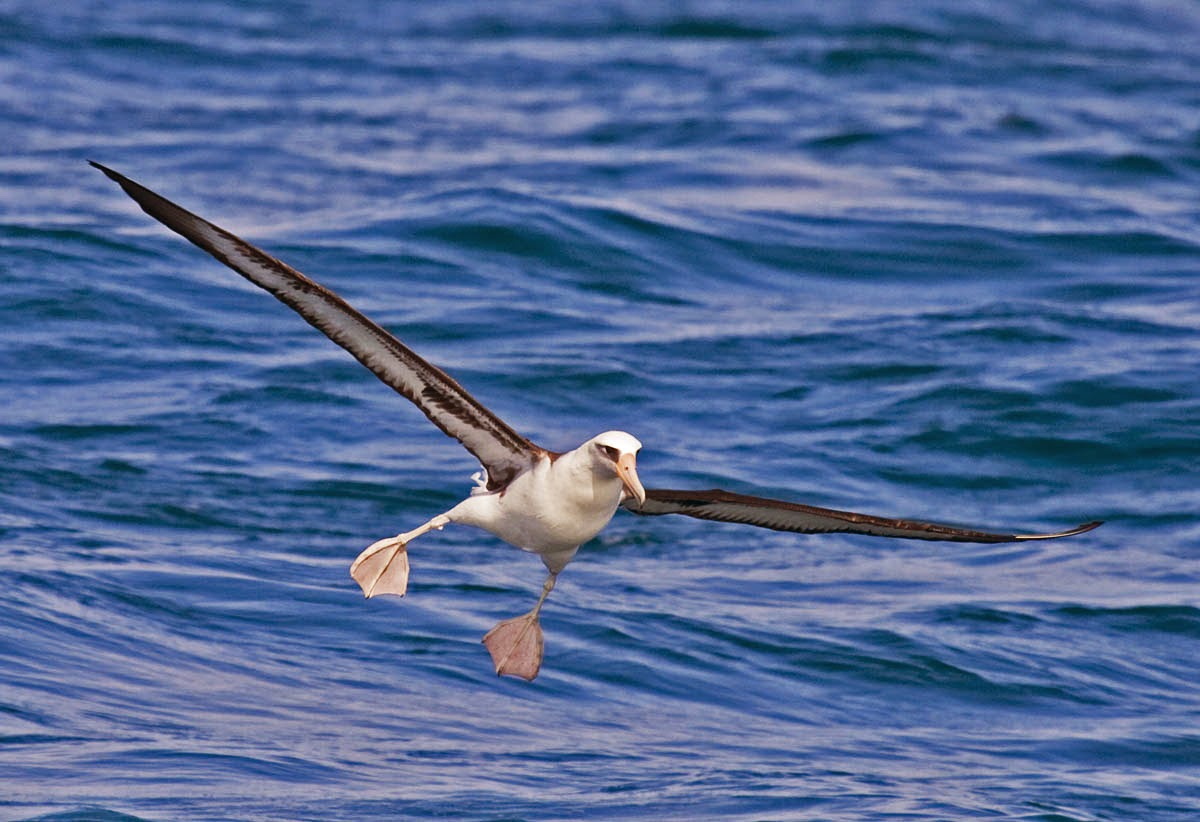
Rare Bird: Laysan Albatross

On May 16, 2015 I was aboard Grande for a pelagic trip from San Diego. We were fortunate enough to encounter a Laysan Albatross--very rare in San Diego County waters.

Actually, Laysan Albatrosses aren't overly rare in deeper waters starting about 35 miles west of San Diego. Unfortunately, because of the nearest-point-to-land rule, 35 miles west of San Diego is either in Los Angeles County or the state of Baja California, Mexico. That's because of San Clemente Island, Los Angeles County (75 miles WNW of San Diego) and Los Coronados Islands (9 miles off Tijuana, Mexico and 15 miles south of San Diego). Once you leave San Diego harbor and then find yourself closer to either of those islands than you are to shore at Point Loma, the island's jurisdiction takes over, and your wonderful bird is now in a different county. This is a very serious topic for many birders--especially those known as "County Listers"--who are very interested in keeping exact track of personal bird sightings in each county. Yes, guilty as charged.

Laysan Albatross
Laysan Albatross. Nine Mile Bank, San Diego County, California. May 16, 2015. Greg Gillson.
Laysan Albatrosses nest in the outer Hawaiian Islands, including Midway and Laysan. They first breed when 5-8 years old. Most of the population chooses to spend the non-breeding time in the Aleutians and Gulf of Alaska. A few visit the West Coast in winter and spring.

Laysan Albatross

About 1983 Laysan Albatrosses began breeding on islands off Mexico. eBird shows a growing count of 288 birds on Isla Guadalupe, about 260 miles south of San Diego, on April 14, 2013. Certainly, these birds transit into the California Current off the West Coast. With these birds adding to the millions already in the North Pacific, one can't help but think that these Mexican breeders may be increasing the likelihood of spotting this species on future West Coast pelagic trips.

Laysan Albatross

The dusky marks on the under wing are variable and serves as a "fingerprint" for identifying individuals.

Gary Nunn blogs about this sighting (San Diego Birding -- Nemesis county seabird – Laysan Albatross in San Diego).

And so does Tommy DeBardeleben (Tommy D's Birding Expeditions -- Deep Sea Birding-The Grande Way)

San Diego County records of Laysan Albatross (based on my own very limited research)
1. One on Thirty Mile Bank 8 January 1998 (Brennan Mulrooney, eBird).
2. One found dead on Torrey Pines beach 8 Mar 2000 (Unitt, 2004).
3. One found dead at Camp Pendleton 13 Jun 2007 (NAB, McCaskie & Garrett).
4. One photographed at Nine Mile Bank 27 Aug 2008 (NAB, McCaskie & Garrett).
5. One found dead in the Split Mountain area of Anza-Borrego Desert 26 June 2013 (Steve Bier).
6. One at Nine Mile Bank 3 May 2015 (Dave Povey).
7. One photographed at Nine Mile Bank 16 May 2015 (this bird! Perhaps the same individual as previous sighting?).

Saturday, January 31, 2015

When Greg met Phoebe

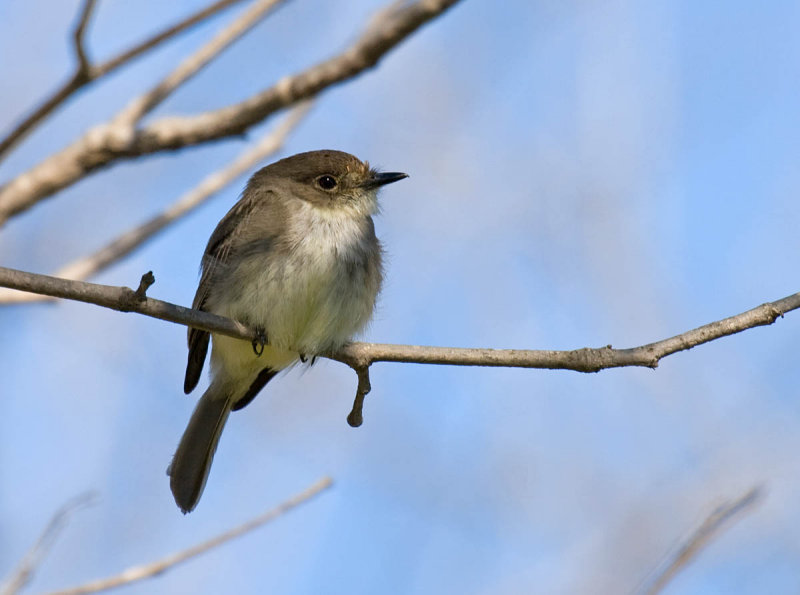
Eastern Phoebe
Eastern Phoebe. Tijuana River Valley, San Diego, California. January 18, 2015. Greg Gillson.
There are over 400 species of New World Tyrant Flycatchers, most in the tropics. Of these, only 3 are named with the Greek woman's name of Phoebe. Lacking eye rings and wing bars (except for 2 South American subspecies of Black Phoebe) as many other flycatchers, the tail wagging behavior and sweet "fee-bee" (Phoebe) calls make identification fairly straightforward. Phoebes nest commonly around people--often on back porches and out buildings.

On January 18, I made a successful effort to find and photograph a rather rare Eastern Phoebe that was fairly reliable down at the Bird and Butterfly Garden [site guide] in the Tijuana River Valley. As it turned out, I happened to photograph all three species of Phoebes this day! I present them here. Plus, I tell you the story of the very first time I met each species.

Eastern Phoebes breed from the Atlantic to the edges of the Rocky Mountains in Canada and the United States. In winter they move south to extreme southern US south into Central America. They are olive above with whitish breast and faintly yellow belly.

I first met Eastern Phoebe: January 9, 1982 at a golf course in Ventura, California. Discovered originally by others in December, but I didn't know about it. I found and identified this bird myself, independently--and took really good notes.

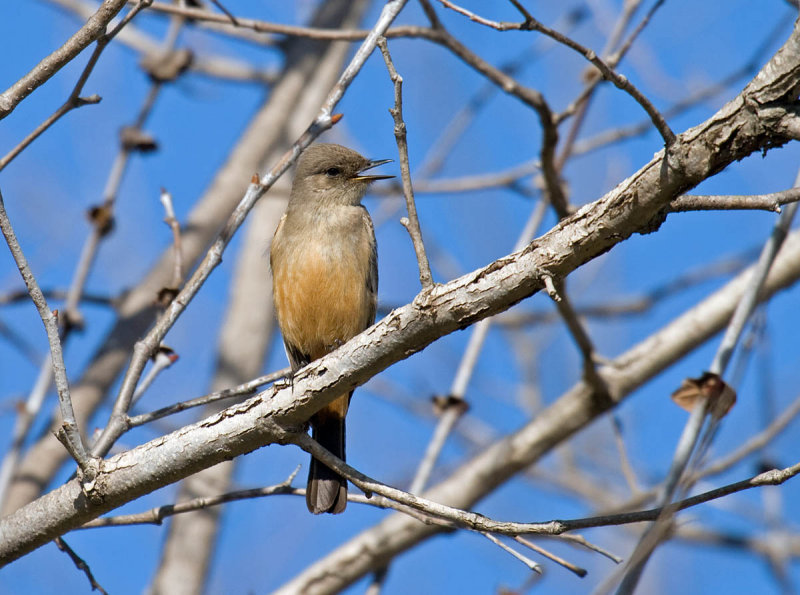
Say's Phoebe
Say's Phoebe. Tijuana River Valley, San Diego, California. January 18, 2015. Greg Gillson.
Say's Phoebes are found in drier lands of western North America--from the 100th meridian westward, and reach all the way to Alaska in summer. In winter, northern birds move south as far as northern Central America. Vagrants can reach the East Coast in winter. They are grayish-brown with a black tail and buffy cinnamon colored below.

I first met Say's Phoebe: November 20, 1972. Albany, Oregon. This was one of the first birds I identified when I began recording birds in my backyard as a school project.

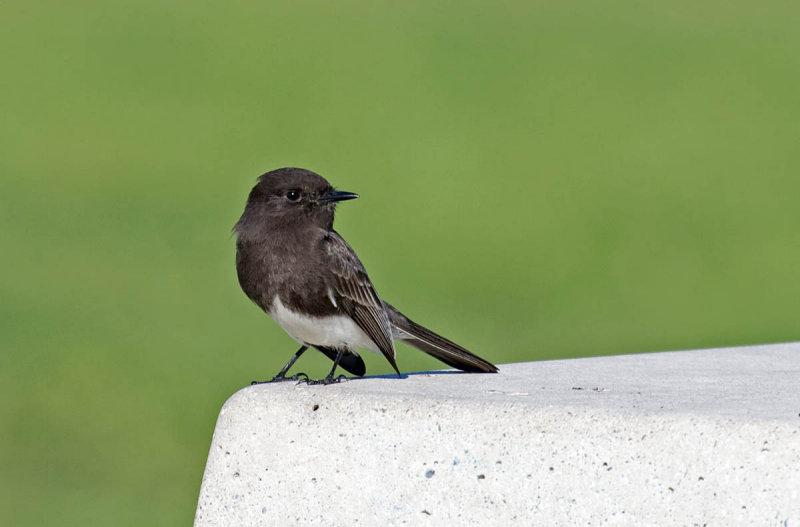
Black Phoebe
Black Phoebe. Chula Vista, California. January 18, 2015. Greg Gillson.
Black Phoebes are less migratory than the other species. They are resident from SW Oregon, through California and Arizona all the way to Argentina in South America. They are almost always found near water. They are blackish except for striking white belly and undertail coverts.

I first met Black Phoebe: March 22, 1976. Death Valley, California. I spent a week in Death Valley with my parents and grandparents during spring break.

Tuesday, January 27, 2015

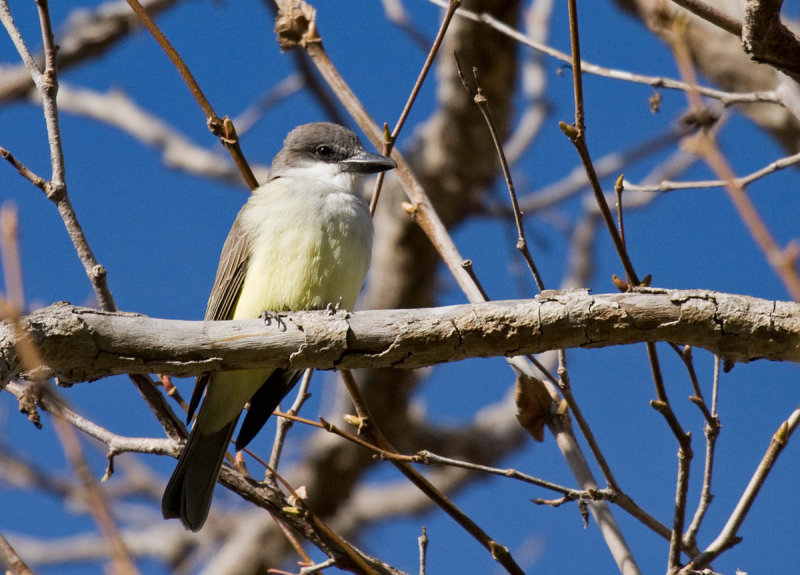
Life Bird: Thick-billed Kingbird

Thick-billed Kingbird
Thick-billed Kingbird. Chula Vista, California. January 18, 2015. Greg Gillson.
In December 2010 an adult female Thick-billed Kingbird was found in an apartment complex bordering the Poggi Creek Greenbelt in Chula Vista. It has returned for each of the past 5 winters.

Last week I took a trip down to the south end of San Diego Bay and the Tijuana River Valley with this bird one of several on my list. After a half hour wandering through this apartment complex and disturbing most of the dogs more than once, I gave up. As I was driving out of my parking space, I spotted it in the top of a sycamore behind one of the apartment buildings. How many times does this happen, that you give up on a stake-out rarity and view it from your car as you are leaving? [This reminds me that Robert Mortensen claims adding 6 life birds while peeing in the woods. Conversely, I know many birders bemoan how the call of nature has robbed them of life birds that showed up for the group while they were momentarily away....]

Where does this individual bird go in summer? Probably Mexico, as birds breed along the western Mexico mainland and reach up to SE Arizona in summer. They also occur at the very tip of Baja. (Map)

They seem to really like sycamores and lowland stream canyons in desert habitat.

Thick-billed Kingbird

Thick-billed Kingbird

Saturday, December 13, 2014

Prairie Falcon on Rangeland Road, Ramona

Prairie Falcon

I drove down Rangeland Road outside Ramona 2 weeks ago and spotted this distant falcon on a rock. I had only binoculars and camera, not spotting scope. So, though I wanted it to be a Prairie Falcon--because I hadn't yet recorded it in the county--I couldn't immediately eliminate Peregrine Falcon.

While wishing doesn't make it so, desire does play into bird identification if one is not careful about poorly seen birds. Not wanting to make a mistake, I took several photos, moving the car to get different views and backgrounds.

When the bird flew it was pale brown with the dark wing-pits of Prairie Falcon--or so I convinced myself--but I waited until returning home to review the photos, before deciding for sure. It was just so far away. I just couldn't tell the exact shape of the cheek mark that would clinch the ID.

Prairie Falcon
Prairie Falcon. Ramona, Oregon. November 28, 2014. Greg Gillson.
Prairie Falcon is certainly not rare in San Diego County, but not as common as I would have thought. But this location, adjoining the Ramona Grasslands Preserve, is a favored spot.

This was my San Diego County Life Bird #269 and County Year Bird #259.

Sunday, October 12, 2014

One year of birding in San Diego County

Factoid that may interest only me...
(à la SI Monday Morning Quarterback)

I have been living in San Diego County for a year now. In those 12 months I have recorded over 270 species. In fact, at the end of September, for just the first 9 months of this year, I saw over 255 species, surpassing the number of species I found in Washington County, Oregon, birding there 30 years.

I had set a goal of seeing 300 species in San Diego County in 2014, but it seems unlikely I'll reach that goal. I decided not to chase rarities, as there are so many regular species I have yet to see within the county. Besides, most of the rarities show up on Point Loma or the Tijuana River Valley--40-50 miles away from where I live in San Marcos in San Diego's North County. I generally only get out for half day birding trips 3 times per month and don't want to spend all my time driving. I did visit Anza-Borrego desert twice and the forested mountains three times on full-day trips, but didn't find all the specialties. Here is a list of some of the species I really expected to find that I haven't yet.

Lawrence's Goldfinch
Western Screech-Owl
Canyon Wren
Prairie Falcon
Yellow-headed Blackbird
Virginia Rail
Lesser Nighthawk
American Bittern
Least Bittern
Long-eared Owl
Dusky Flycatcher
Gray Flycatcher
Bell's Sparrow
Snowy Plover
Red-breasted Sapsucker
Cassin's Vireo
Ladder-backed Woodpecker
LeConte's Thrasher

Tuesday, September 9, 2014

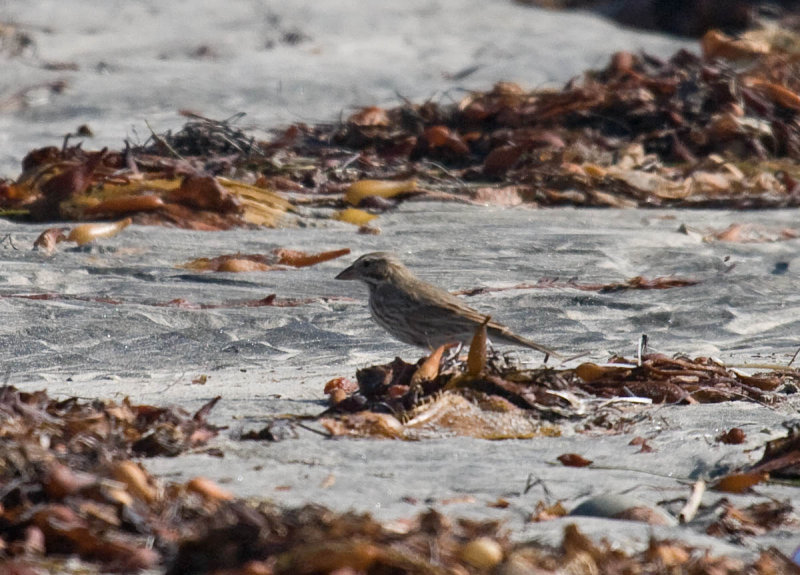
Large-billed Savannah Sparrow

Large-billed Savannah Sparrow
Large-billed Savannah Sparrow. San Luis Rey River Mouth, Oceanside, California. September 7, 2014. Greg Gillson.
While looking at shorebirds at high tide at the San Luis Rey River mouth I noted additional shorebirds in the beach-cast seaweed between the river and the ocean. (The river doesn't quite reach the ocean as the beach blocks the river mouth with sand.) Also, a small bird was running around chasing flies among the piles of seaweed. It was pale and plain brown above--barely showing a few streaks on the back, heavily streaked below. It had a pale eyebrow and submustachial stripe, both bordered with darker brown. The way it was behaving reminded me of a pipit--but the tail was also pale, not black with white outer tail feathers as in pipits.

It was soon apparent by its rather large conical bill that it was a sparrow--looking very much like a pale Song Sparrow. But it lacked Song Sparrow's very heavily streaked back, and the facial stripes weren't quite right. I then knew what it was: Large-billed Sparrow, a primarily Mexican race of Savannah Sparrow. It differs from other Savannah Sparrows in generally lacking the yellow lores that help beginners recognize Savannah Sparrows.

Large-billed Savannah Sparrow

In 2009 there was a proposal before the checklist committee of the American Ornithologists' Union to split Savannah Sparrow into 3 or 4 species: 1) the main North American group of Savannah Sparrows, 2) Belding's of the salt marshes of southern California, 3) Large-billed Sparrows of coastal NW Mexico, and 4) San Benito Sparrow of an island off the coast of Baja.

DNA evidence actually groups Belding's and Large-billed. At first this may seem strange. Belding's, after all, is quite dark and Large-billed pale. But both are birds of salt marshes and both have rather large bills compared to other races. At any rate, the proposal to the AOU didn't pass. They wanted more studies on Belding's from north of San Francisco and more study of the San Benito form. Future research may answer the gaps in knowledge, so a split could come one day soon--if nothing else, splitting the Belding's/Large-billed group from the main Savannah Sparrows.

See my previous post on Belding's Savannah Sparrows, that also pictures a western form of the main continental Savannah Sparrow.

Sunday, August 3, 2014

New names for old birds

I recorded and photographed two new bird names on my list of today's birds. But I didn't record any new life birds. These weren't even new year birds for me. How?

Well, every year at this time the scientifically-slanted AOU (American Ornithologists' Union) publishes its checklist of North and Middle American birds (North Pole to Panama), adding new species discovered visiting North America the past year, changing names (common and scientific), reordering the checklist, and splitting and lumping species based on new DNA or morphometric or other evidence. Once published, the ABA (American Birding Association), the "birding-as-a-sport-club" adopts the checklist changes (but only for US north of Mexico, Canada, and the French Island of St. Pierre et Miquelon, and out 200 miles into the ocean or half the distance to another point of non-included land (but not Bermuda, Bahama (♫ come on pretty momma ♫), Greenland, or Hawaii).

Thus the following two birds I saw today now have different names for different reasons.

Nutmeg Mannikin becomes Scaly-breasted Munia
Nutmeg Mannikin becomes Scaly-breasted Munia. Kit Carson Park, Escondido, California. August 3, 2014. Greg Gillson.
Just last year this feral former cage bird became a countable species in southern California. Wild birds are widespread in river bottoms along the coast. In the pet trade this bird is known as Spice Finch or Nutmeg Mannikin.

The bird has nothing to do with nutmeg, nor is it found where nutmeg comes from. [Maybe it is nutmeg-colored. But that's not a real color. It's a made-up color. The only real colors are those original 8 in the Crayola box. As a kid, my family evidently couldn't afford the 64-color box for me, or the unbelievable 128-color box, so now I refuse to recognize any other colors. This bird is brown (or close enough).]

The Nutmeg Mannikin is NOT related to the bird family of Manakins. Mannikins are finches (known for their lively songs and seed-eating appetites); Manakins are related to flycatchers (sub-oscines, which means they can't sing to save their lives; they eat bugs); Manikins are, well, Mannequins. Where's Ogden Nash when you need him?

Scaly-breasted Munia Lonchura punctulata is the last bird on the ABA checklist--the last bird in your field guide, following House Sparrow and Eurasian Tree Sparrow.

Okay, enough silliness. On to Bird Number 2.

Clapper Rails in the West become Ridgway's Rail
Western Clapper Rails become Ridgway's Rail. San Elijo Lagoon, Solana Beach, California. August 3, 2014. Greg Gillson.
It was low tide at San Elijo Lagoon this morning. Over a dozen of these large rails snuck (sneaked, for you word snobs) out of their marsh vegetation where they usually hide unseen to eat the many exposed fiddler crabs and clams or whatever those lumps in the mud are. They were quite excited and called out often, eliciting a response from all the other rails in the marsh--quite a noise! It is more usual not to see or even hear any rails during a birding visit.

Last time I saw these birds they were called Clapper Rails. But a bunch of Clapper and King rails (several in Mexico) were split in this recent AOU update (see definition of "cryptic species" in yesterday's post about White-breasted Nuthatches). "Clapper Rails" are now found on the Atlantic. Ridgway's (yes, without an 'e') Rails are now the form found in coastal salt marshes in California and along the Colorado River and coastal western Mexico.

Ridgway's Rail  Rallus obsoletus
Clapper Rail  Rallus longirostris

Tuesday, July 22, 2014

San Diego Year Bird #234: Gull-billed Tern

Gull-billed Tern
Gull-billed Tern. Imperial Beach, California. July 4, 2014. Greg Gillson.
One of my target species at Imperial Beach two weeks ago was Gull-billed Tern. Among the many thousand terns were a few Gull-billed, including one close enough for photographs.

I've only seen Gull-billed Tern 5 previous times. The first was in 1978. Our family was visiting relatives in Long Beach, California. My dad and I drove over from there and spent a long day at the Salton Sea. I photographed a Gull-billed Tern flying by at Salton City, very similar to this one. I was shooting slide film at the time. In one of my recent moves I decided I didn't need all those slides. The photos were not as good in those days as is possible now, and converting to digital just didn't make sense. I'd been hauling that box of slides around for years. Dumping them seemed logical. Copies of any rare bird slides had been given to the Records Committee, so any noteworthy documentation was saved that way. I don't think I made a mistake.

Marlene and I lived in Ventura, California from late 1979 through 1984. I saw more Gull-billed Terns at the Salton Sea in 1982 and 1983.

Tim Shelmerdine, David Smith, and I traveled together to North Carolina in 2005 to attend a couple of pelagic birding trips from Manteo with Brian Patteson. I spotted Gull-billed Terns from the ferry to Ocracoke on the Outer Banks.

Marlene and I, and daughter Leslie and husband Daniel flew from Portland to Phoenix and drove 5 hours to My sister's home in Puerto Peñasco (Rocky Point), Sonora, Mexico for my niece's wedding in 2007. While there I also spotted Gull-billed Tern.

This tern has more leisurely flight than most other southern California terns (Least, Common, Caspian, Royal, and Elegant). It is perhaps even more relaxed in flight than Black and Forster's Terns. I hope to see it more regularly now.