Showing posts with label introduced birds. Show all posts

Friday, July 20, 2018

My 600th eBird species

On July 12th I birded at Mile Square Regional Park in Fountain Valley, California, in Orange County.

There I recorded my 600th world eBird species--Egyptian Goose. At least 65 birds roamed the lawns along with almost 200 Canada geese. Egyptian geese are not countable by ABA rules, along with probably 20 other domestic or escaped birds that I have recorded on my eBird list of 545 for "North America" north of Mexico. So my ABA area tally is somewhere near 525.

Egyptian Goose
Egyptian Goose
Egyptian Goose. Fountain Valley, California. July 12, 2018.
Egyptian Goose

Because these "ornamental" birds are generally not "countable" by birders, not much is known about them in North America. Texas and Florida have large non-native populations. In southern California they seem limited mostly to Orange County (and Los Angeles County?). I have not seen them in adjacent San Diego County. But they certainly are unique!

Friday, March 31, 2017

Two world conquerors

I photographed two bird species in Borrego Springs recently that I originally included in the trip report. The things I wrote about them, however, didn't go with the theme of the trip report. So I cut it out and present it separately here.

Some idiot uninformed person decided that every bird that William Shakespeare ever mentioned in his poems and plays should be naturalized to North America. Thus, for a time in the late 1800's one might hear Skylarks and Nightingales and other English birds in various cities in North America.

Soapbox time: When you take a plant or animal from its natural habitat and let it loose in an alien environment, one of two things can happen. It will either die a horrible death, or it will grow in population exponentially and completely overrun its new home and outcompete similar native life. History is replete with examples. From rabbits, goats, and rats destroying Pacific island paradises, to the dandelions in your yard. Himalayan blackberries in the Pacific Northwest. Brazilian pepper trees in southern California. The same goes for letting your no-longer-wanted pet turtle go at the local pond and killing the native turtles, or (sorry to offend) letting your housecat out of doors where they kill 1.4 to 3.7 billion birds each year.

Thus it is that most birders loathe the European Starling. This bird was brought to the United States in the 1890's and a release in New York City led to every one of the starlings in North America today--60,000,000 birds. They're messy, they're noisy, they group into winter flocks of 100,000 or more, they're aggressive toward native songbirds. They have been implicated in the population crash of bluebirds and other birds that nest in old woodpecker holes--usurping them for themselves. But, admittedly, when they attain their breeding finery, and aren't flocking in their usual dirty brown plumage, they can be attractive.

European Starling
Some birders call them "Sky Rats"
European Starling
European Starling putting his best foot (plumage) forward. Borrego Springs, California. March 12, 2017. Greg Gillson.
While the European Starling conquered North America in about 70 years (1890-1960), the Eurasian Collared-Dove did so in only 26 years (1983-2009). This large pigeon accomplished this with strikes that would make Alexander The Great proud. Starting in Florida--of birds perhaps escaped from captivity in the Bahamas--individuals bred, then flew hundreds of miles (primarily to the northwest), and did so again. Their offspring did likewise until they reached Alaska in 2009. Some birds remained behind and are still filling in the "holes" left behind. Unlike the Starling, these doves seem to get along with native doves and other birds. But their sheer volume means they are consuming huge amounts of food formerly eaten by other birds, especially the native Mourning Doves. What the eventual outcome will be, we'll have to wait and see.

Eurasian Collared-Dove
Some birders call them "Sky Rat Lattes"
Eurasian Collared-Dove
They look so innocent.  But when their population grows exponentially, bad things happen.
Eurasian Collared-Doves. Borrego Springs, California. March 12, 2017. Greg Gillson

Wednesday, June 22, 2016

Red-crowned Parrot

I finally got good close looks and photos of a large parrot in San Diego. The only parrot on the official California bird checklist is the Red-crowned Parrot (Amazona viridigenalis). It has been established for years with a good population. But that doesn't mean it's the only parrot you can see, nor does it mean that it's the most-likely. There's an Australian Cockatiel that has escaped near my home and sometimes hangs out with the tame ducks at a retention basin here. This species generally doesn't survive long in the wild. And we're near Tijuana where there's a constant supply of escaped Mexican cage birds of every variety (especially, but not exclusively, colorful singing birds), so that with any unusual bird seen here that has a native range in Mexico one always has to wonder if it is an escapee from captivity.

Most parrots are found right in downtown. There are large night-time roosts at Point Loma and El Cajon. At dusk birds return after being dispersed throughout the area all day. But I live in the North County about 35 miles north of downtown. Parrots are far less common here.

Back in February 2014 I saw my first large Amazon parrot (parrots in the genus Amazona). I got some photos and determined they were likely Lilac-crowned Parrots (Amazona finschi). I know a bit more about their identification now, and still think I identified them correctly.

Both the Red-crowned and Lilac-crowned Parrots are endangered. A primary reason for their decline is deforestation in Mexico. And, although importation of parrots from Mexico into the US is illegal, these birds are still caught for the pet trade inside Mexico. Thus, after 40 years or more of escapes and breeding in the wild, the Red-crowned Parrot is more numerous in southern California and Texas than they are in NE Mexico where they are native and endangered. See this article from the Christian Science Monitor.
Red-crowned Parrot
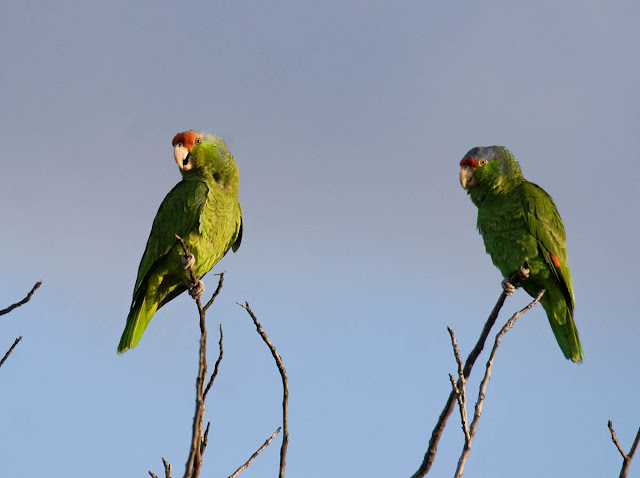
Red-crowned Parrot (left) and hybrid(?) (right). San Diego, California. May 21, 2016. Greg Gillson.
While meeting at the marina for a pelagic trip I heard the loud, harsh screeching of the parrots and located them in a tree over the parking lot. They allowed me to approach quite near. It still wasn't easy to figure out an identification, though.

Of the two birds, neither showed the full bright crown of Red-crowned, but neither did they match Lilac-crowned. The bird on the left (above) has a darker eye. That indicates a young bird, so the restricted red on the crown is expected. The right bird has a definite white eyering, so that is the strongest indication of Red-crowned, as the eyering on Lilac-crowned is blue. And at least one of the birds clearly gave descending whistles among their other grating and screeching calls. That matches Red-crowned and not the rising whistle of Lilac-crowned.

Red-crowned Parrot
Red-crowned Parrot or hybrid with Lilac-crowned Parrot?
The only thing worse to a birder than an introduced bird is a hybrid!
Of course, there is the very real possibility of hybridization. The restricted darker maroon forehead on the above bird certainly fits Lilac-crowned, as does the green feathering along the upper mandible. But the white eyering and pale cere (fleshy area around the nostrils) only belong to Red-crowned.

On the other hand, the outer vanes of the base of the outer tail feathers show blue on Lilac-crowned. And the tail is longer. Neither of those is a match on the above bird. But that restricted dark red forehead. I could be talked into this bird being a hybrid.

Red-crowned Parrot
Red-crowned Parrot
The photo above shows the darker eye of a young bird. There are orange feathers coming in the crown above the eye that point to Red-crowned, even though the cere is a bit dark and the eyering color is ambiguous. And the red comes down all the way to the base of the upper mandible clear down to the gape. There's no problem with this bird being a Red-crowned Parrot, and no reason to invoke the hybrid hypothesis.

Now that I know to listen for the upslurred or downslurred whistles, I'll feel better about identifying birds as they fly over, or are perched high in a palm against overcast coastal morning skies.

Interestingly, many birders do not pay much attention to introduced or escaped birds. After all, only wild, free-flying birds are "countable" by the major birding organizations. Escaped cage birds are not countable, and populations that escape and breed are only considered "established" if they have been present for many years (10-20 years) and their population is not dependent upon continued releases in order to maintain itself. On the other hand, birders can't keep ignoring the growing populations of feral birds in California, Texas, and Florida--they are "real" birds eating food and competing for resources whether or not they are "countable" on a birder's list.

Still, there's more information on identification of parrots on the local parrot cage bird website than in the birding field guides. That doesn't seem right, either.

Sunday, August 3, 2014

New names for old birds

I recorded and photographed two new bird names on my list of today's birds. But I didn't record any new life birds. These weren't even new year birds for me. How?

Well, every year at this time the scientifically-slanted AOU (American Ornithologists' Union) publishes its checklist of North and Middle American birds (North Pole to Panama), adding new species discovered visiting North America the past year, changing names (common and scientific), reordering the checklist, and splitting and lumping species based on new DNA or morphometric or other evidence. Once published, the ABA (American Birding Association), the "birding-as-a-sport-club" adopts the checklist changes (but only for US north of Mexico, Canada, and the French Island of St. Pierre et Miquelon, and out 200 miles into the ocean or half the distance to another point of non-included land (but not Bermuda, Bahama (♫ come on pretty momma ♫), Greenland, or Hawaii).

Thus the following two birds I saw today now have different names for different reasons.

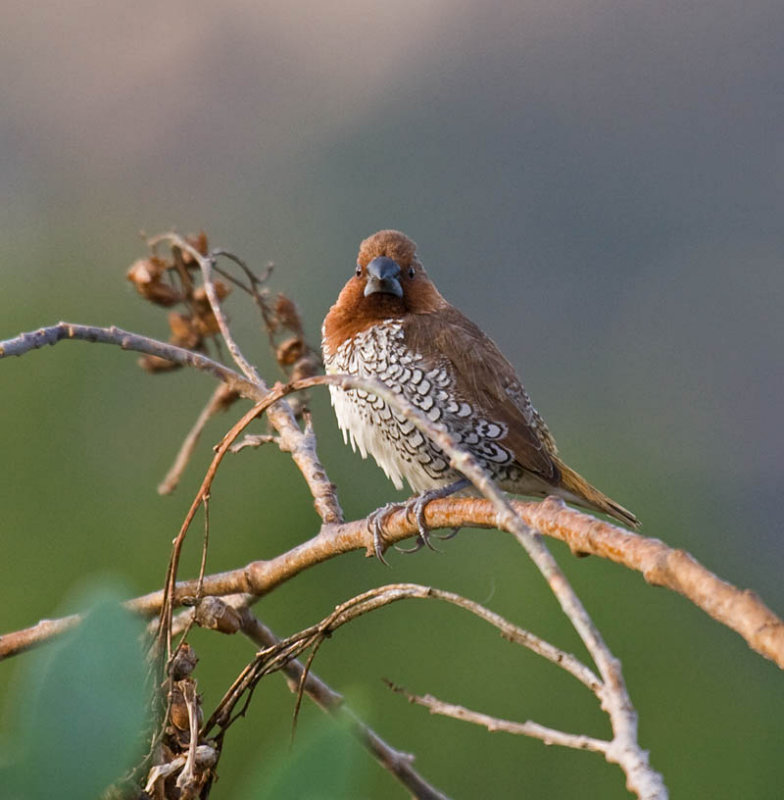
Nutmeg Mannikin becomes Scaly-breasted Munia
Nutmeg Mannikin becomes Scaly-breasted Munia. Kit Carson Park, Escondido, California. August 3, 2014. Greg Gillson.
Just last year this feral former cage bird became a countable species in southern California. Wild birds are widespread in river bottoms along the coast. In the pet trade this bird is known as Spice Finch or Nutmeg Mannikin.

The bird has nothing to do with nutmeg, nor is it found where nutmeg comes from. [Maybe it is nutmeg-colored. But that's not a real color. It's a made-up color. The only real colors are those original 8 in the Crayola box. As a kid, my family evidently couldn't afford the 64-color box for me, or the unbelievable 128-color box, so now I refuse to recognize any other colors. This bird is brown (or close enough).]

The Nutmeg Mannikin is NOT related to the bird family of Manakins. Mannikins are finches (known for their lively songs and seed-eating appetites); Manakins are related to flycatchers (sub-oscines, which means they can't sing to save their lives; they eat bugs); Manikins are, well, Mannequins. Where's Ogden Nash when you need him?

Scaly-breasted Munia Lonchura punctulata is the last bird on the ABA checklist--the last bird in your field guide, following House Sparrow and Eurasian Tree Sparrow.

Okay, enough silliness. On to Bird Number 2.

Clapper Rails in the West become Ridgway's Rail
Western Clapper Rails become Ridgway's Rail. San Elijo Lagoon, Solana Beach, California. August 3, 2014. Greg Gillson.
It was low tide at San Elijo Lagoon this morning. Over a dozen of these large rails snuck (sneaked, for you word snobs) out of their marsh vegetation where they usually hide unseen to eat the many exposed fiddler crabs and clams or whatever those lumps in the mud are. They were quite excited and called out often, eliciting a response from all the other rails in the marsh--quite a noise! It is more usual not to see or even hear any rails during a birding visit.

Last time I saw these birds they were called Clapper Rails. But a bunch of Clapper and King rails (several in Mexico) were split in this recent AOU update (see definition of "cryptic species" in yesterday's post about White-breasted Nuthatches). "Clapper Rails" are now found on the Atlantic. Ridgway's (yes, without an 'e') Rails are now the form found in coastal salt marshes in California and along the Colorado River and coastal western Mexico.

Ridgway's Rail  Rallus obsoletus
Clapper Rail  Rallus longirostris

Friday, March 21, 2014

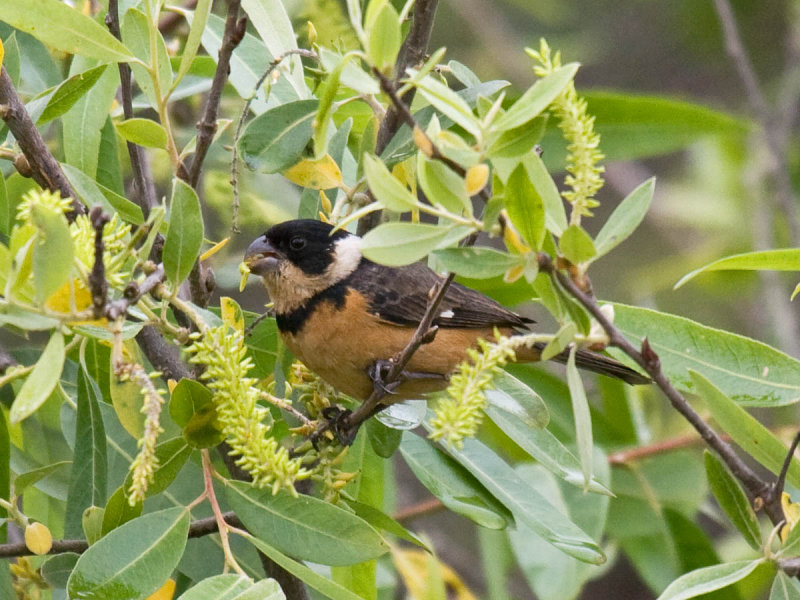
White-collared ("Cinnamon-rumped") Seedeater

White-collared (Cinnamon-rumped) Seedeater
White-collared ("Cinnamon-rumped") Seadeater. Dairy Mart Ponds, Tijuana River Valley, San Ysidro, California.
March 2, 2014. Greg Gillson.
Here's a photo of that White-collared Seedeater I told you about last week in my "Treasure Hunt" post.

Again, this is the West Mexico form, more richly colored than what you'll find in the North American field guides (yes, I know that Mexico is in North America, but field guides don't!).

This is a small bird about junco-sized. I didn't get too much time to observe the bird before it flew off with the typically undulating flight of a finch. But I did snap several photos, most with the bird hidden behind the willow leaves as it ate the blossoms.

Evidently it is fairly common as a cage bird in Tijuana, Mexico, only a mile or so from where I spotted this bird. Though this individual doesn't show any signs of having been in a cage recently (or maybe ever), the species hasn't been established long enough in this area of California to be countable according to the California Birds Record Committee. The general rule for such birds to be considered "established" is that birds have to be maintaining a viable population for many years (~15) without needing extra "excapees" or released birds to keep the population going.

So, an interesting exotic, but not a countable "wild" bird that will NOT go on my list.

Thursday, February 20, 2014

Lilac-crowned Parrot

Lilac-crowned Parrot
Lilac-crowned Parrot. Point Loma, San Diego, California. February 9, 2014. Greg Gillson.
San Diego has many introduced birds flying about. Besides the continent-wide House Sparrows, European Starlings, Eurasian Collared-Doves, and domestic pigeons, ducks, geese, and chickens, there are Orange Bishops, Pin-tailed Whydahs, Black-throated Magpie-Jays, Nutmeg Mannikins, and perhaps a dozen types of parrots and parakeets.

Last week I drove through Point Loma on a brief exploratory visit. Point Loma is a community and huge peninsula that separates the Pacific Ocean from the northwest side San Diego Bay. It has upon it a university, several military installations, the Fort Rosecrans National Cemetery, Sunset Cliffs, Cabrillo National Monument including the Old Point Loma Lighthouse, and residential neighborhoods. The marina is on the bay side of the base of the peninsula, where one departs for pelagic trips. It is only a mile or two from the San Diego International Airport.

This westernmost point of land grabs more than its fair share of rare birds in migration and winter. I had been a bit apprehensive of driving through the military cemetery to look for birds. But it turns out you have to drive through it to visit Cabrillo National Monument. I turned around without going in to Cabrillo because it is a fee area and I wasn't going to be staying on this visit. And I didn't have time to look for some of the rare warblers, tanagers, and other goodies that have been wintering in the cemetery. I still have plenty of common birds to find before I chase too many of the rarities.

However, I did hear this horrible grating screech and pulled over to photograph 6 parrots--my first psittacids of San Diego County. The only parrot currently countable in California is the Red-crowned Parrot. I wasn't sure what species this was when I quickly got out of the car and took the photos. I have settled on Lilac-crowned Parrots, as the red isn't extensive enough and the blue (lilac, even) crown too extensive for Red-crowned. It is also called Lilac-crowned Amazon and Finsch's Amazon, and is native to the Pacific slope of Mexico. So, pretty, but obnoxious and not countable on my ABA list.

Lilac-crowned Parrot

Sunday, February 16, 2014

San Diego Year Bird #160: Nutmeg Mannikin

Nutmeg Mannikin
Nutmeg Mannikin pulling nesting material. Escondido, California. February 2, 2014. Greg Gillson.
It had been two months since I saw my first Nutmeg Mannikin. I saw my second--and first of 2014--at Kit Carson Park in Escondido pulling nesting material from this broken giant grassy-tuft swamp-plant thing (that might not actually be its official name).

And that's all I have to say about this photo.

Tuesday, December 31, 2013

ABA area bird #520 (#515): Nutmeg Mannikin

Nutmeg Mannikin
Nutmeg Mannikin. Lake Hodges, California. December 1, 2013. Greg Gillson.
In September 2013 the American Birding Association, following the lead of the California Bird Records Committee, accepted Nutmeg Mannikin onto the official list of "countable" birds north of Mexico as an established exotic. In other words, their great-great-grandparents may have escaped their cages in San Diego or Tijuana, but they've been reproducing like mad for a decade or more in the wild and are not going away any time soon.

Actually there are 8 criteria they need to meet before they are accepted. And, bummer, if an established exotic ever dies out you have to take it off your list. For instance, if all the starlings or house sparrows die out in North America, they never counted--it's as if they never existed. This actually happened to me with Crested Mynas that lived for a century in Vancouver, British Columbia. I saw them in 1973 and/or 1975 (my notes are missing from those trips). Poof! They're gone. I've never seen one. The rules say so. So you see, that, as they say, is that.

Birds in southern California from San Diego north to Santa Barbara are countable. Even though there are large populations of these birds in Florida they are not countable there,... yet.

Nutmeg Mannikin

Speaking of countable, there may be a few non-countable birds on my list of 520 species seen north of Mexico. I am using eBird to come up with the numbers. eBird lets you track non-countable birds (non-established exotics). I think the  Monk Parakeet and Mute Swan I saw in Oregon are not countable, and Chilean Flamingo, African Collared-Dove, and Nanday Parakeet in California from many years ago (probably countable if I saw it today, but not "bankable"). So, this is more like ABA species #515 for me. That's pretty good for never having birded SE Arizona, Texas, Florida, or Alaska.