Saturday, August 29, 2015

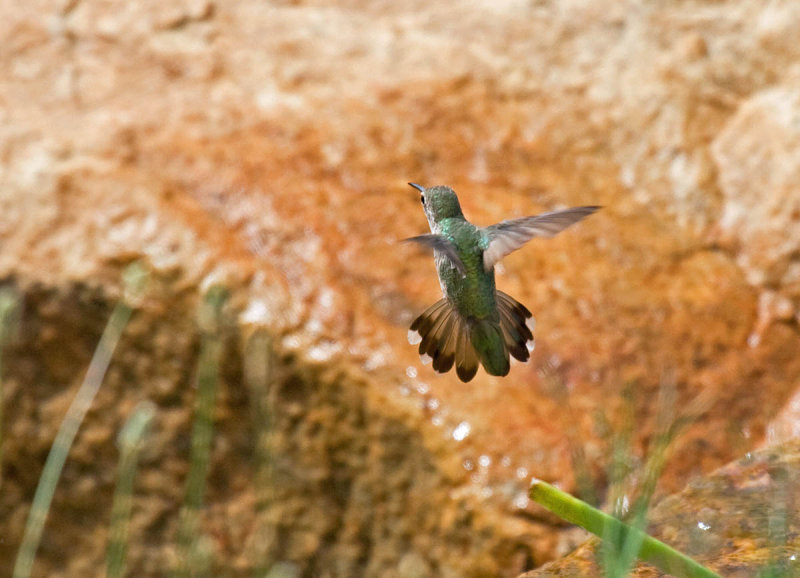
Anna's Hummingbirds near Julian

The identification of female and immature hummingbirds is tough. In the East one only expects Ruby-throated Hummingbird. But in the West there are 7 species and another dozen from Arizona to Texas.

Anna's Hummingbird
Anna's Hummingbird. Julian, California. July 3, 2015. Greg Gillson.
Most female and immature hummingbirds are a similar green. The color, design, and shape of the tail feathers when fanned are key for separation. And the shape of the primary wing feathers when perched are important for ID purposes, too. On such tiny, energetic speedsters, these field marks are not easily observed with only binoculars. Thanks to high speed digital photography in the past dozen years or so, many rare and out-of-range hummingbirds are being identified now that would not have been identified in the past.

For my own photos, too, I am able to gain more confidence identifying these oh-so-similar hummingbirds that might have gone unidentified in the past--even if my efforts so far have only verified that the birds I am photographing are the expected ones.

Wednesday, August 26, 2015

California Thrasher at Scissors Crossing

Eastward over the Cuyamaca Mountains, right on the edge of the Anza-Borrego Desert State Park, I spied a large gray-brown bird in the mesquite. Slightly larger than a robin, plain breast, long curved bill, ample tail.

Nope. Not the rare Crissal Thrasher that one might expect in the desert mesquite trees just 20 miles farther east. Rather, it was the common thrasher of the coastal slope to the west--the California Thrasher.

California Thrasher in mesquite
California Thrasher in mesquite. Scissors Crossing, California. July 4, 2015. Greg Gillson.
It is especially common in dense chaparral, but also found in coastal sage scrub. These birds don't seem to care for human-altered habitats, and are quite scarce even in apparently appropriate habitat in urban areas.

They are harder to find in winter in their dense bushes and shrubs. But come spring they sing loudly from exposed perches. The songs are long and complex and slightly warbled, with both musical and harsh notes.

Saturday, August 22, 2015

On taking field notes

Guess what's in this blue tub?

blue tub

Van Remsen in American Birds September 1977 wrote an article that greatly influenced my birding: "On Taking Field Notes." Following this article I changed the way I kept track of birds I saw. In fact, I kept field notes based on this article faithfully for 28 years, until 1996. After that my field notes kind of sputtered and were irreglular until 2006. Then I started using BirdNotes online for some of my birding trip lists. 

tub full of field notes
A tub full of Greg's bird field notes dated from 1972 to 2006.
In 2010 I started using eBird and became a strong advocate (one might even say "evangelist") of this great program (click here for "What is eBird?" that I wrote in 2010). This real-time online checklist program allows me to take field notes in the way that Remsen recommended. Locations can be mapped precisely. Time and distance are recorded. I can note mere presence or exactly count numbers. Rare birds are flagged (and vetted) so that I must write a description before they'll be accepted into the database. One of the problems of my paper field notes is that I would underline rare birds on my day's list, but then not say anything more about them. Thus, years later, even I can't vouch for some of the sightings of rare birds that I listed but did not describe. I can even add photos to my lists.
birding field note books

The reason I bring this all up (again)? Just this week I finished a 5 year project of entering all those 37 years of my bird notes (1972-2010) into eBird. Yes, every bird that I've ever seen for which I have notes that contain exact locations and dates, are now in eBird. In total, including these old notes and bird lists directly into eBird from 2010 to date, they number over 7000 checklists. 4000 of those lists are complete checklists--every bird I saw at a particular location and date. All my notes, all those valuable data, all that hard work, is preserved and publicly available right now as long as eBird and National Audubon Society and the Internet exist. That's a lot better than sitting unused in a blue tub in my closet.

I think Van Remsen would be pleased.

Friday, August 21, 2015

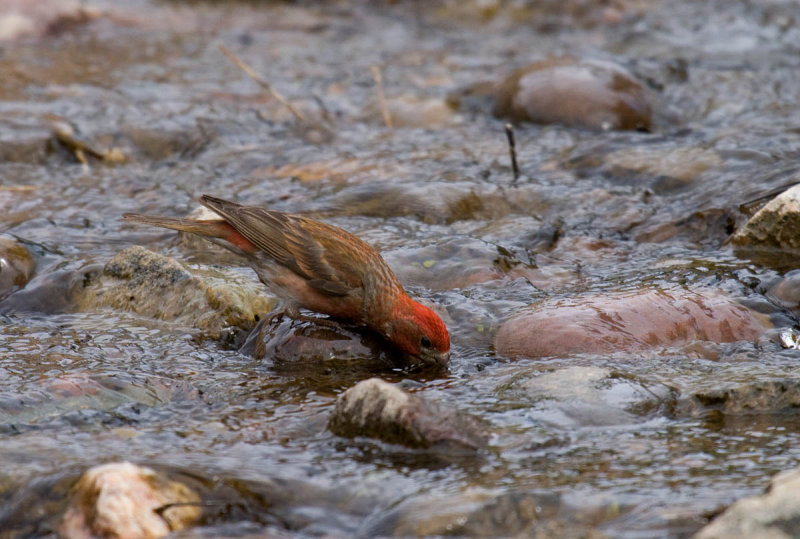
Purple Finch at Julian

One form of Purple Finch breeds across the boreal forests of Canada and into the NE U.S. and winters in Eastern U.S. Another form is a resident down the Cascades and Sierra-Nevadas from southern British Columbia to mountains in extreme southern California. They prefer conifer and mixed forests. I don't know why they don't like the Rocky Mountains.

Purple Finch
Purple Finch. Julian, California. July 3, 2015. Greg Gillson.
As you can see, Purple finches are not purple, but red, paler pink on the breast. The back and wings are brownish, tending toward olivaceous (a dark greenish). They are similar to Cassin's Finches (which are found in mountain pine forests and do like the Rocky Mountains). They are also similar to House Finches that are common feeder birds in towns and lowlands. House Finches have the brighter red more concentrated on the forehead, rump, and upper chest. The lower belly of House Finches are whiter with brown stripes.

Purple Finch

This Purple Finch was photographed at a water feature near our inn in Julian last month. They are found in the higher wooded mountain areas of San Diego County which divide the county in half in a general northwest to southeast manner.

Purple Finch

Purple Finches sing a cheerful, sweet, rollicking song to match the bright coloration of the males. Females are brown striped--really pretty much as the male but with no red hue at all.

Sunday, August 16, 2015

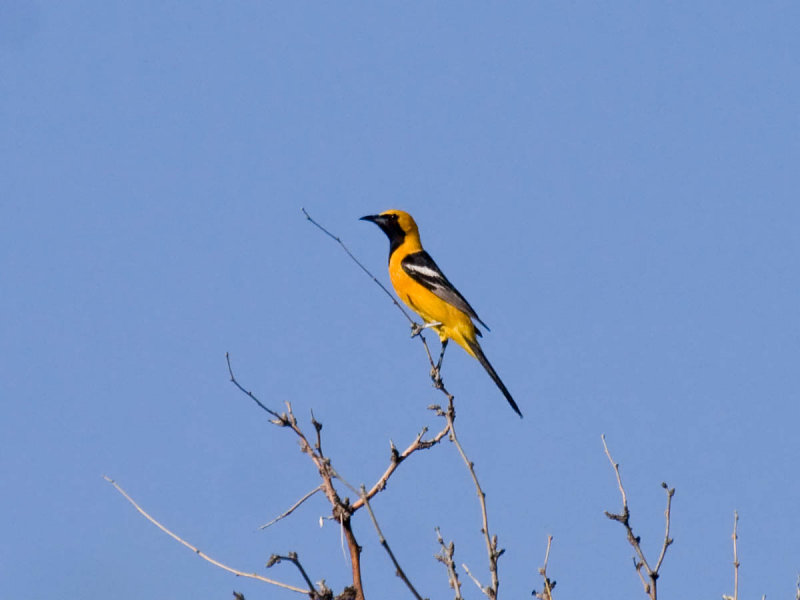
Hooded Oriole at Scissors Crossing

Hooded Orioles are common birds of palm and eucalyptus trees in urban and residential areas of southern California. In fact, they are spreading in such human-altered habitat nearly the length of California now. Nevertheless, they migrate south well into Mexico in winter and are quite rare in winter in southern California, perhaps averaging 2 birds per winter in San Diego County. For instance, in January 2015 there were 3 each of Orchard and Baltimore Orioles known in the county, at least 4 Bullock's Orioles, but apparently only one Hooded Oriole (eBird and San Diego Field Ornithologists newsletter).

Hooded Oriole
Hooded Oriole. Scissors Crossing, California. July 5, 2015. Greg Gillson.
Their historic "native" habitat in San Diego County was sycamore lined intermittent streams feeding into the Anza-Borrego desert and a few scattered oases with the rare native California Palms. This bird photographed above was along one such desert stream.