Saturday, May 7, 2016

American Robin with scaly mite leg infection

Yuck!

I thought I was getting good photos of an American Robin collecting nesting material. Then I looked and the legs were grotesque--like they were made of cottage cheese. Disgusting!

I believe that this is a scaly leg mite infection. It is cause by small mites--spider-like insects barely visible to the naked eye. They burrow under the scales on the leg. Mite infections are frequent among poultry and parrots and spread bird-to-bird or infest cages where birds are kept together.

American Robin with scaly mite leg infection
American Robin with scaly mite leg infection. Click for larger view. Escondido, California. April 15, 2016. Greg Gillson.
The progression of the disease is rather slow. In poultry the infection is fatal if untreated. I imagine it is also fatal in wild birds. As it is building a nest, it will likely spread to its mate and future chicks.

Sad.

Thursday, May 5, 2016

Comparison of two breeding cormorants

At La Jolla Cove the cormorants were nesting on the cliffs right below the walkway. Several people were taking photos and many more were stopping to watch the antics. One particular nest was receiving a lot of attention as the just-hatched chicks were peeking out from under the parent.

Brandt's Cormorant and chick
Brandt's Cormorant and chick. La Jolla, California. May 1, 2016. Greg Gillson.
Brant's Cormorants have a pale patch of feathers on the throat. In the spring the featherless throat pouch turns a brilliant blue. The breeding display consists of flipping the head backwards over its back and ululating with fluttering throat pouch displayed to the sky.

Brandt's Cormorant

A couple of Double-crested Cormorants were also on the cliffs. They have a yellow-orange throat pouch throughout the year. As you can see by the photo below, the high breeding plumage brings a tuft of white feathers back from the eye. These are the "crests" mentioned in the name. Interestingly, these crests are white in Western birds, but black and larger in other populations across North America. Double-crested Cormorants are found in marine and fresh water across the continent, while other cormorants in North America are primarily restricted to salt water habitats. Notice that the eye is circled by blue--it's actually the eyelids in breeding plumage!

Double-crested Cormorant
Double-crested Cormorant. La Jolla, California. May 1, 2016. Greg Gillson.
I love the coppery pattern on the back and wing coverts that birds, such as the one above, show in fresh plumage. As the feathers wear they lose their shine and appear dull blackish-brown.

Tuesday, May 3, 2016

Acorn Woodpecker at Kit Carson Park

Here is a photo of a recent Acorn Woodpecker I'd like to share with you. This was taken on a dark, cloudy morning and required major adjustment of the brightness settings in my photo post-processing at home. Digital cameras, in the default setting, want to turn everything dark gray. So it made the gray morning skies darker than they already were. I did bump up the camera settings for brightness, but they weren't as in good focus or pleasing position as this first shot. So, I changed the camera settings after-the-fact to make up for the poor original photo technique.

Acorn Woodpecker
Acorn Woodpecker. Kit Carson Park, Escondido, California. April 10, 2016. Greg Gillson.

Sunday, May 1, 2016

Birds to know in San Diego: Crown Point and Mission Bay

We continue our monthly series of common San Diego birds by visiting Mission Bay, including Fiesta Island and Crown Point Park. At Crown Point Park on the north side of the bay, you drive into the parking lot and walk the manicured sandy beaches. On Fiesta Island, on the south side of Mission Bay you drive almost 2 miles around and pull over on the edge of the road anywhere to scope out the birds on the more muddy shores.

I wrote a birding site guide to Crown Point Park in January 2014. You might want to view that, too.

Crown Point Park
Crown Point Park
Here are some of the common birds you should know on Mission Bay in San Diego.

Brant
Brant. Chula Vista, California. January 30, 2016. Greg Gillson.
Brant
About 750-1500 of these small marine geese wintered in Mission Bay and San Diego Bay at the end of the 20th century (Unitt 2004). To my eye, there are at least that many birds now. In the photo above you can see their favorite food--eel grass--as one blade dangles from the bill and another is draped across its back. They are present here from November through March, though a few individuals fail to migrate in spring to their breeding grounds to the Arctic coastline. Similar San Diego birds: Canada Goose, Cackling Goose.
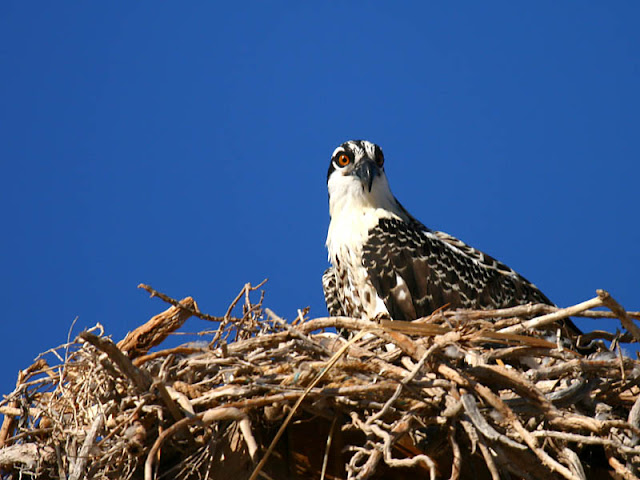
Osprey
Osprey. Rocky Point, Sonora, Mexico. May 11, 2007. Greg Gillson.
Osprey
These fish-eating hawks are regular year round in small numbers at coastal estuaries and inland lakes. They make very large stick nests on tall platforms near, or over, water. They may be seen hovering over water and making strafing runs with talons cutting the water, then carrying their prey away on long bent wings. Similar San Diego birds: Red-tailed Hawk.

Great Blue Heron
Great Blue Heron. Lake Henshaw, California. December 27, 2015. Greg Gillson.
Great Blue Heron
This tall gray heron is familiar to most people in North America. Numbers remain similar in San Diego County all year, but they spread out in winter, farther away from their limited number of nesting colonies. They are found near fresh water shores, but also hunt for rodents and amphibians in bare or short grassy fields. Similar San Diego birds: Little Blue Heron.

Black-bellied Plover
Black-bellied Plover. Crown Point, Mission Bay, California. February 16, 2015. Greg Gillson.
Black-bellied Plover
Found on tidal mudflats and even open beaches, Black-bellied Plovers are rather common from fall through spring. Even summering non-breeding birds are not unusual. They are especially numerous in August and September when juveniles arrive from the Arctic. The eponymous black belly, chest and face is a feature of the spring adult breeding plumage. Similar San Diego birds: Red Knot, Killdeer, Short-billed Dowitcher.

Black Skimmer
Black Skimmer. Crown Point, Mission Bay, California. February 16, 2015. Greg Gillson.
Black Skimmer
This is one odd bird. They are superficially gull-like, with long pointed wings, short legs, and webbed feet. Males are about 20% larger than females. The knife-like lower mandible is much longer than the upper mandible. They skim the quiet shallows of the bay with the lower mandible partially submerged, snagging fish near the surface. Unique in the bird world, their pupils are cat-like vertical slits, perhaps to provide exposure protection from the sunny beach sand. They were first recorded in San Diego County in 1971, expanding their range from Mexico. 300-400 pairs nest at the salt works in south San Diego Bay in May and June. At other seasons these birds hang out on Mission Bay. Similar San Diego birds: None, really.

Ring-billed Gull
Ring-billed Gull. Lindo Lake, California. February 9, 2014. Greg Gillson.
Ring-billed Gull
This rather small gull is widespread near water in the county, west of the desert and below the mountains. While common in estuaries along the coast, they avoid the open ocean. They are regular July-April, though some non-breeders also spend the summer along the coast. Similar San Diego birds: California Gull, rare Mew Gull. Immature gulls of most species have ringed bills at some point in their development (see adjacent immature Ring-billed Gull in above photo).

Long-billed Curlew
Long-billed Curlew. Coronado, California. March 2, 2014. Greg Gillson.
Long-billed Curlew
The long bill on this largest of North American sandpipers is truly amazing. The male may have a bill of only 4-1/2 inches, while the female may have a bill 8-1/2 inches long (like the bird in the photo above). Crabs and marine invertebrates are its preferred food, so they are found primarily in the lagoons and bays. These cinnamon-colored birds nest in grasslands in west-central North America. A very few non-breeders spend the summer. However, as short-range migrants they are found commonly from July-May, so it seems they are here year-round. Similar San Diego birds: Whimbrel, Marbled Godwit.

Birds to know in San Diego: introduction

Next: Birds to know in San Diego: Palomar Mountain

Saturday, April 30, 2016

Blue-gray Gnatcatcher at Dixon Lake

Gnatcatchers are active tiny sprites with expressive long tails. They search for insects and spiders, crawling through low bushes and brush. They give incessant soft slightly-harsh sibilant calls.

There are three species of gnatcatchers in San Diego County. Besides having different songs, calls, and habitat preferences, they all differ in the amount of white on the underside of the black tail. The dusky-breasted California Gnatcatcher has a nearly all-black tail. It is an endangered species of the coastal sage scrub--found in the lowland hills where residential development is most intense. The gray-and-white Black-tailed Gnatcatcher has a bit of white in the tail, but is over half black. It is found only in the desert lands east of the mountains. [See my post on identifying gnatcatchers in southern California.]

Blue-gray Gnatcatchers are found in the most diverse habitats--riparian bottoms, pinyon-juniper, chaparral, and live oak woods.

Blue-gray Gnatcatchers
Blue-gray Gnatcatcher. Dixon Lake, Escondido, California. April 15, 2016. Greg Gillson.
This male Blue-gray Gnatcatcher is more bluish than the females. Females and winter males lack the black line that starts on the forehead and continues just over the eyes. The thin white eyering is obvious. The tail is mostly black with several white outer tail feathers. When the tail is closed, the outer feathers are folded on the bottom of the tail feather stack--thus the tail looks mostly white from below. From above, the tail looks black, unless it is fanned wide open. Then the white outer tail feathers are obvious.

Blue-gray Gnatcatchers

I heard this bird and its mate as I was driving slowly along the pot-holed road on the north shore of Dixon Lake, Escondido. I made a slight hiss with my tongue and the male popped up to investigate. I was able to shoot my photos from the car, using it as a blind. Remember to shut off the engine to remove vibrations that affect image quality. These ended up being my best photographs of this bird that always seems to peek out from behind a tangles of branches.