It was Marlene's and my 40th wedding anniversary. We only had 3 days. Getting "away" sounded better than going to a place with lots of other people. So instead of an expensive stay on a crowded beach, we rented a little cabin in the woods at Julian.
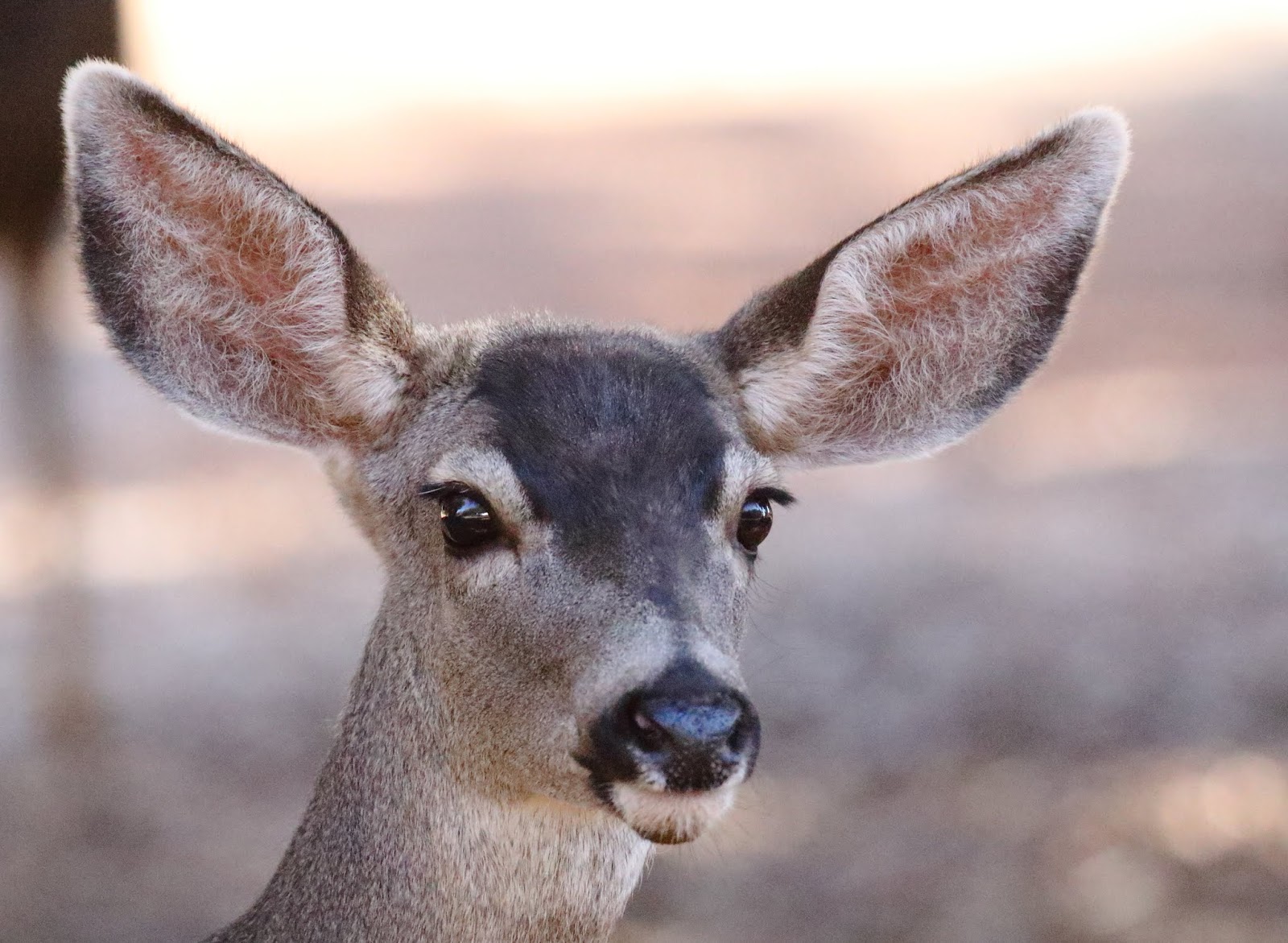
We arrived Saturday afternoon and stayed until noon on Monday. No other people for nearly 48 hours. Pine trees, turkeys, deer, sunsets, oak trees. Silence. Rest. Away.
Here is a collection of photos from our trip. The first 3 were taken on my camera phone, the remainder with my large lens and camera.
As perhaps you can tell from the photos below, there was no time during the weekend when there weren't deer and turkeys in view. In fact, when I walked around the property I invariably had several deer following me around, and the turkeys weren't spooked until I was within 30 feet.
Just what we needed!
Thursday, November 15, 2018
Tuesday, November 13, 2018
Last pelagic trip of fall
Well, unlike most of the earlier trips this year, the pelagic trip from San Diego on October 22, 2018 lacked exciting rarities. But, I guess, if rarities occurred on every trip, they soon wouldn't be rarities, would they?
But the trip was unique in its own way.
We loaded onto the boat about 6:00 am. We started out in fairly heavy fog in the bay. That made for some interesting sunrise pictures.
Once offshore it quickly became lighter and the fog less dense. So it became possible to get the first few usable bird photos.
Flocks of Black-vented Shearwaters were diving into the water chasing bait fish chased to the surface by tuna.
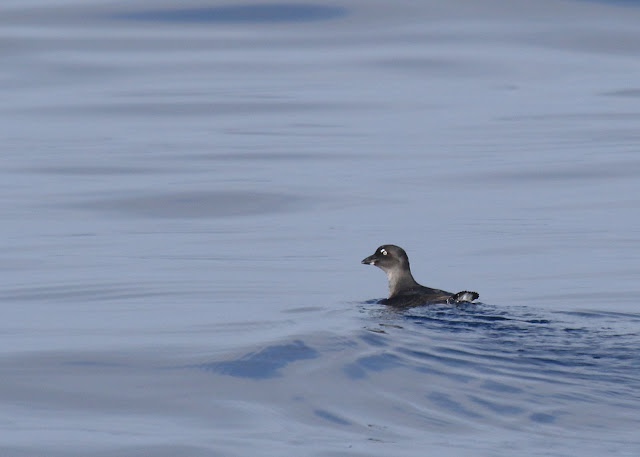
Later in the morning as we moved farther offshore we left the larger number of birds. Sporadic sightings of Cassin's Auklets happened throughout the day, some eventually closer to the boat.
Then, in deeper water we spied a few California Flying Fish! They soared along for a couple of hundred feet before plunging back into the warm water. If the started flying too close to the surface they would stick the bottom of their tail into to the water and wiggle it back and forth to gain speed.
Nothing exciting showed up far offshore. After noon we turned the boat around and headed back toward shore. That's when we spotted a Northern Fulmar in heavy molt.
Then, we spotted this...
If you can't make it out, it is the snout of an Elephant Seal. The animal is facing directly away and its head is flipped over backwards looking at us upside down! The bulbous tip of the nose is up in the air and the forehead is at water level with both its eyes looking at us from just above the water.
As we neared shore again a group of dolphins raced us.
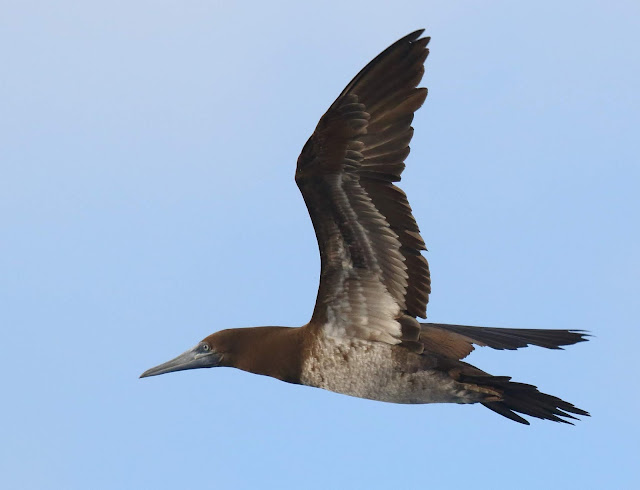
And a third-for-the-day Brown Booby passed over the boat before continuing on.
The day was quickly ending. The gulls were getting a late afternoon snack.
We entered the bay at dusk and it was quite dark by the time we reached the dock.
But the trip was unique in its own way.
We loaded onto the boat about 6:00 am. We started out in fairly heavy fog in the bay. That made for some interesting sunrise pictures.
Once offshore it quickly became lighter and the fog less dense. So it became possible to get the first few usable bird photos.
| Juvenile Heermann's Gull. |
| Black-vented Shearwater |
Flocks of Black-vented Shearwaters were diving into the water chasing bait fish chased to the surface by tuna.
| Black-vented Shearwaters |
| California Gull chasing bait fish forced to the surface. |
| Cassin's Auklet |
| California Gull |
| California Flying Fish |
| Pink-footed Shearwater |
| Brown Booby |
| Red Phalaropes |
| Northern Fulmar |
If you can't make it out, it is the snout of an Elephant Seal. The animal is facing directly away and its head is flipped over backwards looking at us upside down! The bulbous tip of the nose is up in the air and the forehead is at water level with both its eyes looking at us from just above the water.
As we neared shore again a group of dolphins raced us.
| Pacific White-sided Dolphin |
| Brown Booby |
We entered the bay at dusk and it was quite dark by the time we reached the dock.
![]() |
| Moon over San Diego Bay. |
Sunday, November 11, 2018
Birds in three dimensions
The majestic bird spreads its great wings and gracefully launches itself from the cliff into powerful flight.
Or not.
More than likely the bird steps off the ledge of its high-rise home and when it reaches the correct floor opens its wings to get off its self-imagined elevator. Or, like a day-old Wood Duck chick, fledging from its nest 35 feet up in a tree cavity, it jumps out, bouncing when it hits the ground, and waddles away to the pond.
J.B.S. Haldane, On Being the Right Size (1928) wrote:
Birds have the freedom of flight because of their strong breast muscles and wings. Additionally, because smaller birds don't weigh much compared to their surface cross-section, they have no fear of falling. A fall won't hurt them, because the air holds them up. Gravity is still the same 32 feet per second squared, in a vacuum, but in the open air they flutter down gently like a leaf.
Because of their ability to fly, and the lack of fear of hurting themselves in a fall, birds necessarily perceive the 3-dimensional world in a different way than we do. They live more fully in a 3-dimensional world than we can even imagine.
Watch this funny Suicidal Pigeon video on YouTube.
Or not.
More than likely the bird steps off the ledge of its high-rise home and when it reaches the correct floor opens its wings to get off its self-imagined elevator. Or, like a day-old Wood Duck chick, fledging from its nest 35 feet up in a tree cavity, it jumps out, bouncing when it hits the ground, and waddles away to the pond.
J.B.S. Haldane, On Being the Right Size (1928) wrote:
"To the mouse and any smaller animal [gravity] presents practically no dangers. You can drop a mouse down a thousand-yard mine shaft; and, on arriving at the bottom, it gets a slight shock and walks away, provided that the ground is fairly soft. A rat is killed, a man is broken, a horse splashes.
"For the resistance presented to movement by the air is proportional to the surface of the moving object. Divide an animal’s length, breadth, and height each by ten; its weight is reduced to a thousandth, but its surface only to a hundredth. So the resistance to falling in the case of the small animal is relatively ten times greater than the driving force.
"An insect, therefore, is not afraid of gravity; it can fall without danger, and can cling to the ceiling with remarkably little trouble. It can go in for elegant and fantastic forms of support like that of the daddy-longlegs."As humans we are strongly bound to the ground. We're not as solidly bound to the ground as an earthworm, perhaps, but our experience isn't as unbounded as a bird. We are only now starting to get used to seeing video shot from drones, floating off from the ground up over the roof tops uninterrupted. Yet that is the world that most birds live in.
Birds have the freedom of flight because of their strong breast muscles and wings. Additionally, because smaller birds don't weigh much compared to their surface cross-section, they have no fear of falling. A fall won't hurt them, because the air holds them up. Gravity is still the same 32 feet per second squared, in a vacuum, but in the open air they flutter down gently like a leaf.
Because of their ability to fly, and the lack of fear of hurting themselves in a fall, birds necessarily perceive the 3-dimensional world in a different way than we do. They live more fully in a 3-dimensional world than we can even imagine.
Watch this funny Suicidal Pigeon video on YouTube.
Subscribe to:
Posts (Atom)