Showing posts with label molt. Show all posts

Wednesday, July 18, 2018

Great-tailed Grackle at Dixon Lake

Grackles tend to be noisy and somewhat obnoxious residents of parks, lake shores, and parking lots. Great-tailed Grackles are found from Texas to California, never far from water... or people.

Great-tailed Grackles first arrived in San Diego County in 1977, but were not noted breeding until 1988. By the time of the publication of the San Diego County Bird Atlas (2004, Philip Unitt) birds were locally common throughout most lowland wetlands and lakes.

These birds are fairly common at the golf course across the street from my home and nearby at Dixon Lake. They were not recorded there during the Atlas project. So, they have continued to expand until it would be unusual to find a lowland lake with manicured lawns that did not support a colony of these birds.

The male pictured below was "singing" last month on the shore of Lake Dixon, in Escondido. The display is quite involved and includes spread tail, slightly open wings, and head throws with loud squeaks, rattles, squeals, and whistles.

Great-tailed Grackle
Great-tailed Grackle. Dixon Lake, California. June 15, 2018.
Take another look at the bird below. See the dark and light bands on the feathers of the tail? These are growth bars. Dark bars are daytime growth and the pale bars indicate night time. Each pair is a day of growth. How many days did it take to grow the longest tail feather? (I count over 30 pairs of growth bars in the longest feather.)

Grackles are quite unique in molting all their tail feathers at once, thus being tailless in late summer. The tails of grackles will have all feathers showing the same wear and fading, as they are all the same age. Most other birds molt the tail sequentially (or in groups of 3-4 feathers at a time), thus would show groups of feathers with differing wear and fading patterns as adults (> 1 year old).

Great-tailed Grackle

Tuesday, July 10, 2018

Acorn Woodpecker at Kit Carson Park

The best part of our job as property managers is that we live where we work. The worst part of our job as property managers is that we live where we work. We have no commute from work to home. But if we're not careful, we could end up working on our days off. So we always try to do something away from home on our weekends.

In April, Marlene and I just got away for an hour at nearby Kit Carson Park. Marlene sat on a bench by the lake, reading a book. Rather than my usual hike, I photographed the woodpeckers immediately nearby. I obtained two decent images.

Acorn Woodpecker
Acorn Woodpecker. Escondido, California. April 22, 2018.
Acorn Woodpecker

Males and females are told apart by the forehead coloring. The top photo shows a female with a black band between the white forehead and red crown. The male immediately above has a full red crown connecting to the white forehead.

Notice that the all the feathers of the wing on the top photo are brownish rather than black as the back? That indicates that this bird is one year old. All the flight feathers are the same age, worn and faded.

Older birds molt flight feathers a few at a time, usually throughout the autumn in the northern hemisphere. That way they always have enough feathers to fly. Thus there will be new shiny black feathers amid older browner feathers, as seems to be the case with the lower bird.

Wednesday, May 30, 2018

Black-bellied Plover

Black-bellied Plovers winter commonly along San Diego's beaches. "Winter" is a relative term. For many shorebirds "winter" could mean all but 6 weeks in "summer,"--May 15 to June 15--when adults rush to the Arctic tundra to breed, then rush back. And some non-breeding birds remain locally all summer.

Black-bellied Plover

Black-bellied Plovers habitualize themselves to people on beaches. Thus it is relatively easy to get good, close photos of these birds. One of the highest concentrations where approach is easy, is at Crown Point Park on Mission Bay. Several hundred plovers hang out on the sand beaches, often with other shorebirds including Red Knots, Short-billed Dowitchers, Dunlins, Sanderlings, Ruddy Turnstones, Marbled Godwits, and Willets. Other birds winter birds flocking together on the beach there includes Royal Terns and Black Skimmers.

These photos, however, came from the mouth of the Tijuana River estuary, on February 18, 2018.

Black-bellied Plover

The striking black underparts of adults is attained in April and May and remains to September. I don't see this breeding plumage often in southern California--even in late spring. I'm just guessing, but it may be that primarily only first-year birds winter this far south? Such first-year birds (certainly top photo) remain in the plumages shown here all summer, similar to gray winter adults, but with some black feathers showing on the wing coverts (lower photo). Adults should complete molt into breeding plumage (a considerable energy budget) before migrating north (also a considerable energy budget). They won't molt and migrate at the same time--it takes too much energy. Or, maybe I just haven't been on the beach at the right time in spring.

Wednesday, June 10, 2015

Black Phoebe at San Luis Rey River Mouth

Here are some shots of the photogenic Black Phoebe. They like to sit out in the open, over the water, and are not very timid around people. So the challenge becomes to find interesting behaviors and backgrounds. Otherwise they become BOS ("bird on stick")--a rather dull photo.

Well, I didn't do any better with the background on these, but here they are anyway. The perch seems to be a dead stick and pickleweed (Salicornia). This individual has clean wide white fringes on the wing feathers, and pointed buff tips to the greater and lesser secondary coverts--forming the wingbars. Thus, I believe this is a juvenile bird just a few weeks old. Adults would have older, faded, worn wing and tail feathers that grew in last fall.

Black Phoebe
Black Phoebe. Oceanside, California. May 24, 2015. Greg Gillson.
Black Phoebe

Sunday, October 19, 2014

Albinistic Western Gull in San Diego Bay

Albino Western Gull. San Diego California.
Albino Western Gull. San Diego, California. October 4, 2014. Greg Gillson.
Returning to port on the October 4th San Diego pelagic trip a strikingly white large gull followed the boat into the bay.

While some birders were hoping the leaders would announce to them it was a Glaucous Gull, I recognized immediately that the only large gulls that white were albinos. Size, seasonal expectation, and the thick bill reveals that this is a locally-resident Western Gull.

White feather lack melanin, which imparts strength to the feathers. Thus the white feather tips are abnormally worn--not molting, even though I believe this gull is only a few months old--a juvenile. This bird, if it lives that long (albinos rarely survive long), will get new feathers through molt next September. It will be really ratty by then. Again, if it somehow survives.

Fully albino birds, such as this one appears to be, are not that frequent, but partially color-challenged birds are not that uncommon, especially in black birds such as crows and blackbirds. Birders who observe and identify unknown birds based on shape will not be fooled.

Below is a normally-colored juvenile Western Gull of the same age from our trip--what the top bird should look like.

Western Gull. San Diego, California.
Western Gull. San Diego, California. October 4, 2014. Greg Gillson.

Thursday, June 26, 2014

One-year old Blue Grosbeak

Blue Grosbeak
Blue Grosbeak. Carlsbad, California. June 8, 2014. Greg Gillson.
Earlier in spring I saw my first-ever male Blue Grosbeak. This bird is a male, just about one year old.

Blue Grosbeak

Thursday, June 5, 2014

Lesser Goldfinch

Lesser Goldfinch
Lesser Goldfinch. Fallbrook, California. May 4, 2014. Greg Gillson.
This is the most common goldfinch in southern California. This bird's northernmost regular range is near Portland, Oregon.

Lesser Goldfinches maintain their bright plumage year-round. American Goldfinches, on the other hand, employ a different molt strategy. The bright yellow male "wild canaries" of summer, molt into a dull buffy non-breeding plumage for the winter. Thus, in winter, Lesser Goldfinches are brighter yellow than American Goldfinches!

More details of the American Goldfinch molt are here.

Thursday, April 10, 2014

Wrentit

Wrentit
Wrentit. March 9, 2014. San Marcos, California. Greg Gillson.
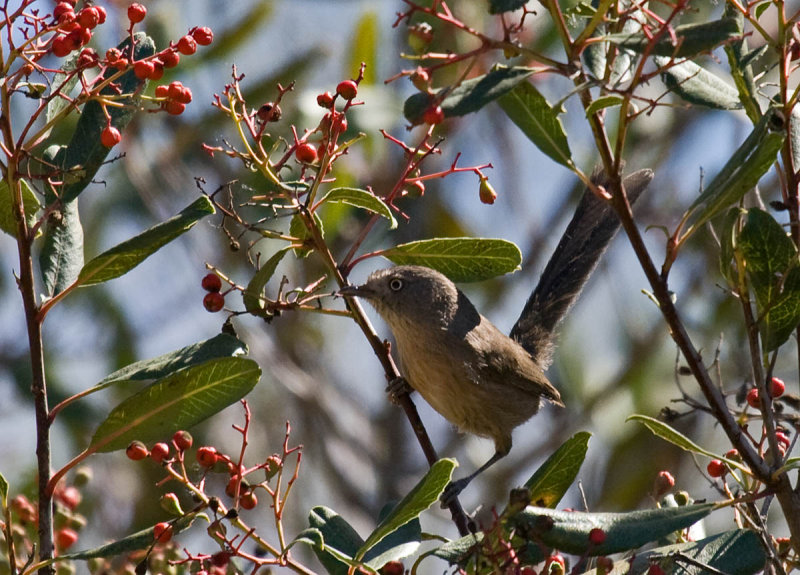
The Wrentit is found in chaparral and evergreen shrubs from the mouth of the Columbia River in Oregon south to the middle of Baja California (Norte). It's an odd little bird with no close relatives, thus the reason it gets shuffled around into different families. It is neither a wren nor a tit (chickadee). It is currently placed in the Babbler family, but recent DNA research may indicate that it has closer relatives in the Old World Warbler family. In either case, the Wrentit is the only New World member of either of these families of otherwise Old World birds.

More often heard than seen, this species skulks in dense bushes near the ground.

The next photo shows something interesting in regards to molt and aging. See the barely visible numerous evenly-spaced bars across the tail? Those are growth bars. Since all the tail feathers show the growth bars all the tail feathers grew in at once. This could happen if the bird lost its tail, somehow--an attack by cat or bird. However, it is more likely that these tail feathers grew in all at once during the prejuvenile molt. In other words these are the first set of feathers to grow in from the downy chick stage.

The bars themselves are caused by differences in feather growth between day and night. It looks like it took about 2 weeks to grow in the tail, judging from the number of growth bars. March 9 is the photo date. It seems early, but the best explanation is that this is a recently fledged young bird. If so, then the bird must have hatched before the 25th of February.

Wrentit with tail growth bars
Wrentit with growth bars on tail. March 9, 2014. San Marcos, California. Greg Gillson.
The Wrentits here in southern California are much paler gray-brown than the rich ruddy brown ones I am used to seeing on the Oregon Coast. Take a look at an Oregon bird below.

Wrentit
Wrentit. July 30, 2011. Lincoln County, Oregon. Greg Gillson.