Tuesday, June 7, 2016

Dinosaurs survive!

Is this how you view dinosaurs?...

Dinosaur flash cards from about 1968
Dinosaurs as depicted in my 1968 "Prehistoric Animals" flash card set.
That's how they were thought to look in the 1960's--slow, cold-blooded, lizard-like. Brontosaurus had to stay in deep water to support its massive bulk. Tyrannosaurus Rex had to lay out on the ground all morning to soak up enough warm sun rays to finally move and seek carrion--its long tails dragging behind on the ground as it plodded along.

I think I got interested in dinosaurs about 1966 or so, after a visit to the Denver Museum of Nature & Science. I remember the Stegosaurus skeleton as it appears in the 1950's post card ("before" picture) in this post on Denver's Fighting Dinosaurs. In 1995 the Stegosaurus skeleton was remounted to appear more lifelike and interacts, now, with a new Allosaurus skeleton.

In the 1970's and 80's came the revolutionary idea of "hot-blooded dinosaurs." Now dinosaurs were depicted as active and more mammal-like (see the Jurassic Park movies). The dinosaurs were often posed more horizontally than in the past, their necks stretching forward and tails lifted off the ground. Apatosaurus (the former Brontosaurus) now ran around in herds on dry land. And T-Rex could run and chase, not just look for already dead animals to scavenge.

But that's not how dinosaurs are viewed today. Recent fossil discoveries reveal that many dinosaurs sported feathers. I received a recent blog post from the Cornell Lab of Ornithology, a part of Cornell University devoted to the study of birds. The post was about dinosaurs: "They Had Feathers: Is the World Ready to See Dinosaurs as They Really Were?". Included in the article were depictions of colorful and fully-feathered herds of active dinosaurs running through patches of snow--quite the change in habits, physiology, and habitat than previously thought! I suggest you click on that link and check it out. Most scientists today view birds as direct descendants of theropod (carnivorous bipedal; think T-Rex and Velociraptor) dinosaurs. In 2012 Matthew P. Martyniuk even wrote A Field Guide to Mesozoic Birds and Other Winged Dinosaurs.

This change in hierarchical classification makes for quite the confusion. Birds are still considered to be the biological order of Aves, equal in taxonomic rank to the order of mammals and the order of reptiles. However, reptiles now contain dinosaurs. Dinosaurs are divided into several groups including theropods. Birds are a subdivision of theropods. Birds are now a way-down-the-line group of reptiles, yet co-equal. Confused? Good. I didn't want to be the only one.

Birds are the only dinosaurs to have survived the Cretaceous-Paleogene extinction event, when 75% of plants and animals perished. All non-avian dinosaurs perished when a meteor or asteroid crashed into the Gulf of Mexico 66 million years ago. At least, that's the present theory, feathers and all.

How do you view dinosaurs now?...

Domestic Pigeon Dinosaur

Saturday, June 4, 2016

Blue Whale

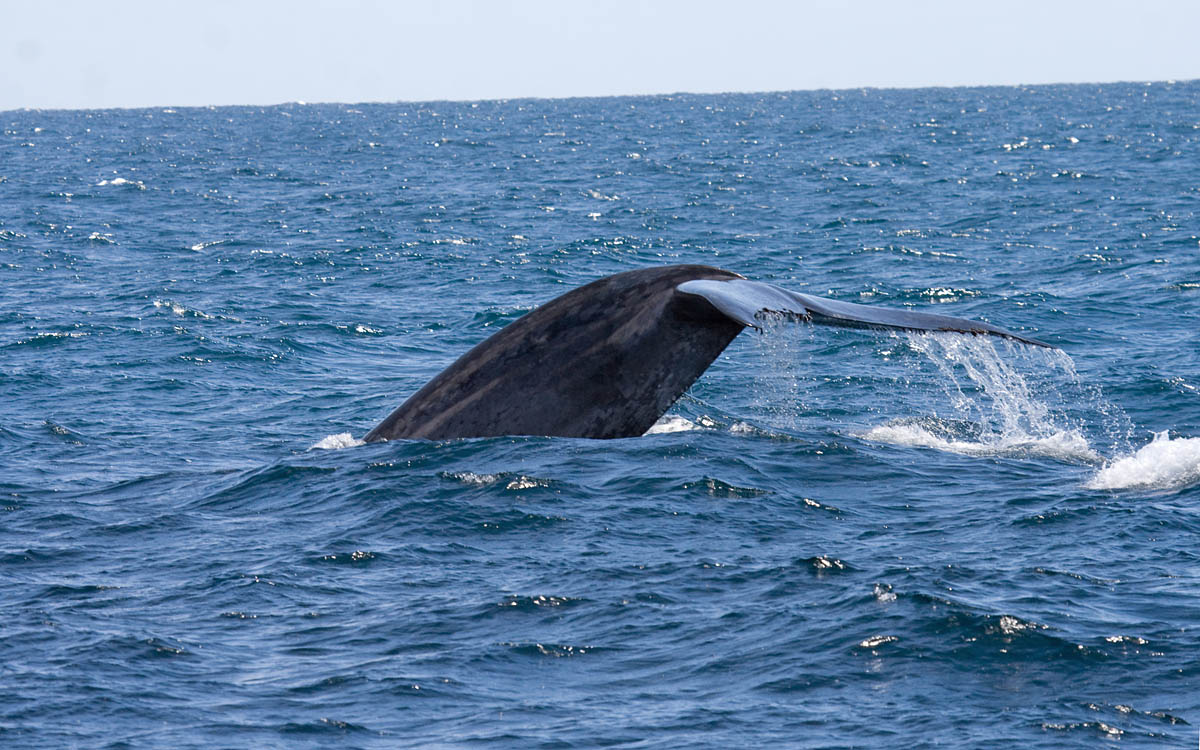
The May 21 pelagic birding trip out of San Diego was a great success. I'll be writing about it soon. One of the highlights about 30 miles offshore was a rather close Blue Whale. It dove as we first approached and we decided to wait 10-15 minutes for it to resurface. Even though this was not a bird, it was a great decision. A Black-foooted Albatross flew up to investigate what we were doing! As soon as the albatross landed to eat popcorn and pose for some photos, the whale surfaced.

It has been 10 years since I saw my first Blue Whale. It left a lasting impression on me. I wrote at the time:
"The huge geyser of a spout hung in the air. The dual blow-holes were like washtubs. The smooth, almost translucent blue back kept rolling and rolling until the small dorsal fin finally arose. And then, during the dive, the huge flukes lifted up like a rising apparition, water pouring off every surface. My knees are still weak from being so close to this huge, gentle, monster."
Blue Whale off San Diego
The spout of Blue Whale is typically 30 feet tall.
Information from Wikipedia follows.

Whaling
Blue Whales are fairly fast. Thus, it wasn't until special whale hunting steamships were invented (primarily from the 1890's) that significant numbers of Blue Whales were killed. Peak hunting was from 1930 to 1946.

Worldwide, whale hunting into the 1970's plummeted Blue Whale numbers to the point of extinction (650-2,000 animals). Though Blue Whale populations in Antarctica are recovering at about a 7% per year clip, they remain at only 1% of their original numbers there. The world wide total number of Blue Whales today (5,000-12,000 animals estimated in 2002) is less than 5% of the pre-steamship whale hunting numbers of 275,000. Blue Whale populations in the western Pacific (Japan) have not recovered.

The California population of Blue Whales was never very high. The population today has returned to pre-hunt numbers (2,200 animals).

Blue Whale off San Diego
The blow hole is on the top of the head.
The biggest animal to have ever lived on earth
Everything about the Blue Whale is B-I-G. The creature grows regularly to 80 feet in length, sometimes close to 100 feet. They weigh 80-150 tons. The tongue weighs 3 tons. The heart weighs 400 pounds. The penis is 8-10 feet long. At birth the calves weigh 6,000 pounds, drink 100 gallons of milk every day, and gain weight at the rate of about 200 pounds per day.

Blue Whale off San Diego
75% of the whale is in front of the dorsal fin, which is typically only 9-11 inches tall.
On the other hand, the food that Blue Whales eat--krill--is T-I-N-Y. Krill are shrimp-like swimming crustaceans only 1-2 centimeters (1/16th of an inch is in the middle of this range).

No dieting allowed
While an average adult human may require 2000 calories per day, an adult Blue Whale requires a daily intake of 1.5 million calories! That means straining out of the water up to 40 million krill, equal to 7,900 pounds of krill, every day.
Trivia bonus box:
Food calories are actually kilocalories, or 1000 calories. A calorie is the heat necessary to raise one gram of water 1 degree Celsius. The food calorie, or kilocalorie, is the heat required to raise a kilogram (1 liter or a bit more than a quart) of water 1 degree Celsius (1.8 degrees Fahrenheit).
Blue Whale off San Diego
The back is so long that the spout and dorsal fin are not seen above the water at the same time.
Here is the final dive sequence...

Blue Whale off San Diego
Arching the long blue-gray back in preparation for a deep dive...
Blue Whale off San Diego
The last 25% of the whale...
Blue Whale off San Diego
A waterfall pours off the flukes...
Blue Whale off San Diego
Typical Blue Whale fluke shape.
For more information on at-sea identification of the 3 largest whales: Blue, Fin, and Sei, check out the Wild Whales website sponsored by the Vancouver Aquarium.

Wednesday, June 1, 2016

Birds to know in San Diego: Palomar Mountain

We head up into the mountains of the North County as we continue our monthly series of common San Diego birds.

In 2003 the Cedar Fire burned over 280,000 acres of San Diego County. Much of it was in the forested mountains. Nearly all the conifers (>95%) were lost in the Cuyamaca Mountains. In order to grow back they need at least 18 inches of rain annually. They haven't been getting that much in recent years--so conifers may be permanently gone in many places where they were found formerly. One area of forest that was spared in 2003 and again in 2007 fires was Palomar Mountain State Park and the nearby observatory.

Palomar Observatory
Palomar Observatory
Coulter Pine, Incense Cedar, Canyon Live Oak, Black Oak make up most of the larger trees in this forest. Several campgrounds are here and this is a popular place to visit in summer at 6000 feet elevation. Snowfall is regular in winter, though doesn't often remain on the ground very long.

I visited Palomar Observatory in April 2015 and wrote about it here.

In September 2016 I wrote a birding site guide to Palomar Mountain Sate Park.

Here are some common birds to know from the forests of Palomar Mountain.

Acorn Woodpecker
Acorn Woodpecker. Palomar Mountain, California. July 13, 2014. Greg Gillson.
Acorn Woodpecker
This brash, noisy woodpecker is common in oak groves, and is especially common in the oak-pine forests surrounding Palomar Mountain. Birds spend their days placing acorns into holes they drill in the dead branches of their granary trees. That way they'll have food for winter. As the acorns dry, they shrink and become loose. So the birds move them to slightly smaller holes and wedge them in tightly so they will be more difficult for squirrels to remove. They are constantly adding, testing, and moving acorns. This bird was the inspiration for Woody Woodpecker! Similar San Diego birds: Nuttall's Woodpecker.

Band-tailed Pigeon
Band-tailed Pigeon. Julian, California. July 3, 2015. Greg Gillson.
Band-tailed Pigeon
Here is another bird that feeds on acorns in the foothills and mountains. It also eats elderberries. Both of these are abundant at Palomar Mountain. I didn't know this until researching, but Palomar Mountain is evidently named for these birds (paloma means dove in Spanish). The deep cooing these birds make is often mistaken for owls, though pigeons do not coo at night. These birds also rely on mineral springs and fly every day to drink from them. Similar San Diego birds: Eurasian Collared-Dove, White-winged Dove, Mourning Dove, Domestic Pigeon.

Dark-eyed Junco
Dark-eyed Junco. Palomar Mountain, California. July 13, 2014. Greg Gillson.
Dark-eyed Junco
Most people with backyard feeders in North America know this bird--often called "Snow Birds" by those who don't know the junco name. However, in San Diego it is more restricted to oak woodlands and higher mountains, generally above 1500 feet elevation (Unitt 2004). Various subspecies of "Oregon" Juncos with black-headed males (as depicted above) are most common. In winter, Gray-headed Juncos, Pink-sided Juncos, and Slate-colored Juncos are rare, more frequent in the mountains. Similar San Diego birds: None.

Mountain Chickadee
Mountain Chickadee. Palomar Mountain, California. July 13, 2014. Greg Gillson.
Mountain Chickadee
This is the only California chickadee found south of Santa Barbara County. I was surprised to find Mountain Chickadees regularly in lowland towns in northern San Diego County. The San Diego County Bird Atlas found one pair breeding near Fallbrook (Unitt 2004). However, in recent years they seem regular throughout the year (albeit in very small numbers) in backyards in Vista, San Marcos, and Escondido. Here is eBird May and June records for past 10 years. Similar San Diego birds: Oak Titmouse (habitat, behavior, and husky "chick-a-dee" calls similar)

Steller's Jay
Steller's Jay. Cuyamaca Rancho State Park, California. 22 March, 2015. Greg Gillson.
Steller's Jay
This black-headed jay with the sweeping crest is common in pine and oak woodlands at higher elevations. If you picnic at a mountain campground you are likely to be accosted by begging Steller's Jays. This bird has a name that drives certain precise people (a.k.a. the "spelling police"--who me?) crazy. The bird is named after Georg Wilhelm Steller from birds he collected and brought back on the Vitas Bering expedition from Russia to Alaska. Thus, it may be a stellar jay, but it's name is Steller's Jay. Similar San Diego birds: Western Scrub-Jay.

Yellow-rumped Warbler
Yellow-rumped Warbler. Cuyamaca Rancho State Park, California. 22 March, 2015. Greg Gillson.
Yellow-rumped Warbler
This is perhaps the most abundant winter visitor to San Diego County. It is found from lowlands to higher mountains, September to May. It is an extremely rare breeder on a few peaks that reach above 5000 feet. Winter birds are paler and streaky showing only a hint of the breeding plumage. Eating insects in summer, they switch to fruit and berries (even poison oak berries!) in winter and are thus able to remain in more northerly climes than other warblers. Birds breeding in northeastern Alaska and east of the Rocky Mountains have white throats; Western birds have yellow throats and were formerly described as separate species--Myrtle and Audubon's Warblers, respectively. Similar San Diego birds: Townsend's Warbler.


Birds to know in San Diego: introduction

Next: Birds to Know in San Diego: Any City Park with a Pond

Friday, May 27, 2016

Birding Cuyamaca Peak (south)

Two point seven miles. It is 2.7 miles from the parking lot of Paso Picacho Campground to the summit of Cuyamaca Peak. It doesn't sound that far, but it is continuously uphill. The elevation goes from 4880' to 6512'. Let's see, that's 1632 feet of elevation change in 14,256 linear feet. That's an 11.4% grade, right? No wonder my feet, knees, legs, and hips hurt!

I just got back from hiking the trail this morning (May 15, 2016). I arrived in drizzly fog and 47F at 6:00 AM. It was a warmer 62F and sunny when I returned to my vehicle about 11:00 AM to rush home to Escondido. I've got lots of photos to share, and maps to create, so I won't actually publish this for 2 more weeks.

The Campground and the Peak are in Cuyamaca Rancho State Park south of Lake Cuyamaca. This is 11.7 miles south of Julian on Hwy 79. It is also almost the same mileage north of Descanso on Hwy 79 at the intersection of Interstate 8.


The campground was spared from the October 2003 Cedar Fire. Not so, the 3 peaks of the Cuyamacas--North, Middle, South. There is a little swale of trees that was spared on the South Cuyamaca Peak. Otherwise, the once impressive forests of Oak, Incense Cedar, Coulter Pine, and other conifers were incinerated.

The south peak of the Cuyamacas is the second highest mountain in San Diego County. At 6512' it is only 20 feet shorter than Hot Springs Mountain near Warner Springs. It is supposed to have much easier access. I don't know about that. I drove up Hot Springs Mountain in my Kia Soul in April 2014. Not that I should have, mind you, but I did. Then I hiked only a mile through the forest on rather level roads up top.

The advantage of Cuyamaca Peak is that the highway is paved all the way to the Paso Picacho Campground. And the "trail" to the top, though almost 3 miles, is paved. Yes, there is a radio/microwave relay on top and the single-lane fire road is steep but paved. I just wish that someone could walk the first mile-and-a-half of the trail for me, because the birds I want to see are on the upper half!

So, I checked out The Hiking Guy web site. He has this hike listed as 6 miles round trip. Yep, that's right. And he has the hike as 2.5 hours. No, no, not so much. Of course, I was searching for birds to identify and photograph. It took me 3 hours to reach the summit, and another hour-and-forty-five minutes to return without too many diversions. Five hours. It took me 5 hours. And I feel like I rushed. If I ever attempt this again, I will make sure to spend the entire day to search more off-trail and wait patiently for birds to photograph.


eBird lists. Nearly all birders in the past seem to have combined their bird sightings for the entire hike. Then they generally placed their list marker either in the campground or on the summit. So, for birders wanting to plan a visit, the bird list is enticing, but useless to find the exact location of several rare and local birds.

So, on this trip I divided my hike into 7 lists between 8 points, as per the map above. And I included exact numbers. This way you may be able to know where on the hike I saw each species. Then you can plan a personal killer hike for yourself!

Target species are nesting Green-tailed Towhees, Thick-billed Fox Sparrows, and Dusky Flycatchers. All are very local as breeders in the County. This used to be a reliable spot to find White-headed Woodpeckers, but since the 2003 conflagration, only a couple have been noted. And as I mentioned, the eBird lists are poor for determining exactly where, though there are only pines near the peak and campground.

Most common species: Acorn Woodpecker (campground), House Wren (every one of my individual checklist locations), Spotted Towhee.

Use the map above to plan your hike on the paved Lookout Road.

A) Day use parking lot in Paso Picacho Campground. $8 day use fee. No dogs. The forest around the campground contains many noisy Acorn Woodpeckers.

B) Finding the beginning of the trail is a bit problematic. The easiest (so I'm told) is to ignore the park signs and take the maintenance road near the entry kiosk. Otherwise, walk through the campground to space 69 to find the trailhead there.
A to B: 0.34 miles through the campground. Here's my eBird checklist. 19 species including Band-tailed Pigeon, 24 Acorn Woodpeckers, Oak Titmouse, White-breasted Nuthatch.
Campground meadow at parking lot
C) West Side Trail crosses Lookout Road.
B to C: 0.27 miles from the campground to West Side Trail. Here's my eBird checklist. 9 species including the first of several heard-only Mountain Quails, 2 Black-chinned Sparrows, and 3 Lazuli Buntings.
Starting out. Burned pine and oaks from 2003. Cuyamaca Peak looks so-o-o-o far away!
Looking back at Paso Picacho Campground with Stonewall Peak.
Black-chinned Sparrow. Cuyamaco Rancho State Park. May 15, 2016. Greg Gillson.
D) Azalea Spring Fire Road heads north across Lookout Road.
C to D: 0.52 miles from West Side Trail to Azalea Spring Fire Road. Here's my eBird checklist. 18 species including Costa's Hummingbirds, a late migrant Hermit Warbler, 6 Black-chinned Sparrows, the first 3 of the target Green-tailed Towhees, 5 Black-headed Grosbeaks, and 6 Lazuli Buntings.
E) Deer Spring is somewhere in the tangle of brush. The chaparral is especially dense here and this is the location of most sightings of Green-tailed Towhees and Thick-billed Fox Sparrows (though I didn't find Fox Sparrows this time).
D to E: 0.29 miles from Azalea Spring Fire Road to Deer Spring. Here's my eBird checklist. 9 species including 2 more calling Mountain Quail.
Green-tailed Towhee and Fox Sparrow habitat near Deer Spring.
F) The remnant forest starts here with several Incense Cedars and then more pines.
E to F: 0.52 miles from Deer Spring to the remnant forest. Here's my eBird checklist. 13 species including 3 rather close--but still unseen--Mountain Quail, 2 Olive-sided Flycatchers, several Orange-crowned Warblers, and 2 more Green-tailed Towhees.
Olive-sided Flycatcher. Cuyamaca Peak. May 15, 2016. Greg Gillson.
Looking back downhill. Early morning fog over Lake Cuyamaca.
G) Burnt Pine Fire Road splits off and the Lookout Road begins its final steep ascent up Cuyamaca Peak.
F to G: 0.42 miles through the forest to Burnt Pine Fire Road. Here's my eBird checklist. 14 species including 2 Band-tailed Pigeons, the first Dusky Flycatcher, 7 Mountain Chickadees in the conifers.
Lower edge of the forest with Incense Cedar.
In the forest.
Dusky Flycatcher habitat just below the summit on the north.
Dusky Flycatcher. Cuyamaca Peak. May 15, 2016. Greg Gillson.
Cuyamaca Peak Summit
G to summit of Cuyamaca Peak: 0.33 miles from Burnt Pine Fire Road to the summit. Here's my eBird checklist. 14 species including another Olive-sided Flycatcher, 4 Dusky Flycatchers on the southeast side out of the wind, 2 Hermit Warblers, and 8 Dark-eyed Juncos.
California Lilac
Hermit Warbler. Cuyamaca Peak. May 15, 2016. Greg Gillson.
On the summit looking north. A brisk damp breeze.
On my way back down I lumped all the birds together, but placed notes in eBird for the unusual ones.
Summit to Parking Lot: 2.7 miles. Here's my eBird Checklist. 30 species including: Mountain Quail voices carry far, I recorded 3 individuals on the way down, 2 Anna's Hummingbirds were discovered right at the edge of the campground, I only detected 3 Dusky Flycatchers on the way down, Pygmy Nuthatches were missed on the way up but found in the forest and in the campground going back, 4 Green-tailed Towhees were found on the way down, some were in slightly different locations than on the way up, a male Bullock's Oriole was a new bird for the hike and, finally, a Townsend's Solitaire in the forest up top was a rare late spring surprise--could it be nesting in the county?
So there it is. I should sleep well tonight!

Wednesday, May 25, 2016

Sharp-shinned and Cooper's Hawk comparison

On May 8th I spotted a late Sharp-shinned Hawk being attacked by a much larger Cooper's Hawk. I don't often get to see these birds together. They are quite similar. Females are quite a bit larger than males. The large female Cooper's is biggest, bigger than a crow. Next, the male Cooper's and female Sharp-shinned are very similar in size, somewhat the size of a pigeon. The male Sharp-shinned is the smallest--jay-sized. And the typically solo bird can be hard to estimate as to size, so misidentification, or lack of specific identification, is frequent among even experienced birders.

The tail of the Cooper's Hawk is rounded, while the Sharp-shinned Hawk has a square tip.

In relaxed flight or gliding, the Cooper's Hawks hold their wings out rather straight, with the head and neck projecting far in front of the straight leading edge of the wing--like a large flying cross. Contrariwise, the Sharp-shinned Hawk holds its wings forward at the wrist. The wrists then project forward nearly as far as the head on a short neck.

In the (not-very-good) chase photo below the Cooper's Hawk is flapping rapidly and has its wings extended forward, but the Sharp-shinned Hawk has the typical flight profile.

ID: Comparison of Cooper's and Sharp-shinned Hawk
Female Cooper's Hawk attacking male Sharp-shinned Hawk. Escondido, California. May 8, 2016. Greg Gillson.
At any rate, when reporting a Sharp-shinned Hawk this late in the spring in southern California, it is very helpful to have a photograph for proof--especially a comparative shot like this!