While working outside yesterday I heard the faint refrains of a singing Vesper Sparrow. That is county life bird #200.
My birding in San Diego includes these previous visits. In September 1981 I drove into the Anza-Borrego visitor center on the way from the Salton Sea to Ventura. That netted me 4 species. I held those 4 species alone for over 20 years. In April 2004 I took a 5-day pelagic trip from San Diego, but no other birding other than the harbor and open ocean. That bumped my total to 29 species. I visited San Diego twice in 2008. In March, Troy Guy and I flew from Portland to Cabo San Lucas to ride back to San Diego on an empty whale watching boat the entire length of Baja. Then Terry Hunefeld showed us around to some favored birding sites, including San Elijo Lagoon. My county list jumped to 99. In October 2008 I came back with Marlene on an "anniversary" trip (our 30th!). Marlene hung out on the beach at a bed and breakfast in Encinitas, while I spent 3 days on a boat trip at sea. That brought me up to 112 species.
Marlene and I moved to San Diego county in late September 2013. Starting a new job, losing a job, unemployed and searching for a new job, and starting another new job, not to mention moving 3 times in 60 days, prevented a whole lot of birding. Nevertheless, birding one morning per week in those 3 months, I tallied 186 species to bring my life total in the county to 200.
Tomorrow starts a new year. I think 300 for the year in San Diego County is a good goal to try for. To get that many I have to bird desert, mountain, coast, and ocean (which I was going to do anyway). But it is not so many that I have to chase every rare bird reported. For instance, eBird reports that Barbara Carlson leads all county birders this year with 391 species. [Not all birders use eBird. Inconceivable!] In 6th place for the year, at 301 species, is Nancy Christensen whom I met last Sunday at Oceanside looking for a Glaucous Gull that showed up after we left. That seems just about the right goal to try for. It allows me to explore new areas, search for several life birds, and have fun, without stealing time from more important things.
So expect to hear about my efforts...

Tuesday, December 31, 2013

ABA area bird #520 (#515): Nutmeg Mannikin
 |
| Nutmeg Mannikin. Lake Hodges, California. December 1, 2013. Greg Gillson. |
Actually there are 8 criteria they need to meet before they are accepted. And, bummer, if an established exotic ever dies out you have to take it off your list. For instance, if all the starlings or house sparrows die out in North America, they never counted--it's as if they never existed. This actually happened to me with Crested Mynas that lived for a century in Vancouver, British Columbia. I saw them in 1973 and/or 1975 (my notes are missing from those trips). Poof! They're gone. I've never seen one. The rules say so. So you see, that, as they say, is that.
Birds in southern California from San Diego north to Santa Barbara are countable. Even though there are large populations of these birds in Florida they are not countable there,... yet.
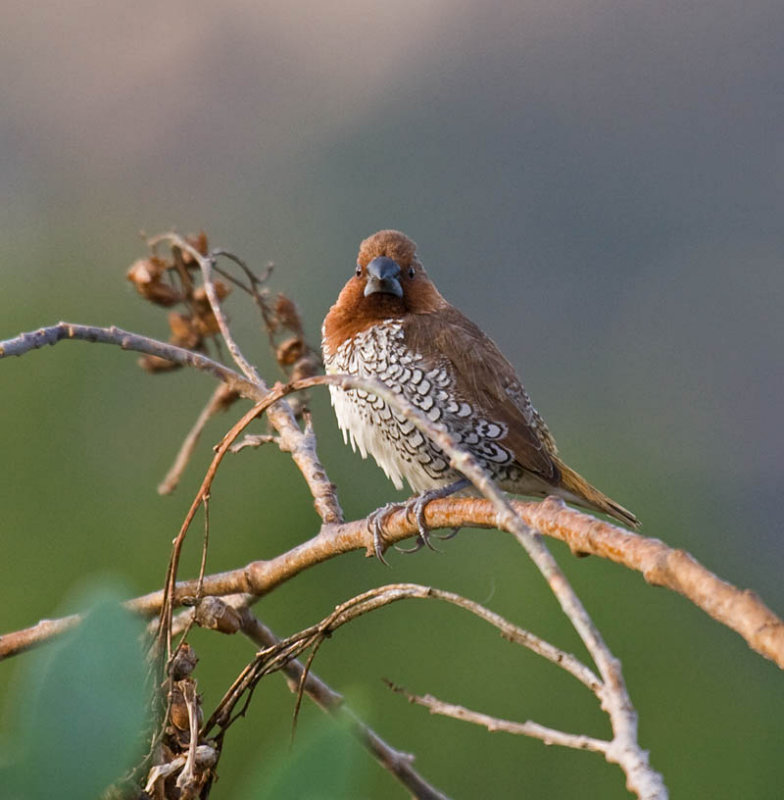
Speaking of countable, there may be a few non-countable birds on my list of 520 species seen north of Mexico. I am using eBird to come up with the numbers. eBird lets you track non-countable birds (non-established exotics). I think the Monk Parakeet and Mute Swan I saw in Oregon are not countable, and Chilean Flamingo, African Collared-Dove, and Nanday Parakeet in California from many years ago (probably countable if I saw it today, but not "bankable"). So, this is more like ABA species #515 for me. That's pretty good for never having birded SE Arizona, Texas, Florida, or Alaska.
Sunday, December 29, 2013
Thanksgiving--playing on the freeway

Our move to San Marcos on November 28 to start our new job was supposed to be quick. We had a small U-Haul and friends to help us load and unload. But the 30 minute trip ground to a quick halt immediately after getting on the I-15 freeway.
We learned there was a bomb threat from a car parked under the overpass you can just make out in my cell phone photo above.
We sat for 2 and 1/2 hours on the freeway. Many people got out of their cars. As there was no traffic from the other direction some played catch with a football while others did hand stands and cartwheels in the empty lanes. Actually, I didn't see anyone overly upset. I used the time to rest. I wish to thank the Dunn's for helping us to move and sitting with us on the freeway and not complaining (out loud, at least).
Here is a news report about the bomb hoax.
If you are in any doubt, no, it is not a good idea to stick a cardboard box in the back of your sister's car with the word "bomb" written on it. Go directly to jail, do not pass Go, do not collect $200.
Saturday, December 28, 2013
Prickly Pear Cactus and the Mexican-American War

Prickly Pear cacti (genus Opuntia) are fairly uncommon in the hills of San Diego County in the native coastal sage scrub habitat. Evidently they are harder to identify than Empidonax flycatchers. My best guess is that these are Western Prickly Pear (O. occidentalis). However they may also be Coast Prickly Pear (O. littoralis). They could also be a hybrid between these and/or other species. It doesn't help that Wikipedia doesn't even recognize O. occidentalis. Perhaps the cacti expert on Wikipedia thinks that it the same as O. engelmannii, which goes by about a dozen common names (Cow Tongue Prickly Pear, Desert Prickly Pear, Texas Prickly Pear, Engelmann's Prickly Pear, etc.).
The photo above was taken at San Pasqual Battlefield State Historic Park, about 5 miles SE of Escandido. The name is bigger than the park that commemorates a nasty battle in 1846 in the Mexican-American War. Unless you count stealing Texas from Mexico, the only good thing that I can see that came from this war was the creation of this little park where there is at least one Cactus Wren that I saw on December 8th.
Wednesday, December 25, 2013
Western Grebe mystery
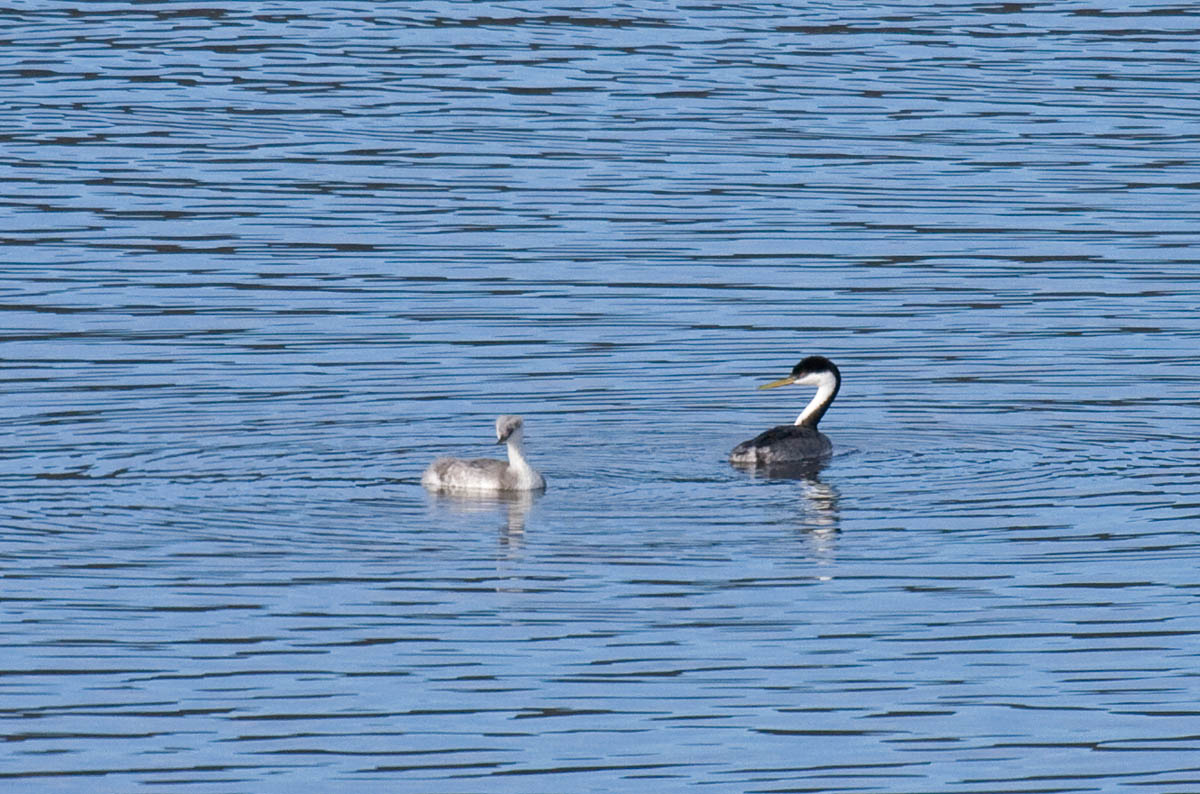 |
| Western Grebe with chick. Lake Hodges, California. December 1, 2013. Photo by Greg Gillson. |
It is inevitable that moving 1100 miles southward I would encounter some bird status differences that would surprise me. But I am unable to find anything written that would lead me to understand finding multiple Western Grebe chicks in December! Yet there they are on Lake Hodges at Rancho Bernardo.
If anyone can enlighten me on this subject, please do so in the comments section below. Thanks.
 |
| Mating display of Western Grebe. Lake Hodges, California. December 1, 2013. |
Subscribe to:
Posts (Atom)